

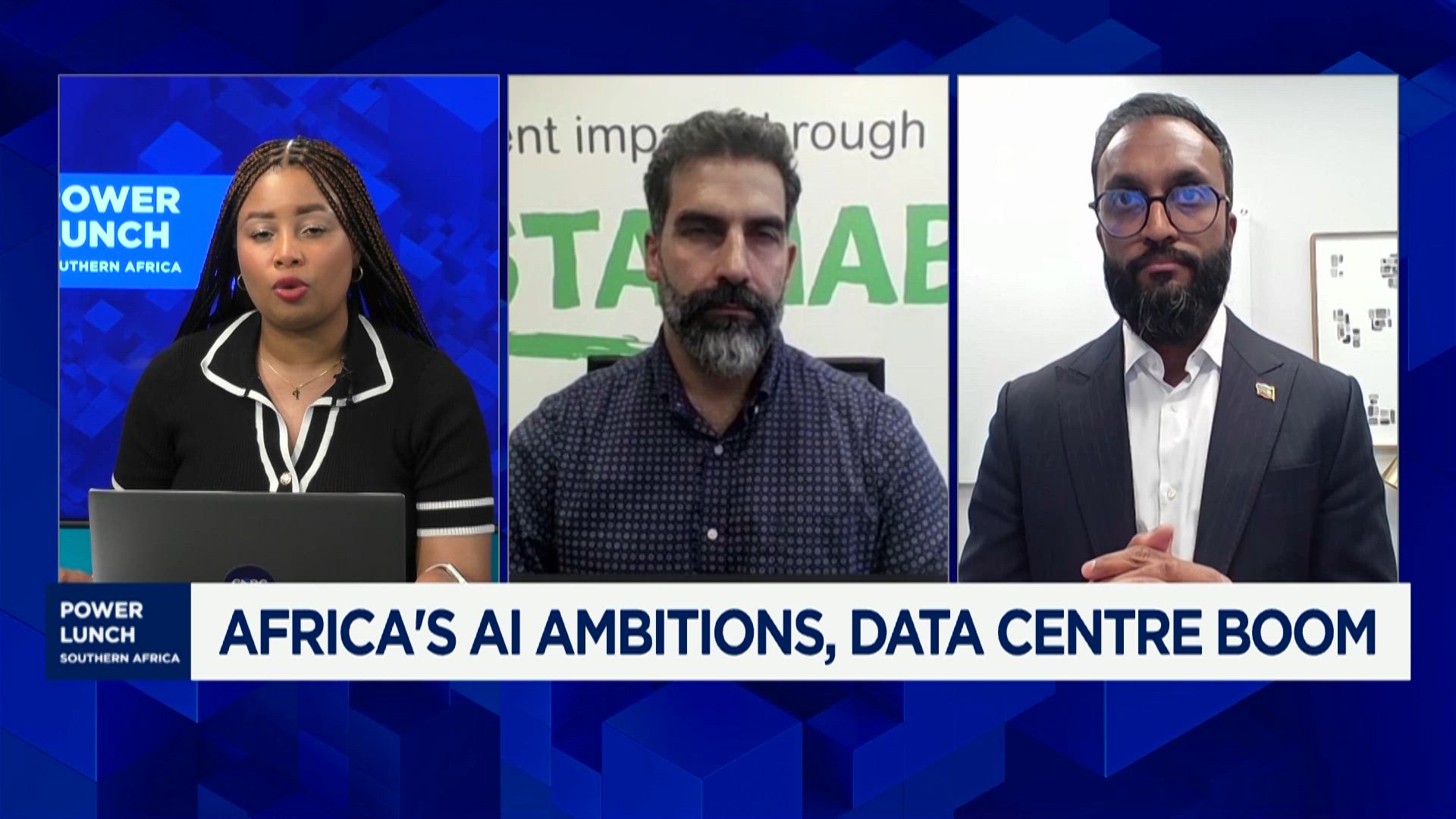
Artificial Intelligence is rapidly becoming a defining force in the global economy, with the technology expected to add almost $16 trillion to global GDP by 2030. Yet Africa accounts for less than 1 per cent of global data centre capacity, despite being home to nearly a fifth of the world’s population. As governments and investors race to build the digital infrastructure needed for the AI economy, the question is whether Africa can seize this moment— not just as a consumer of AI, but as a creator of it.
Joining CNBC Africa to unpack what’s needed to build that future is Steven Santini, Vice President: Secure Power, SSA, Schneider Electric and Kesh Mudaly, Managing Director & Partner at BCG.
Mon, 27 Jul 2026 13:02:11 GMT
Disclaimer: The following content is generated automatically by a GPT AI and may not be accurate. To verify the details, please watch the video
AI Generated Summary
Key Points:
- Africa accounts for less than 1% of global data center capacity despite having roughly 18% to 20% of the world’s population.
- Schneider Electric and BCG executives said regulation, data governance and interoperable policy frameworks are the first steps to unlocking AI infrastructure investment.
- The executives said local data center capacity would help African countries retain and process data domestically instead of exporting it and reimporting foreign-built applications.
- Power and water infrastructure were identified as critical constraints, but the guests said AI and data center demand can also help catalyze broader utility investment.
- Both speakers said the long-term goal is for Africa to build local skills, jobs and AI applications rather than remain mainly a market for foreign innovation.
Topics
Africa AIdata centresartificial intelligencedigital infrastructureSchneider ElectricBCGenergy infrastructurewater infrastructuredata sovereigntyAfrica Business News
- Africa accounts for less than 1% of global data center capacity despite hosting nearly a fifth of the world’s population, underscoring the scale of the continent’s digital infrastructure gap.
- Executives from Schneider Electric and BCG said policy reform, predictable permitting, stronger data governance and investment in power and water systems are critical if Africa is to capture more value from the AI economy.
- The executives argued that local data center capacity could help African countries process and retain data domestically, supporting jobs, engineering skills and locally developed AI applications.
- They also said AI-linked infrastructure investment can be structured to expand grid and water capacity more broadly, rather than divert resources away from households and industry.
Africa’s ambitions to become a meaningful player in the artificial intelligence economy will depend on whether governments and investors can move quickly to build local data centers, strengthen data governance and expand energy and water infrastructure, executives from Schneider Electric and Boston Consulting Group said.
Speaking in a CNBC Africa interview, Steven Santini, vice president for Secure Power at Schneider Electric for French-speaking and sub-Saharan Africa, and Akesh Mahali, managing director and partner at BCG, said the continent has a narrow window to avoid becoming primarily a consumer of AI tools built and hosted elsewhere.
The urgency reflects the scale of both the opportunity and the shortfall. AI is expected to add nearly $16 trillion to global GDP by 2030, according to estimates cited in the discussion. Yet Africa, home to roughly 18% to 20% of the world’s population, has less than 1% of global data center capacity.
Mahali said that imbalance risks repeating a familiar pattern in which Africa exports raw value and imports finished products at a premium. In the AI era, he said, the equivalent danger is that African data is processed overseas and then returned to local users through foreign-owned applications and platforms.
“We do have a bit of a way to cover,” Mahali said, adding that the opportunity remains significant if the continent can build the right digital and physical foundations.
The executives said the first priority is not only attracting hyperscale investment, but also building local data center capacity that can host cloud services and data processing within African markets. That, they argued, would allow countries to retain more value from their own data and support innovation tailored to domestic needs.
Santini said demand for AI infrastructure is already visible, both from within Africa and from foreign investors looking at the continent as a future growth market. But he warned that the region must “grab the bull by the horns” and invest deliberately in its own capabilities if it wants to avoid offloading infrastructure development to other regions.
A central issue is regulation. Mahali said data governance, data sovereignty rules and interoperability across African markets should be the starting point for policymakers.
“If you don’t get that right, then the demand doesn’t come,” Mahali said. Without clear demand signals and rules for how data can be stored, used and transferred, he said, the supply of data centers and the infrastructure behind them will struggle to scale.
That policy challenge is tied closely to infrastructure. Both executives pointed to power and water systems as the backbone of any serious AI strategy, with data centers requiring large and reliable utility inputs. But they rejected the idea that expanding AI-related infrastructure must come at the expense of households, manufacturing or other development priorities.
Santini said the buildout should not be seen as an “either or” choice. Instead, he argued that data centers can act as an anchor customer for broader investment in electricity generation, transmission and grid modernization, while also supporting improvements in water systems.
He said digitization and embedded AI tools can also improve the efficiency of those same utilities by helping operators identify losses, optimize usage and improve reliability for the wider economy.
The sustainability question remains especially sensitive in Africa, where many countries already face water stress, climate pressures and electricity shortages. Santini said those concerns must be addressed at the design stage rather than treated as an afterthought.
He pointed to cooling technologies such as closed-loop and dry-loop systems, as well as broader efficiency metrics, including power usage effectiveness and water usage effectiveness, as tools that can help operators reduce strain on scarce reure operators remain accountable to communities and regulators
For the two executives, the bigger question is not simply whether data centers can be built, but who captures the value if they are. Santini said local infrastructure creates a pathway for engineering skills, technical jobs and domestic application development. He argued that hosting more digital infrastructure within Africa would help countries meet local requirements with local talent rather than relying too heavily on technology developed in Europe, Asia or the United States.
Mahali made a similar point using a value-chain lens. He said the infrastructure layer itself can support local technicians, engineers and technology workers, while the processing and use of data can create room for startups/” title=”Fund backed by SA’s top CEOs to bet R10bn on startups”>startups and entrepreneurial ventures to build new products.
“You do not want to export your data and import that IP,” Mahali said. “You really want to leverage the richness of African data in Africa.”
He added that Africa’s young and growing population strengthens the case for domestic AI development over time, particularly if countries can turn demographic growth into a larger base of users, builders and innovators.
On whether policymakers are moving with enough urgency, Mahali said interest in AI has clearly increased, but that coordination remains a weak point. He called for more integrated planning across ministries and closer alignment between governments and the private sector.
That, he said, means linking data regulation, power planning, water infrastructure and fiscal incentives rather than treating them as separate policy tracks. If governments can align those areas, he said, they will have a stronger “launch pad” to scale the sector.
Santini said investors are already looking at Africa more aggressively, describing the continent as a new frontier for data center development because of available land and the potential to build new energy systems. But he said faster execution will require more predictable permitting, clearer energy regulation and smoother coordination between public and private actors.
“We need predictable permitting,” Santini said, adding that sustainability rules should also be clear enough to hold operators accountable without slowing projects unnecessarily.
Looking ahead, both executives said success should be measured not only by the number of data centers built, but by whether African economies become more technologically independent. Santini said one sign of progress would be a growing ability to develop AI solutions for local needs without depending overwhelmingly on external providers.
Mahali said he would watch both demand and supply indicators: a sharp increase in AI usage across the economy and a move up the value chain in the physical infrastructure that supports it, including local supply chains tied to water, energy and digital systems.
For now, the message from both executives was that Africa still has a meaningful opportunity to shape its place in the AI economy, but only if it can move beyond rhetoric and build the regulatory, utility and digital foundations needed to support local innovation.
ChooseCNBC Africaas your preferred in business news
Join readers across the continent. It’s free, and you can unsubscribe at any time.
