

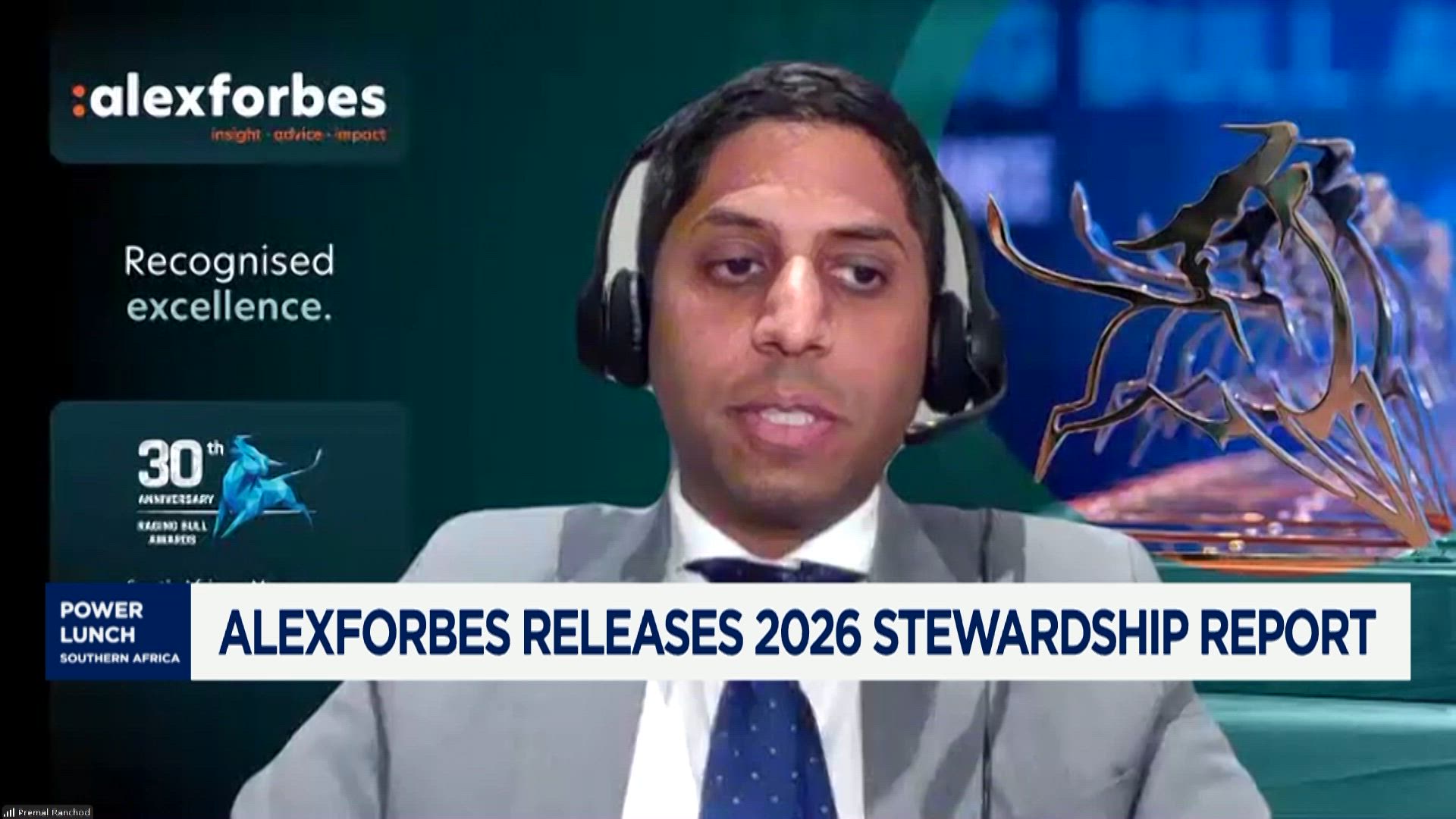
According to the latest stewardship report from Alexforbes Investments, issues such as water insecurity, ageing infrastructure and governance weaknesses are affecting business performance, portfolio resilience and long-term returns. The report, based on engagements with asset managers overseeing R8 trillion in assets, suggests investors are placing greater emphasis on financially material risks as they assess where to allocate capital. Joining CNBC Africa is Premal Ranchod, Head: Research, Alexforbes Investments.
Mon, 27 Jul 2026 11:23:18 GMT
Disclaimer: The following content is generated automatically by a GPT AI and may not be accurate. To verify the details, please watch the video
AI Generated Summary
Key Points:
- Alexforbes Investments said 99% of South African business holdings assessed face future water risk.
- The firm’s stewardship report is based on engagements with asset managers overseeing 8 trillion rand in assets.
- Water insecurity, ageing infrastructure and governance weaknesses are already affecting business performance, portfolio resilience and long-term returns.
- Mining, resource companies and agriculture are among the most exposed sectors because of their heavy reliance on water.
- Alexforbes said operational disruptions, higher capital costs and weaker credit quality are some of the ways water risk can filter into investment outcomes.
- The firm said many companies remain dependent on municipalities and public water agencies, limiting how much they can mitigate the problem on their own.
Topics
Alexforbes InvestmentsSouth Africa water riskESG investingasset managersinfrastructure riskgovernance weaknessesportfolio resilienceJSEmining sectoragriculturewater insecuritySouth African economy
- Alexforbes Investments said its latest stewardship report found that 99% of South African business holdings assessed by asset managers are exposed to future water risk.
- The report draws on engagements with asset managers overseeing 8 trillion rand in assets and shows investors are placing greater emphasis on financially material risks when allocating capital.
- Alexforbes said water insecurity, ageing infrastructure and governance weaknesses are already affecting business performance, portfolio resilience and long-term returns.
- Mining, resource-linked businesses and agriculture were identified as among the most exposed sectors, while broader service delivery failures are affecting companies across the economy.
South African investors are increasingly treating water insecurity as a material financial risk rather than a narrow environmental concern, as Alexforbes Investments warned that ageing infrastructure, governance weaknesses and service delivery failures are already weighing on business performance, portfolio resilience and long-term returns.
The warning comes from Alexforbes Investments’ latest stewardship report, which was based on engagements with asset managers overseeing 8 trillion rand in assets. According to the firm, the findings suggest the conversation in capital markets has shifted decisively toward financially material environmental, social and governance risks as investors assess where to allocate money.
Premal Arranchar, head of research at Alexforbes Investments, said the change in focus has gathered momentum over the past several years as ESG considerations have become more embedded in mainstream investment processes.
“Over the past few years, the conversation has progressively gotten more interesting,” Arranchar said in a CNBC Africa interview. He added that ESG has taken “a fundamental foothold” among many asset managers, which he described as a positive development for managing investment outcomes and addressing South Africa’s infrastructure challenges.
A central message from the report is that water risk should no longer be viewed as a distant or abstract sustainability issue. Instead, it is increasingly being assessed in the same way investors think about other system-level constraints that can disrupt economic activity and impair returns.
Arranchar said the aim is to avoid what he described as an “electricity-sized water problem,” drawing a comparison with the power supply constraints that have hampered South African businesses and economic growth in recent years.
“We think that the next challenge is definitely on water,” he said. Because water systems are decentralized across different catchment areas around the country, he said, local disruptions can translate into broader financial risks for businesses and the economy.
The report’s findings suggest those risks are not confined to a handful of heavy industrial users. Arranchar said that, at a basic level, all companies are vulnerable to water insecurity and service delivery failures because water is a fundamental input for economic activity and day-to-day operations.
He said the pressure is especially visible in Gauteng, South Africa’s economic hub, where service delivery concerns have become more prominent. Even companies that are not intensive water users can still face interruptions that affect productivity, raise costs or undermine operating stability.
The exposure becomes more acute in sectors that consume large volumes of water. Arranchar identified mining and re on water in mineral processing and cleaning activities
He also pointed to agriculture and produce exports as areas of concern in an economy that remains closely linked to farming output and reing or distribution failures can directly affect output, supply chains and export capacity
For investors, the transmission mechanism from infrastructure stress to portfolio returns is increasingly clear. Arranchar said water shortages and infrastructure failures can cause operational disruptions at company level, force businesses to spend more capital to secure backup supply or improve resilience, and ultimately weaken credit quality.
Those company-specific effects can then spill into the wider economy. If disruptions become widespread, they can weigh on gross domestic product growth, pressure business confidence and reduce the earnings resilience that investors look for in both listed and unlisted holdings.
“There could be operational disruptions, higher capital costs for these companies in the environment they operate in, and that leads to a weaker credit quality,” Arranchar said. “Beyond that it starts impacting the broader economy and therefore the gross domestic product of the economy.”
The report also highlights the limits of company-level mitigation when the underlying distribution system is failing. While some businesses have invested in backup capacity or water recycling systems, Arranchar said many remain dependent on municipalities and public water distribution agencies.
That leaves even proactive companies exposed to risks they cannot fully control on their own. As a result, Alexforbes is arguing for the issue to be elevated beyond municipal-level concern and treated as a national economic and investment priority.
“As much as companies might want to be quite proactive about the management of water rer the water distribution agencies within the economy,” Arranchar said
He said the report calls for the conversation to move beyond individual municipalities and onto the national agenda, reflecting the scale of the potential impact on growth, operations and long-term investment returns.
Looking ahead, Arranchar said investors may still be underestimating the extent of future water risk, even where companies have not yet experienced a serious disruption. According to the report, asset managers indicated that some portfolio companies have so far avoided major incidents because they have taken proactive steps such as securing backup water
But that resilience may not be enough if risks intensify. Arranchar said future water disruptions could stem from climate-related events such as droughts and floods, or from continued infrastructure failures in the distribution system.
That means the risk is both physical and institutional, combining weather-related shocks with governance and maintenance shortcomings. For investors, that mix could make water one of the more important medium-term variables in judging resilience across South African portfolios.
The stewardship report adds to a broader debate in South African markets over how infrastructure constraints are shaping valuations, capital allocation and the long-term competitiveness of local businesses. With power, logistics and municipal performance already in focus, water is increasingly emerging as the next major test for companies and investors alike.
Alexforbes’ findings suggest the market conversation is moving in that direction, but the bigger question will be whether policy action and infrastructure delivery move fast enough to reduce the risk before it becomes a deeper drag on growth and returns.
ChooseCNBC Africaas your preferred in business news
Join readers across the continent. It’s free, and you can unsubscribe at any time.
