

©
When the G20 met on African soil for the first time in November 2025, it signalled that the continent is becoming more important to the world as an economic partner. China and the United Arab Emirates (UAE) have already spent the past decade gaining ground as trade partners to African countries, narrowing the EU’s long-held lead.
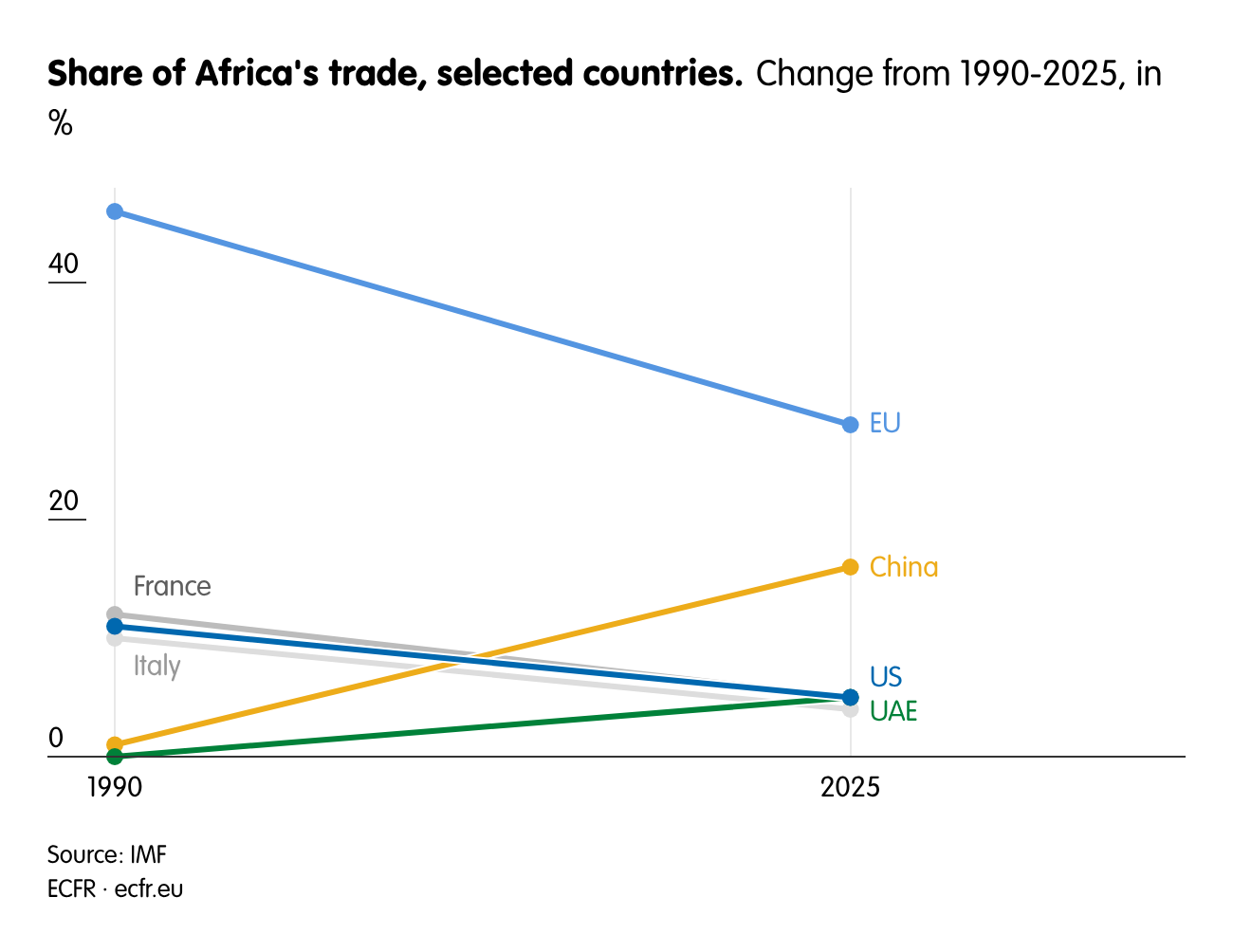
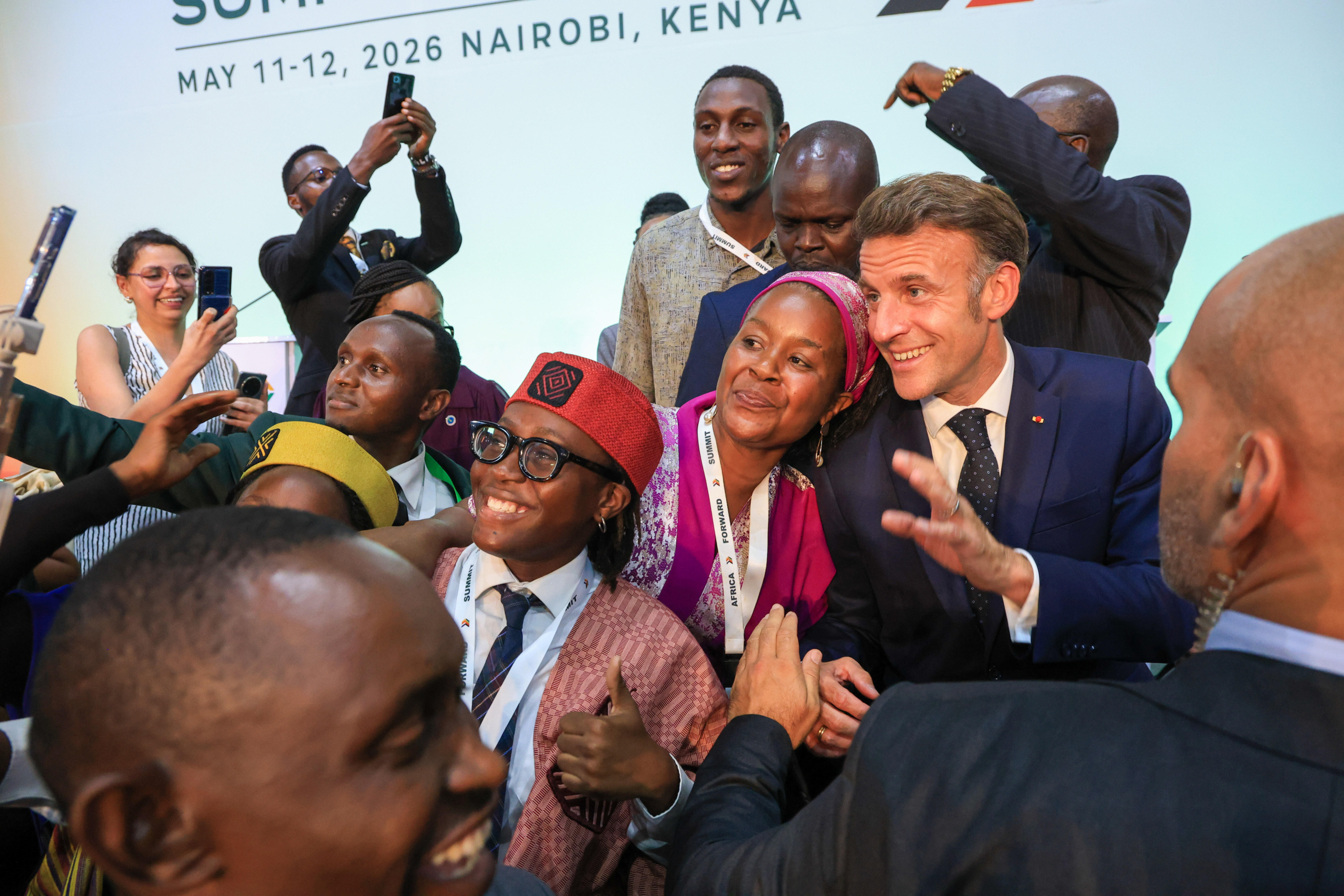
France and Italy have recast their economic strategies accordingly, hunting for markets and suppliers of their own in Africa as global alliances shift and supply chains fracture. In 2026 alone, Italy convened its second Africa Summit in Addis Ababa and France held its Africa Forward Summit in Nairobi, the first France-Africa summit co-organised with an African country outside France or Francophone Africa. The rest of Europe is also adapting its approach. Since 2020, at least nine European countries have revised or substantially repositioned their Africa policies,[1] recognising that Africa can be more than a supplier of natural resources.
Africa’s own governments are pressing for this shift, positioning themselves as equal partners rather than aid recipients. European language is adjusting to match, with Brussels, Paris and Rome talking more about investment and partnership than about aid. European leaders must now make those national strategies pull in the same direction, keeping pace with rivals and delivering for both sides of the Mediterranean.
Under pressure
The EU is Africa’s largest trading partner, but individually its largest member states are just middle-sized players in today’s Africa.
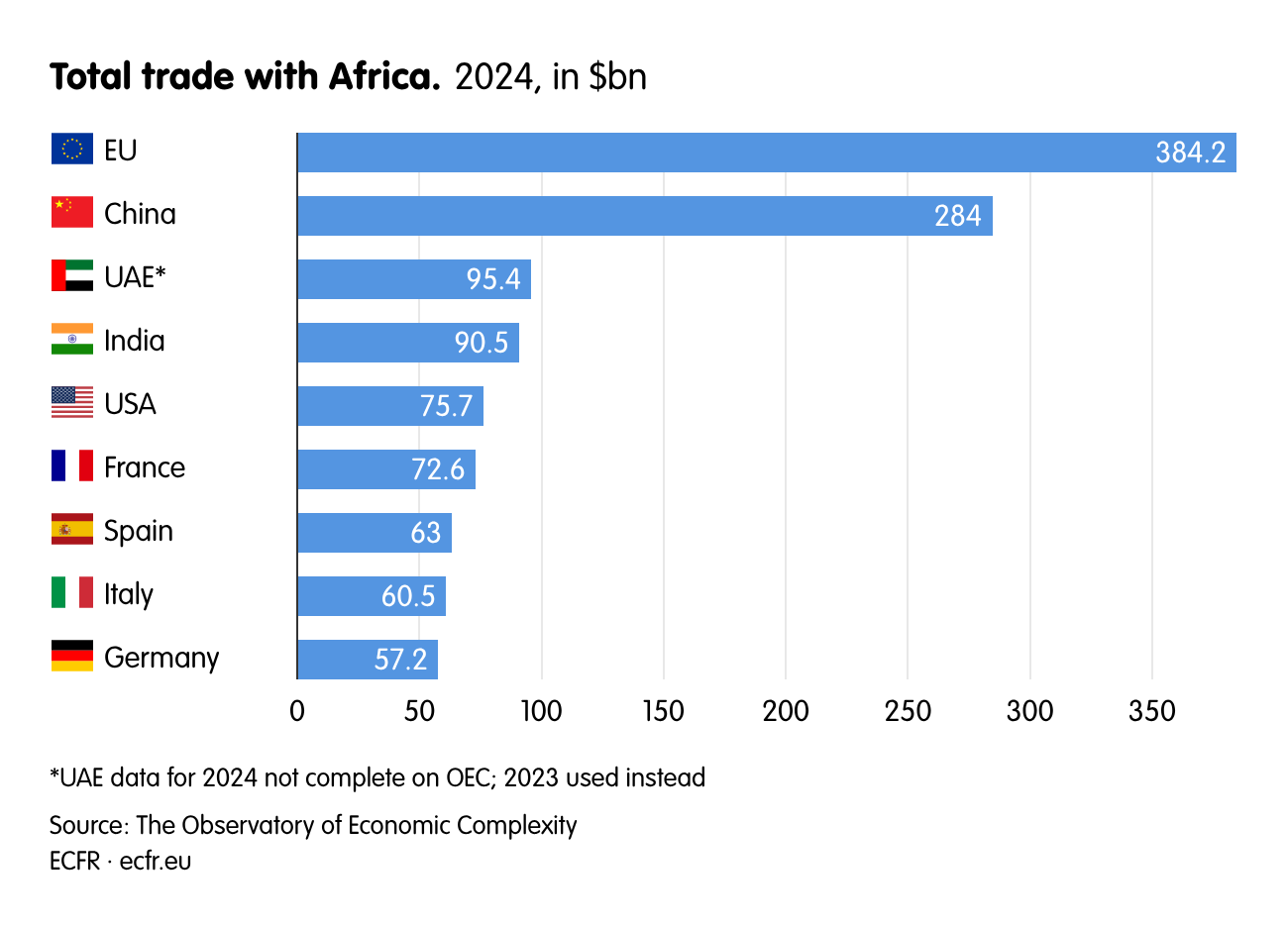
Investment tells a similar story. European firms hold the largest stock of foreign investment in Africa, over €250bn, but only 10% of all new investment to African companies in 2024 came from Europe.[2]China and Gulf Arab states have spent the past decade increasing state-backed private investment to build market share across the continent. On present trends, the EU will fall further behind.
The right sort of investment
The kind of investment matters as much as its scale in making Africa a stronger industrial partner for Europe: greenfield manufacturing projects, regional infrastructure and industrial ecosystems do more than capital alone to build that capacity. However, European commercial ties with Africa are more extractive than transformative. In 2025, 70% of EU imports from Africa were primary products and just 28% were manufactured goods. Both French and Italian imports from Africa follow the same trend, which also shows up in where the money goes. In 2024, Italy and France were among the top investors in Africa’s extractives. Most capital-exporting economies share this extractive bias, since it reflects where Africa’s industrial development currently stands. Manufacturing gets only a modest share of investment, even though it matters most for the continent’s shift away from raw material exports.
The reason lies in how investors price risk. Capital is expensive in Africa: investors see the continent as disproportionately risky, which pushes money towards safe, asset-backed extractive projects rather than the long-term capital needed for more uncertain sectors, such as manufacturing. Even Africa’s own $4trn in domestic capital sits idle: weak banks and cautious institutions channel it into short-term holdings and government debt instead of long-term manufacturing investment.
Winds of change
France, Europe’s traditional leader on African matters because of its colonial and post-colonial history, and Italy, now seeking to emerge as its rival in European policy towards Africa, are already trying to address these issues. Both have overhauled their Africa policies and both used their G7 presidencies (in 2024 and 2026 respectively) to position Africa and development cooperation within a broader agenda of economic security built on private capital rather than aid. Yet this shift has not been matched by greater strategic coordination across Europe.
France, Italy and the EU broadly agree on what matters—energy, critical minerals, infrastructure, skills and industrialisation—but not on how to pursue it. A growing number of other member states, such as Germany and Spain, now see the continent as a partner for secure supply chains and political influence. The EU’s <a href="https://international-partnerships.ec.europa.eu/policies/global-gateway_en” rel=”nofollow noopener” target=”_blank”>Global Gateway, its flagship strategy to mobilise up to €300bn in global infrastructure investment by 2027, was meant to give these efforts a common framework. Yet these strategies largely continue to operate in parallel, reflecting national priorities, commercial interests and historical ties. That leaves Europe without the scale, coherence or investor confidence needed to support industrial ecosystems and compete with partners able to combine finance, diplomacy and commercial clout.
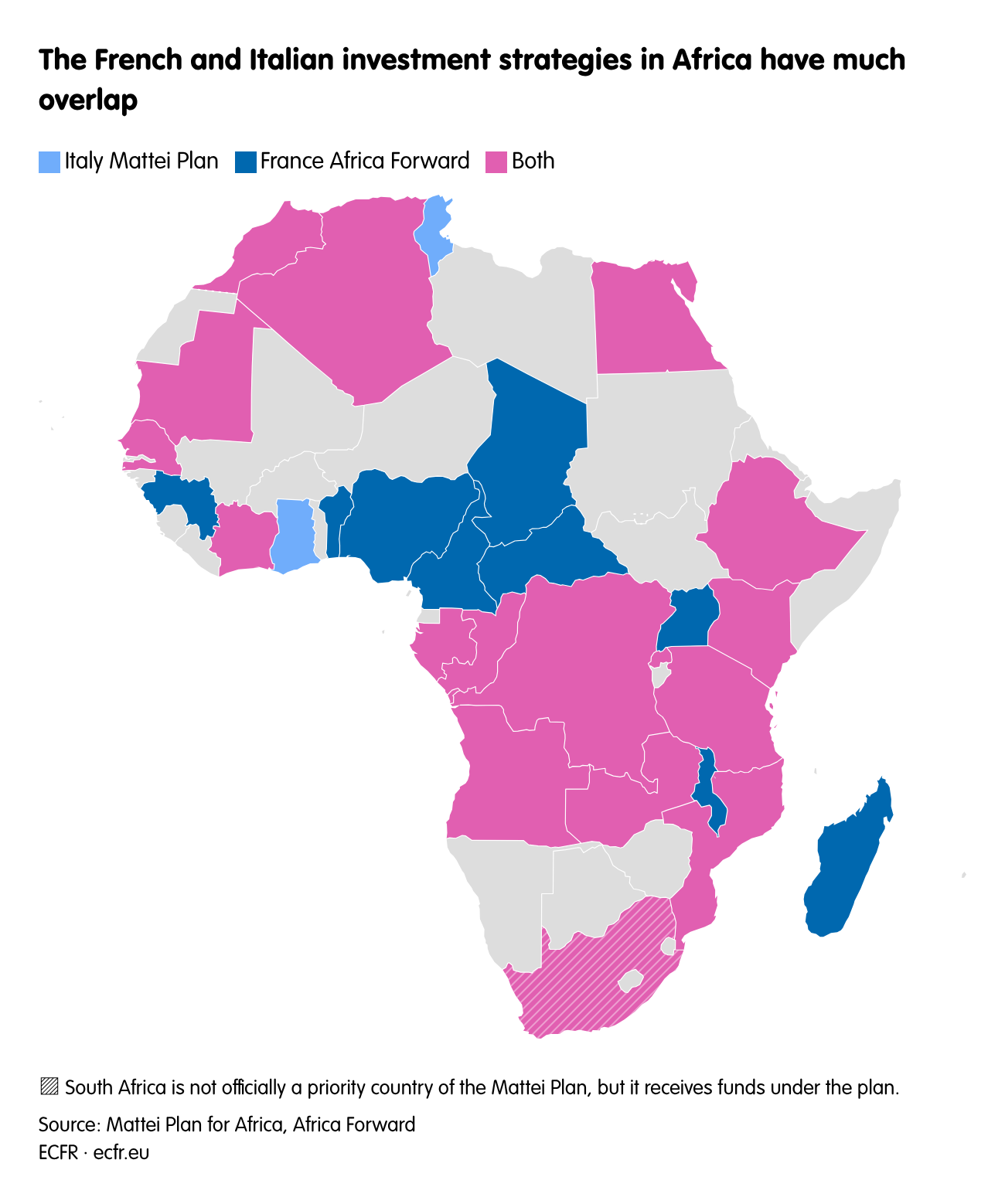
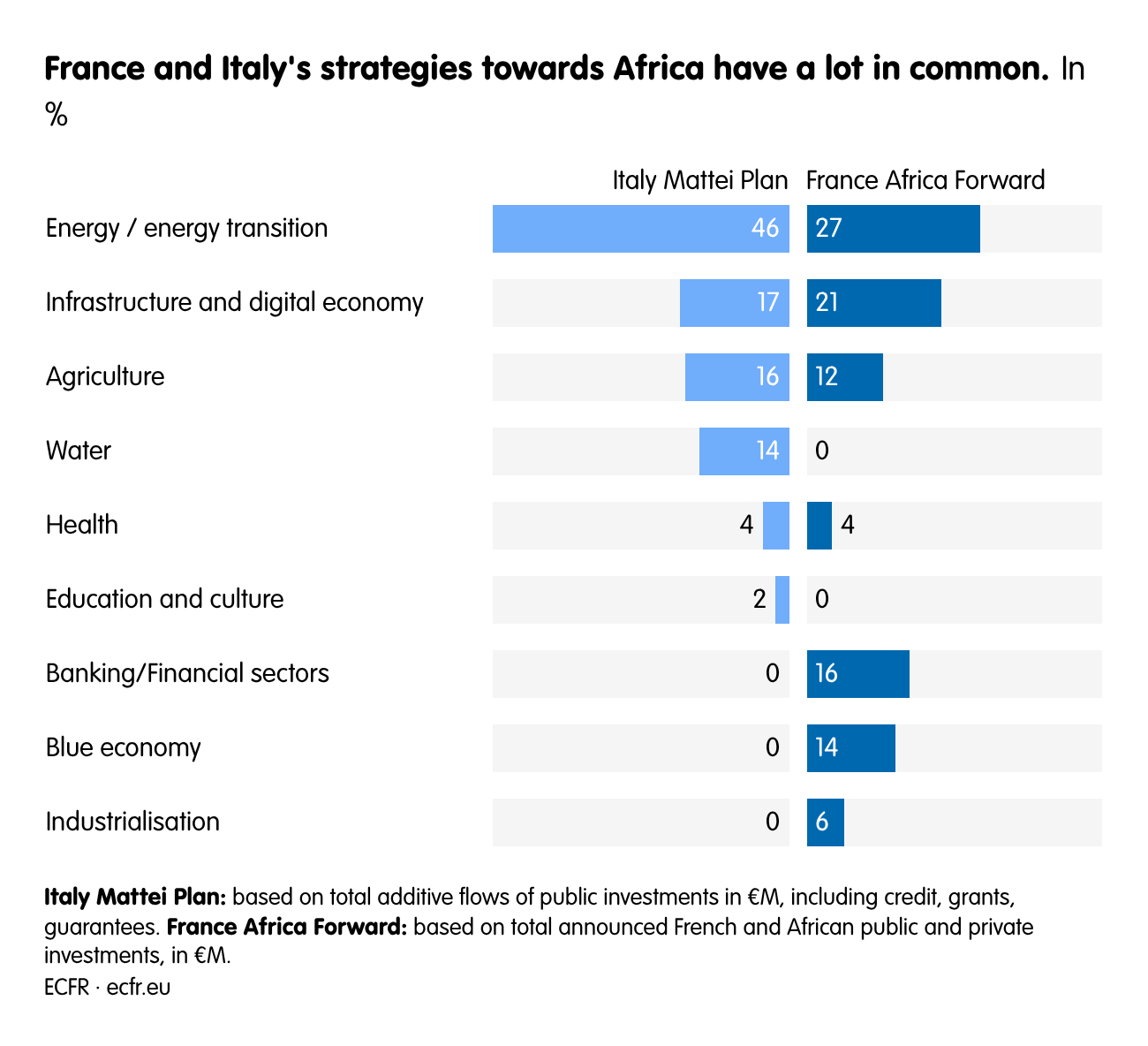
Italy’s flagship Africa strategy, the 2024 Mattei Plan, and France’s 2026 Africa Forward investment strategy illustrate this dynamic: though the two emerged from different starting points, they increasingly pursue the same objectives, target overlapping countries and lean on comparable financial instruments. This reflects both Europe’s converging strategic interests and the reality that Africa’s infrastructure deficit concentrates investment in a narrow set of sectors. But it also shows that these strategies are additive rather than complementary.
Doing more with less
A core part of France’s and Italy’s new strategies is how to finance their ambitions in Africa. China, the UAE and even America use their private sectors as tools of state strategy. Italy and France are responding by using public money to pull in private investment and international lenders.
The Mattei Plan itself is a modest €5.5bn public fund spread over four years (2024–2027), but it uses guarantees, development finance and partnerships to unlock far more money than that. Italy’s export credit agency, SACE, has already put up €4bn in guarantees since the Mattei Plan was launched, pulling in an estimated €18.5bn of private funds. Partners such as the African Development Bank (AfDB), the World Bank and the UAE add even more to the pot.
France’s plan, set out in the Africa Forward Summit, is part of a wider €23bn package, split between a €14bn pledge from Paris and €9bn from African partners. Of that, just €1.94bn is public funds; the rest is private. The strategy targets African strategic autonomy, especially in food and digital technology, and leans more on small businesses, private investors, and risk-mitigation tools such as the African Trade and Investment Development Insurance, a pan-African credit insurer. As with Italy, the aim is to make limited public money go further.
Both countries have internationalised their financing—leaning on institutions such as the AfDB, the World Bank, Gulf sovereign investors and export-credit cover. Yet joint European ventures remain rare: aside from a handful of joint initiatives—such as the collaboration between the Italian, French and German state development banks on a water infrastructure project in Morocco under the Mattei Plan, or Denmark’s support for the Italy-AfDB Mattei Plan financing facility—both strategies have attracted relatively little structured participation from other European governments. Rome and Paris find it easier to build coalitions with international lenders and non-European partners than with each other. This limits opportunities to pool resources and build larger industrial investment platforms.
What Europe should do
France and Italy are changing course. The EU should now turn their separate initiatives into systems that reshape investment and drive African industrialisation. Three recommendations show how.
Since European countries individually cannot outspend China or the Gulf states, they must change the terms on which their capital competes. Member states and European institutions should increasingly pool guarantees, coordinate development finance institutions and build common project pipelines. Joint risk-sharing mechanisms involving institutions such as Italy’s development bank (Cassa Depositi e Prestiti), France’s development agency (Agence Française de Développement), the European Investment Bank and African financial institutions would reassure private investors more than multiple national commitments operating independently. The objective should be to change the risk calculus for investors.
European countries deal with Africa country by country, or sector by sector. Industrialisation, however, crosses borders and sectors. Value chains need regional energy systems, transport corridors, customs integration, digital connectivity and labour mobility. Europe’s comparative advantage lies precisely in its experience building integrated markets. Even its most ambitious African venture, the Lobito Corridor—a planned rail line linking Congolese and Zambian mines to Angola’s Atlantic coast, backed by America, the EU and Italy—has yet to knit infrastructure, investment and regional integration into a single plan. Rather than approaching Zambia, Angola or Namibia as separate investment destinations, Europeans should use their collective weight to back it, and corridors like it, as platforms that align infrastructure, regulation, energy and manufacturing across several countries.
Some barriers sit above any single project: high sovereign risk premiums, the cost of capital and weaknesses in the global financial system continue to discourage productive investment in Africa. Europe should use platforms such as the G7 and the upcoming UK and South Korean G20 presidencies to ensure greater African participation in these discussions. It should also work to reform the global investment environment itself: support the African Credit Rating Agency, use multilateral guarantees more, and make financing cheaper for African economies. Shaping these rules is how Europe can help Africa become an industrial partner.
Europe is adapting, and France and Italy are showing the way. The challenge now is to weave these separate national efforts into one system capable of making Africa a genuine economic partner with a stronger geopolitical voice.
[1] Czech Republic, Denmark, France, Italy, Germany, Netherlands, Spain, Sweden, United Kingdom.
[2] EU outward investment to Africa: €9bn in 2024, per Eurostat (approximately $9.7bn converted at the yearly average exchange rate of 1 EUR = 1.0822 USD). Total FDI inflows into Africa: $97bn in 2024, per UNCTAD’s World Investment Report 2025. $9.7bn ÷ $97bn ≈ 10%.
The European Council on Foreign Relations does not take collective positions. ECFR publications only represent the views of their individual authors.
Authors
Maddalena Procopio@madprocopio on X
Senior Policy Fellow
Suzanne Tisserand
Policy Fellow
