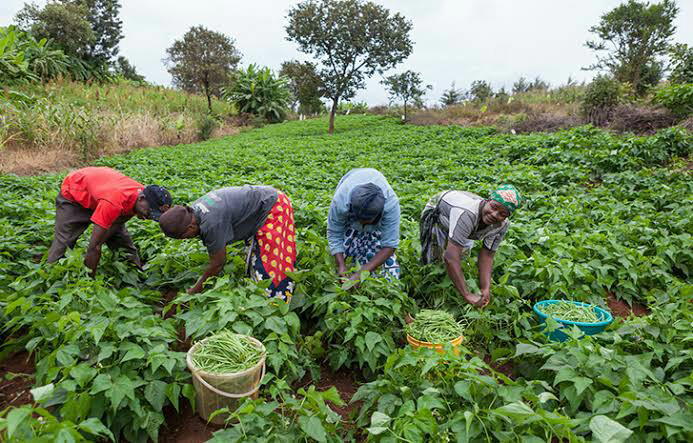
Experts have called for reforms to activate climate financing across Africa, urging governments, development partners and private investors to channel more funding to smallholder farmers to support climate-smart agriculture and improve food security.
Speaking at the inaugural Climate-Smart Agriculture (CSA) Dialogue Series convened by TransGreen Foundation, Secretary General of the Global Flagship Initiative for Food Security, Conrad Rein, said the world was producing more food than at any point in history and possessed the capital, innovation and political commitment required to address food insecurity, but continued to face an implementation shortage.
He noted that Africa faces a $365 billion climate adaptation finance gap through 2035, while only $5.53 billion, representing 0.8 per cent of tracked global climate finance, reaches small-scale agri-food systems.
“The future of food security will depend not only on how much money we mobilise. It will depend on how effectively we deploy it. Capital follows confidence”, Rein said.
Associate Professor of Agricultural Economics at Rivers State University, Ikechi Agbugba, said the biggest barrier to climate-smart agriculture adoption across Nigeria and Africa remains the disconnect between agricultural research and extension systems.
He attributed the challenge to the deterioration of extension programmes, inadequate grassroots technical capacity, institutional negligence and mistrust of Cooperative societies.
Postdoctoral Researcher at Niigata University, Japan, Ayomikun Ajayi, said advanced agricultural research should be deployed through simple communication channels that farmers already use, rather than depending on expensive digital devices.
“A machine learning model in Japan, a text message on a Nokia in rural Nigeria, same intelligence, same power, different vessels. The future does not need a smartphone. It needs a signal,” Ajayi said.