

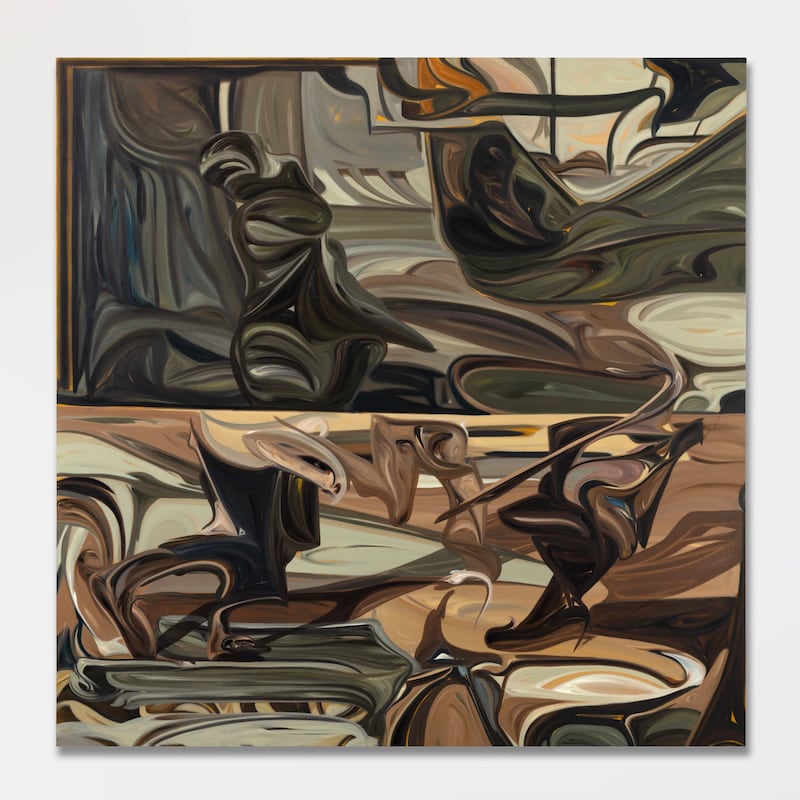
To exist in two different places is often the experience of a diasporan, and in his painting Thresholds, Luke Agada captures that duality well, of being spread thin between the here and there, and of being more than that ambiguity, more than the totality of one’s parts.
Displayed as one of the opening pieces of a new exhibition at Efie Gallery, the painting is cleanly bisected into two horizontal planes. Both portions are populated by whirling, fluid forms. Prolonged observation starts revealing human figures from the abstractions. A nose becomes evident. An ear. Gestures and postures. But what dominates the composition is the single line that swirls from the upper part of the piece, the only line to break the barrier that segments the two contrasting portions, inhabiting both planes.
Many of the works in the exhibition deal with similar themes. In Abstracto, In Concreto: On Memory and Presence brings together works by four artists of African descent, each of whom has practised or continue to practise in the diaspora.
The exhibited works all toe the line between the figurative and the abstract. Thresholds is a clear example of that, along with the pair of charcoal drawings by Agada that are also displayed in the opening segment and likewise abstract human figures.
“It’s a radical form of drawing,” curator Brice Arsene Yonkeu tells The National. “It can be tied to his experience as a doctor. Agada used to be a veterinary surgeon. These works clearly demonstrate how an artist is able to play with abstraction and figuration. They give a clear introduction into what visitors are going to experience in the exhibition.”
Agada, a Nigerian artist living in Chicago, also draws from the concept of the “third space”, which the exhibition literature describes as “a hybrid, unstable zone where identity and histories intersect”. This instability is evident in the watery forms in Thresholds, as well as Agada’s charcoal drawings, but it also ripples to the other pieces within the exhibition. Even in the works that at first seem strictly figurative.
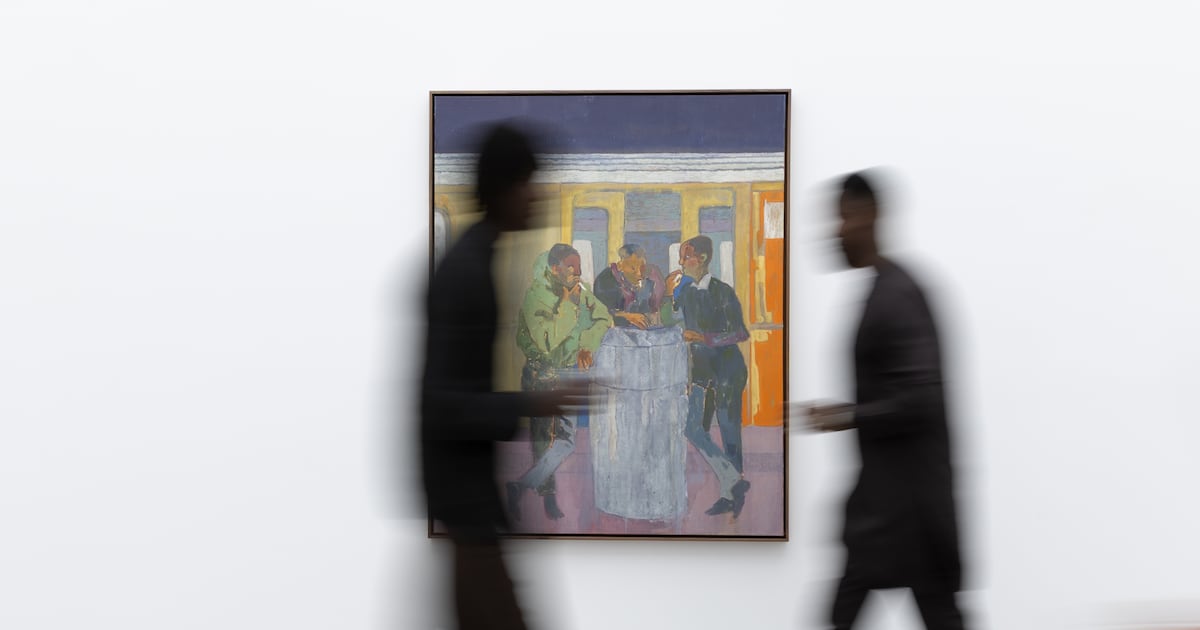
Ludovic Nkoth’s Smoke Break is a stark contrast to the preceding works, teetering more towards the figurative. It shows three figures smoking around a cylindrical table at what, at first glance, seems to be a subway station, with the train doors opening (or closing) in the background. Certain details, however, upend that initial reading.
“Something I found challenging, rewarding and enriching in this work is how you are wondering, are they in a pub, or outside, because you can’t really smoke in these spaces. But then you look at the orange and yellow doors, the way they are opening and you think it’s actually a subway. But then there is a roof, a ceiling,” Yonkeu says.
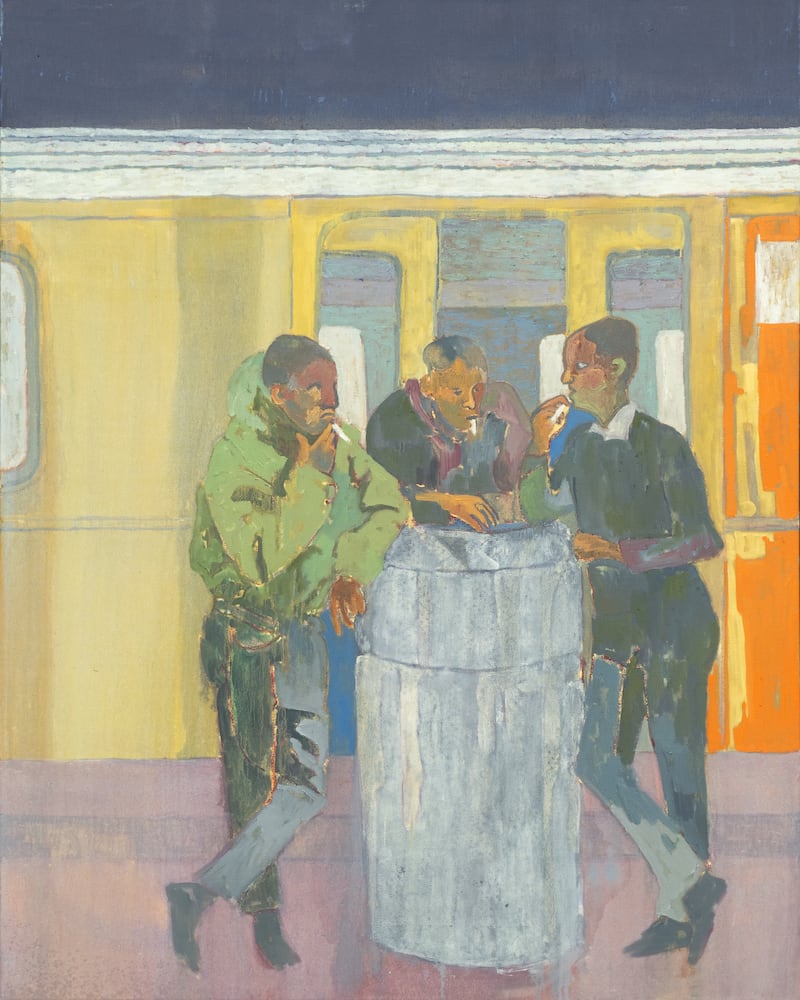
The three subjects are also peculiar in the disparity of their clothing. One is in a casual hoodie and pair of jeans. Another is in a shirt tucked inside a sweater. The third seems to be in a blazer. The differences suggest that they were at contrasting places prior to coming together for a smoke break. Their faces and gazes are also somewhat obscured, so the nature of their conversation (if they are conversing at all) is left entirely to the viewer’s interpretation. It is a subtle take on abstraction by Nkoth, a Cameroonian artist living in New York.
“How you see this painting and its three subjects will depend on your own encounters,” Yonkeu says. “It creates a universal moment. These three figures assemble in a way that almost feels ritualistic. It feels like there’s this idea of community, where you can meet with people, peers and unpack the day, unpack life. These three people are dressed in very different ways, so they probably have different jobs or come from different socioeconomic situations. The painting is arresting because it tells us that we have more in common than we think.”
Naila Opiangah’s approach to abstraction is different. Where Agada obscures and extends human forms, Opiangah omits all features from her figures, leaving their outlines pristine and assembling them into architectural forms. In Victoire. Passe, the artist and trained architect – who is from Gabon and lives in New York – presents figures of gold, green and pink posing in postures that can be read as celebratory, agonising, fearful or joyous. They intertwine into one another to create a tower-like mass in the canvas.
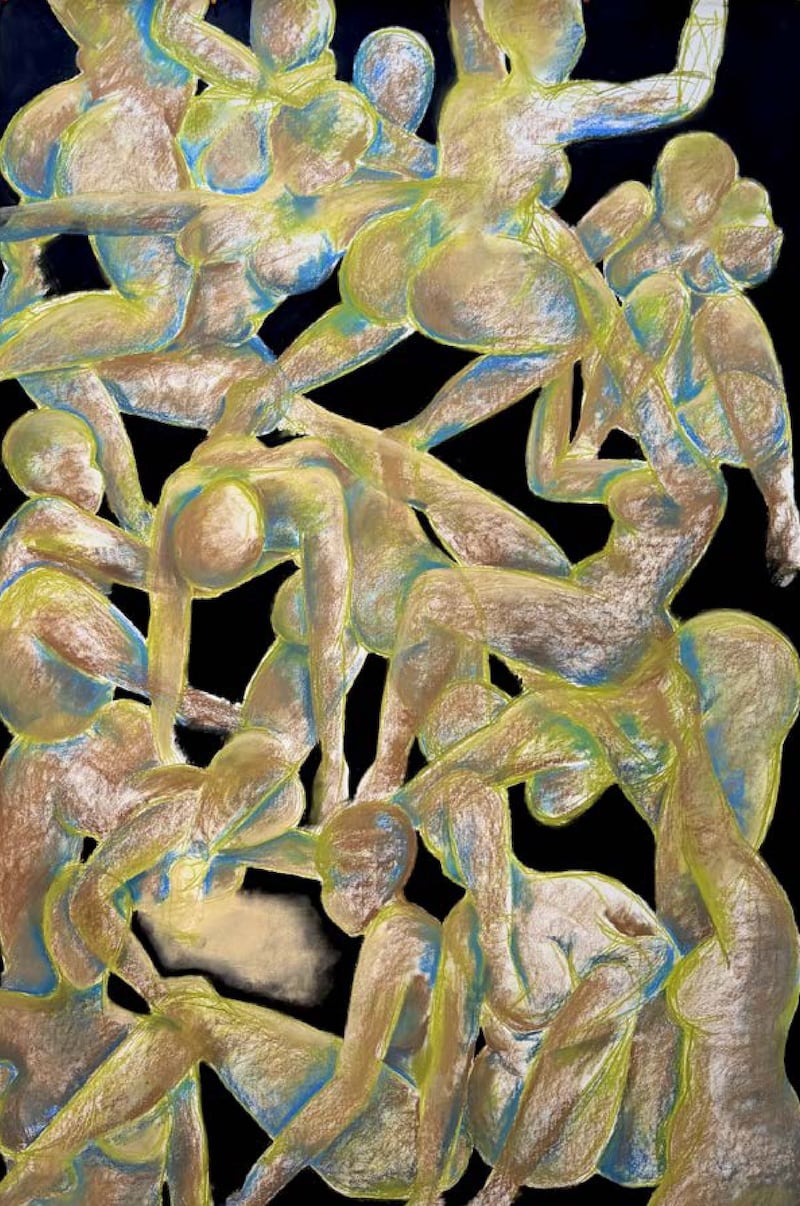
“Victoire. Passe is quite sensational,” Yonkeu says. “It is one of her largest paper works. The first thing you see are forms that make you think of female forms, but they are androgynous silhouettes. I find it quite architectural. It makes me think of the tower of Babel. The overall composition feels figurative, but then from the way that the bodies are abstracted and also whatever you think is going on there, the interpretation definitely ends up being very abstract, which is a wonderful quality.”
The figures in Opiangah’s Ore Fields, meanwhile, look facelessly back at the viewer, posing in similarly ambiguous postures. Circles are superimposed in the composition, the figures within taking on hues similar to the ones in Victoire. Passe.
For Yonkeu, the circles are like portals. And it isn’t a far reach from there to think of the worlds in Ore Fields and Victoire. Passe as being interconnected, the latter diving into the portals the artist references.
Bringing the exhibition’s medley of the figurative and the abstract to a climax are the paintings of Tunji Adeniyi-Jones. The UK artist, who lives in New York, is presenting a pair of works that are composed with an effervescent touch, with human forms bubbling to the surface the longer you look.
In Orange Sentinel, for instance, a flower turns into a hand as the viewer begins tracing its pink stem towards the elbow. Other features such as an eye, a hair, a pout that could be warning or beckoning begin emerging from the composition. There are no neutral hues here. Every shade is bold. The oranges range from burnt to fiery. The greens are almost neon, the pinks hot.
Not many artists usually use such dominant shades together, but it is because of this palette that the painting bubbles to the eye.
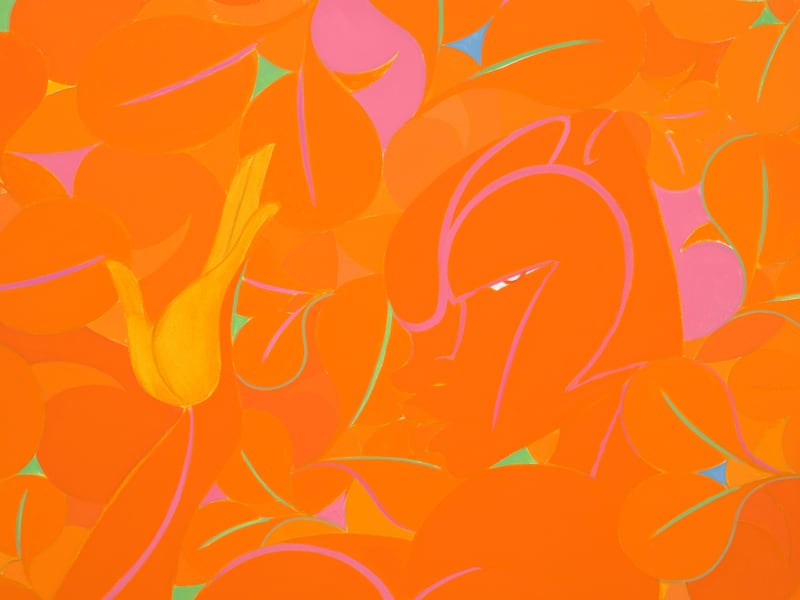
“Tunji’s figures are drawn from Yoruba mythologies and culture. These figures act like they have messages for us. Here, the sentinel is showing her hand out and showing a side profile look. Is it a warning? Is it an invitation?”
Overall, Yonkeu hopes that the paintings prompt visitors to think about the different ways in which the human body contains “history, inheritance and imagination”, and says the exhibited artists seek to make these complexities evident in their paintings.
“Sometimes when people know they are going to encounter a figurative painting, they tend to have a very simplistic way of looking at the work,” he says. “That’s also more so the case when people think about black bodies or Africans; they think about just their understanding of certain aspects of our histories. Across all these works, however, there’s a complexity that forces you to change your way or your approach of reading the paintings.”
In Abstracto, In Concreto: On Memory and Presence runs until September 17 at Efie Gallery, Dubai
