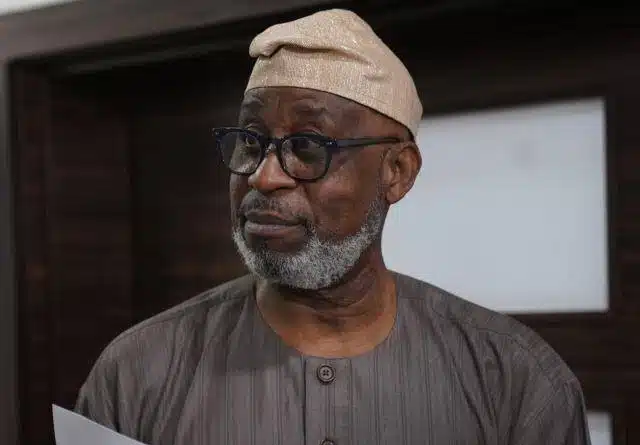
Nigeria’s Minister of Solid Minerals Development, Dele Alake, has called on African countries to take greater control of the continent’s mineral red homegrown reefits
Alake made the call at the Ministerial Forum on Critical Minerals, Value Chain and Beneficiation: Pathways for African Transformation, organised by the African Development Bank (AfDB) in Abidjan, Côte d’Ivoire.
Addressing ministers and industry stakeholders from across the continent, the minister urged African mineral-producing nations to move beyond isolated national approaches and pursue coordinated regional strategies that would maximise the value of the continent’s vast mineral wealth.
According to a statement issued by the Ministry of Solid Minerals Development on Sunday, Alake said Africa must end its dependence on exporting raw minerals and instead adopt policies that encourage local processing and greater ownership of its natural resources. ”While the mantra of value addition has ushered in an era of economic independence for mineral-producing nations, we need concrete, actionable strategies to take charge and be in full control of our natural assets to ensure total economic freedom,” Alake said. The minister, who also chairs the Africa Mineral Strategy Group (AMSG), argued that Africa should assume control of the technical systems used to assess its mineral resources, describing the continued reliance on the Australia-based Joint Ore Reserves Committee (JORC) reporting standard as outdated.
”For the overall interest of the continent, and to efficiently and effectively safeguard its reed to assess its mineral assets,” he said.
To achieve this, Alake advocated the adoption of the Pan African Re, developed by the Africa Minerals Development Centre, noting that the framework would promote transparency, consistency and ethical standards while reflecting the unique characteristics of Africa’s mineral re
As part of efforts to deepen regional integration, the minister proposed the establishment of a West African minerals processing hub stretching from Lagos to Dakar, modelled after the Lobito Corridor. He said the initiative would enable participating countries to share infrastructure, lower operational costs and strengthen regional mineral value chains.
According to him, the proposed corridor would also create opportunities for industrialisation, employment and shared economic growth across West Africa.
Alake further expressed concern over the continent’s low level of intra-African trade, noting that trade among African countries accounts for only about 16 per cent, compared with approximately 60 per cent in Asia and 70 per cent in Europe.
Also speaking at the forum, President of the African Development Bank Group, Dr Sidi Ould Tah, said Africa’s abundant deposits of critical minerals had yet to translate into commensurate economic development due to inadequate financing and low levels of foreign direct investment.
The meeting adopted the Abidjan Declaration, which places financing at the centre of efforts to transform Africa’s solid minerals sector. Under the declaration, the AfDB pledged to deploy its financing instruments, capital mobilisation capacity and technical expertise to support mineral-producing countries, de-risk investments, finance critical infrastructure and accelerate the development of sustainable mineral value chains.
UPDATE NEWS:
Nigerians can now invest ₦2.5 million on premium domains and profit about ₦17-₦25 million. All earnings paid in US Dollars. Rather than wonder,
click here to find out how it works.



 "Top 10 largest stadiums in Africa and where they are located")