

The Economic Times daily newspaper is available online now.
Full Moon July 2026: Date, Time, Global Visibility and Fascinating Cultural Meanings Around the World
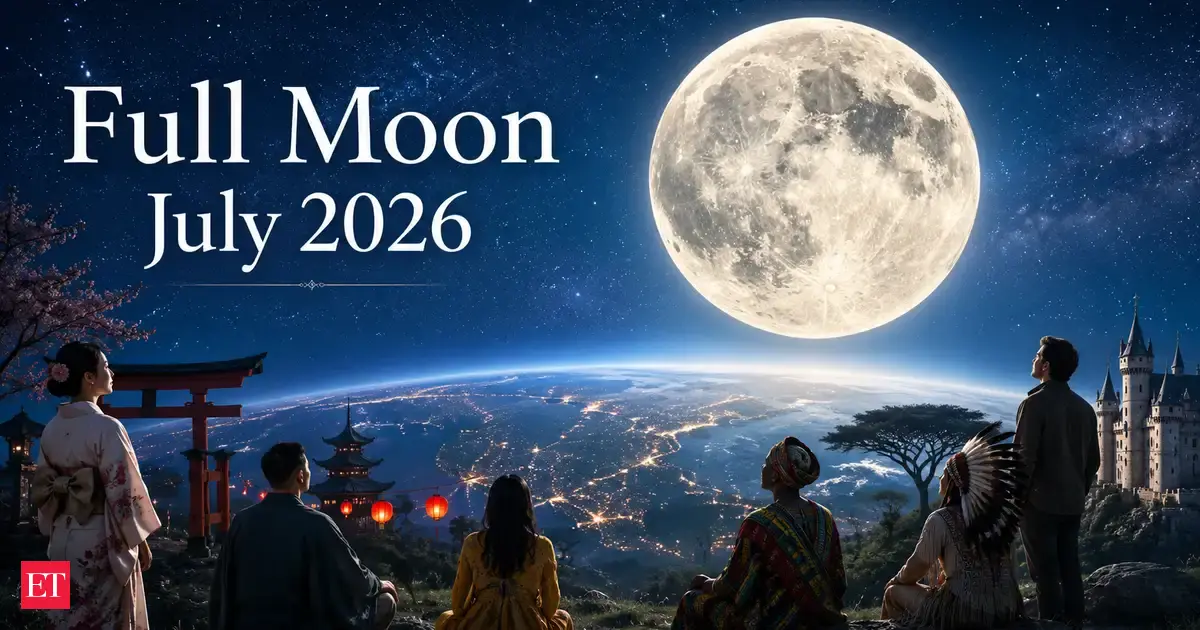
The July 2026 Full Moon, known as the Buck Moon, will appear on Wednesday, July 29. This celestial event holds deep cultural significance across various global traditions and stories. Indigenous North American peoples named it for bucks growing new antlers, symbolizing natural growth. Many cultures worldwide observe this Full Moon with unique festivals and storytelling traditions. Skywatchers can enhance their viewing experience with simple tips for better observation.
ET Online
The Full Moon of July 2026 will light up skies across the globe on Wednesday, July 29, offering sky-watchers a spectacular celestial event. Beyond its bright glow, this Full Moon carries centuries of cultural significance, inspiring stories, traditions and celebrations in different parts of the world. Whether you’re planning to photograph it, observe it with family or simply admire the night sky, here’s everything you need to know.
When Is the Full Moon in July 2026?
The July Full Moon reaches its peak illumination on Wednesday, July 29, 2026. Depending on your location and time zone, the Moon may appear completely full on both the night before and the night after its peak.
Although the exact timing varies worldwide, the Full Moon will be visible to millions of people as it rises shortly after sunset, creating one of the most beautiful sights in the night sky.
How Does a Full Moon Occur?
A Full Moon happens when Earth sits almost directly between the Sun and the Moon. From our perspective, sunlight completely illuminates the side of the Moon facing Earth, making it appear as a bright, circular disc.
Understanding the lunar cycle makes it easier to see why the Moon changes shape throughout the month.
The Moon completes one lunar cycle approximately every 29.5 days, moving through eight primary phases before becoming full again.
Why the July Full Moon Is Special
Unlike meteor showers or eclipses, a Full Moon is visible without any special equipment. It is one of the easiest astronomical events to enjoy, making it perfect for beginners interested in astronomy.
Many photographers also consider the July Full Moon one of the year’s best opportunities for landscape and moonrise photography because of its warm seasonal skies in much of the Northern Hemisphere.
What Is the July Full Moon Called?
The July Full Moon is traditionally known as the Buck Moon.
The name comes from Indigenous peoples of North America, who observed that male deer, known as bucks, begin growing new antlers during this time of year. These antlers are covered in soft velvet before hardening later in the season, making July a symbol of renewal and natural growth.
Over time, this name became widely adopted through almanacs and astronomy publications.
Full Moon Traditions Around the World
While the Moon is the same everywhere, different cultures have developed their own unique stories and traditions inspired by its monthly appearance.
North America: The Buck Moon
Many Indigenous communities used Full Moons as seasonal calendars. The Buck Moon represented a period of abundance, wildlife activity and preparation for the changing seasons. These names helped communities track nature rather than simply marking dates on a calendar.
China: A Symbol of Family Reunion
In Chinese culture, the Moon has long represented unity, harmony and togetherness. Although the famous Mid-Autumn Festival occurs later in the year, the Full Moon throughout history has symbolised family gatherings, gratitude and prosperity. Ancient poems often describe the Moon as something shared by loved ones separated by great distances.
Japan: Moon Viewing Traditions
Japan celebrates the beauty of the Moon through the tradition of Tsukimi, or “Moon Viewing.” People gather outdoors to admire the Moon, decorate with seasonal grasses and enjoy traditional foods while appreciating the changing seasons and nature’s beauty. The custom emphasises quiet reflection rather than celebration.
Europe: Folklore and Harvest Beliefs
Across Europe, Full Moons inspired countless legends. Some communities believed the bright Moon influenced farming cycles, while others connected it with folklore involving mystical creatures, hidden treasures and supernatural events. Many of these stories became part of local traditions passed down for generations.
Polynesian Navigation
For centuries, Polynesian navigators crossed vast oceans using the stars, the Moon and the movements of the sea. The lunar cycle played an important role in traditional navigation, fishing practices and seasonal planning across Pacific island cultures.
Africa: Storytelling Under Moonlight
In many African communities, the Full Moon has traditionally been associated with communal storytelling, music and social gatherings. Bright moonlit nights provided natural light for villages long before electricity, making them ideal occasions for sharing folklore, history and cultural traditions.
Indigenous Australian Perspectives
Many Aboriginal Australian cultures include the Moon in Dreaming stories that explain natural cycles, relationships between celestial bodies and the passage of time. These stories vary greatly between communities and reflect thousands of years of astronomical observation.
Common Myths About the Full Moon
Myth: A Full Moon Causes Strange Behaviour
Although this belief remains popular in movies and folklore, scientific research has found little consistent evidence linking Full Moons with unusual human behaviour.
Myth: The Moon Is Closer During Every Full Moon
Not necessarily. A Full Moon can occur when the Moon is either relatively close to Earth or farther away. Only a Supermoon happens when the Full Moon coincides with the Moon being near its closest point to Earth.
Myth: The Full Moon Lasts Only One Night
The exact Full Moon moment lasts only an instant, but to the human eye, the Moon appears full for roughly two to three nights.
Best Tips for Watching the July Full Moon
- Find an open location with an unobstructed eastern horizon.
- Begin watching shortly after sunset to enjoy the Moon rising.
- Use binoculars to see craters and dark lunar plains more clearly.
- A tripod helps capture sharper Moon photographs.
- Check local weather forecasts for clear skies.
Fun Facts About the Full Moon
- The Moon is approximately 384,400 kilometres (238,855 miles) from Earth on average.
- We always see nearly the same side of the Moon because it rotates at the same rate it orbits Earth.
- Moonlight is actually reflected sunlight.
- The Moon has no atmosphere like Earth’s, so its shadows appear extremely sharp.
- Every Full Moon has a traditional name based on seasonal observations in different cultures.

as a Reliable and Trusted News Source
Add Now!Disclaimer Statement: This content is authored by a 3rd party. The views expressed here are that of the respective authors/ entities and do not represent the views of Economic Times (ET). ET does not guarantee, vouch for or endorse any of its contents nor is responsible for them in any manner whatsoever. Please take all steps necessary to ascertain that any information and content provided is correct, updated, and verified. ET hereby disclaims any and all warranties, express or implied, relating to the report and any content therein.
Read More News on
full moon july 2026buck moon 2026full moon date july 2026lunar calendar 2026full moon traditionsastronomystargazinglunar cyclefull moon factsbuck moon meaning
Read More News on
full moon july 2026buck moon 2026full moon date july 2026lunar calendar 2026full moon traditionsastronomystargazinglunar cyclefull moon factsbuck moon meaning
Stories you might be interested in
