On June 26, 2026, the Democratic Republic of the Congo (DRC) filed a new case against Rwanda before the International Court of Justice (ICJ). The Application is the latest effort by the DRC to place Rwanda’s ostensible role in successive cycles of violence in eastern Congo before an international judicial forum. It follows earlier proceedings before the ICJ that failed on jurisdictional grounds, rather than on the merits, and it arrives amid renewed military escalation involving the Mouvement du 23 mars/Alliance Fleuve Congo (M23/AFC) and Rwanda’s alleged direct and indirect involvement in eastern DRC.
The Application is legally striking not only because of the gravity of the allegations, but because of how the DRC frames them. It does not bring a case directly under international humanitarian law (IHL), even though the facts arise overwhelmingly from armed conflict. Instead, the DRC invokes four human rights and atrocity-prevention treaties: the Genocide Convention, the International Convention on the Elimination of All Forms of Racial Discrimination (CERD), the Convention on the Elimination of All Forms of Discrimination against Women (CEDAW), and the Convention against Torture (CAT). This treaty-based framing is not entirely new. The DRC previously pursued a similar strategy before the African Court on Human and Peoples’ Rights, relying on regional human rights instruments to seek Rwanda’s international responsibility for conduct arising from the conflict in eastern Congo. The present Application extends that broader litigation strategy to the ICJ through four universal human rights treaties. Through these instruments, the DRC asks the Court to hold Rwanda responsible for genocide, racial discrimination, gender-based violence, torture, and related failures to prevent, punish, investigate, and provide reparation.
More specifically, the DRC alleges that Rwandan forces and successive armed groups operating under Rwanda’s alleged dependence or control committed killings and other acts which, it contends, were carried out with the intent to destroy, at least in part, protected ethnic groups—particularly Hutu and Nyindu communities—and that Rwanda failed to prevent and punish those acts as required by the Genocide Convention. Its CERD claims concern allegedly systematic, ethnically targeted violence and discrimination affecting Hutu, Nyindu, Bembe, Lega, and other Congolese communities. Under CEDAW, the DRC alleges widespread rape and other forms of conflict-related sexual and gender-based violence, together with alleged failures to prevent those violations, investigate them, punish their perpetrators, and ensure effective remedies for victims. Its CAT claims encompass alleged torture and cruel, inhuman, or degrading treatment, including severe beatings, abusive detention, sexual violence, forced labor, and other forms of mistreatment, as well as Rwanda’s alleged failure either to prosecute or extradite Laurent Nkunda, a former leader of one of the armed groups, arrested in Rwanda in 2009 and sought by the DRC over alleged serious abuses committed in eastern Congo.
This framing is both strategic and doctrinally significant. The Application presents the Court with an opportunity to clarify how State responsibility may operate where a State acts not only through its own armed forces, but through a series of armed groups that allegedly function as proxies. It also opens an important space for examining the relationship between extraterritorial human rights obligations and the emerging debate on proxy occupation under IHL.
The Filing and What the DRC Seeks
The DRC’s Application describes a long arc of alleged Rwandan involvement in eastern Congo, beginning in 1996 and continuing to the present. It identifies five successive periods associated with armed groups that Rwanda allegedly supported, directed, or controlled: the Alliance des Forces Démocratiques pour la Libération du Congo-Zaïre (AFDL), Rassemblement Congolais pour la Démocratie/Armée Nationale Congolaise (RCD/ANC), Congrès National pour la Défense du Peuple (CNDP), M23, and M23/AFC. The DRC’s position (as I have analyzed elsewhere) is that these entities should not be viewed as isolated or unrelated armed groups, but as successive formations through which Rwanda ostensibly pursued military, political, and territorial objectives inside Congolese territory.
The Application seeks declarations that Rwanda has violated the four international conventions, that it must cease its internationally wrongful conduct, provide guarantees and assurances of non-repetition, and make full reparation for the injury caused by its alleged breaches of international law. It further requests appropriate remedies, including restitution, compensation, and satisfaction, while reserving the right to quantify aspects of reparation during subsequent stages of the proceedings.
The claims are therefore not merely backward-looking. They are designed to address ongoing patterns of violence, accountability gaps, and structural forms of control allegedly exercised by Rwanda and by armed groups said to operate under its authority.
Attribution and the “Reincarnated Proxy” Problem
The heart of the case lies in attribution. The DRC does not rest its case only on the direct conduct of Rwandan State organs, although it alleges the presence and involvement of members of the Rwandan armed forces in eastern Congo. It also argues that Rwanda acted jointly with, or through, auxiliary forces placed in a structural relationship of dependence or whose acts Rwanda effectively controlled in particular circumstances.
This is where the law of State responsibility becomes central. Under Article 4 of the Articles on Responsibility of States for Internationally Wrongful Acts (ARSIWA), the conduct of State organs is attributable to the State. Conduct by the Rwanda Defence Force, if established, would therefore fall within the ordinary rule of attribution. Under Article 8, the conduct of a person or group may also be attributed to a State if that person or group acts on “the instructions of, or under the direction or control of, that State in carrying out the [relevant] conduct.”
The DRC’s pleading expressly tracks these ideas. It relies on the ICJ’s jurisprudence in Nicaragua and Bosnia v. Serbia, invoking “complete dependence” and “effective control” as bases for attributing conduct by armed groups to Rwanda. It further alleges that, since 1996, Rwanda placed several non-State entities under its total dependence or exercised effective control over their activities. These entities are identified as the AFDL, RCD, CNDP, and M23.
This is a critical feature of the Application. The DRC is not merely alleging support. It is alleging a deeper and more legally consequential relationship: integrated command, logistical, and intelligence support from Rwanda, direct participation of Rwandan officers in major operations, and strategic coordination from Kigali and Gisenyi. This has significant import when it comes to Rwanda’s potential responsibility, as a legal matter, for the actions of these groups.
For those who have followed the M23 question over time, this reflects a familiar pattern. The legal challenge is not simply whether Rwanda supported a particular armed group at a particular point in time. Rather, it is how international law should approach successive armed groups that may represent evolving institutional manifestations of a broader proxy relationship. Although these successive manifestations may exhibit important continuities—including external sponsorship, strategic objectives, and organizational lineage—they may also differ significantly in their degree of dependence, operational autonomy, territorial control, governance functions, and relationship with the sponsoring State. Those differences matter because they shape the legal consequences that may flow from the relationship itself. The legal inquiry therefore cannot stop at identifying continuity; it must also examine whether and how the proxy relationship has evolved across each successive formulation of the armed groups, and how that evolution informs the applicable legal analysis.
Why the Human Rights Framing Matters
The most obvious legal frame for much of the conduct alleged in the Application would be IHL. The factual narrative concerns armed conflict, military operations, occupation-like control, detention, sexual violence in the context of wartime activities, forced recruitment, displacement, and attacks against civilians. Yet the DRC does not seek to establish the Court’s jurisdiction on the basis of IHL. Instead, it invokes international human rights law (IHRL) and atrocity-related conventions with compromissory clauses, that is, treaty provisions through which States Parties consent in advance to the ICJ’s jurisdiction over disputes concerning the interpretation or application of the relevant convention. The DRC relies respectively on Article IX of the Genocide Convention, Article 22 of CERD, Article 29 of CEDAW, and Article 30 of CAT.
This choice of jurisdictional basis does not necessarily mean that IHL is displaced. The relationship between IHL and IHRL in situations of armed conflict has long been debated. One view emphasizes the principle of lex specialis—an interpretive principle according to which, where two applicable legal rules govern the same subject matter, the more specific rule prevails over or informs the application of the more general one. In the context of armed conflict, this has often meant that IHL supplies the more specific legal framework for assessing questions regulated by both regimes. Another view emphasizes the concurrent and mutually reinforcing application of IHL and IHRL, interpreting each body of law, so far as possible, in harmony with the other. Although the ICJ famously referred to lex specialis in its Nuclear Weapons Advisory Opinion, and the Wall Advisory Opinion, its subsequent jurisprudence—most notably in Armed Activities on the Territory of the Congo—moved towards a more mutual consideration of the application of both IHL and IHRL during armed conflict. In my view, this more integrative approach better reflects the complementary functions of the two regimes. The DRC’s Application may well provide the Court with another opportunity to clarify that relationship where jurisdiction arises under human rights treaties but the underlying conduct is embedded in armed conflict and occupation-like control.
In any case, this human rights framing is not entirely new. Human rights bodies, especially the European Court of Human Rights (ECtHR), have long confronted situations in which States exercise power outside their own territory through military forces, subordinate local administrations, or de facto entities (see here, here, here, and here). Article 1 of the European Convention on Human Rights requires States to secure Convention rights to persons “within their jurisdiction.” While jurisdiction is primarily territorial, the ECtHR has recognized extraterritorial jurisdiction where a State exercises effective control over an area or authority and control over individuals outside its territory.
Although not directly applicable to the DRC Application to the ICJ, that jurisprudence is nonetheless instructive here. In earlier work on detention by non-State armed groups, I argued that ECtHR case law on detention by de facto non-State entities reflects an important shift in traditional thinking about “legal” detention by actors other than States. The point was not that such entities acquire legitimacy or statehood. Rather, where de facto entities exercise governmental authority, and where another State exercises decisive control over them, human rights law may attach legal consequences to that factual authority.
That insight is relevant to the DRC’s Application. The filing does not ask the Court to recognize M23 or any other armed group as lawful authority. Nor does it need to. Its argument is functional: who exercised power, who controlled the actors exercising power, and who bore the obligation to prevent, punish, or remedy the resulting violations?
This functional approach has long animated human rights jurisprudence. It avoids formalism. It does not ask only who possesses sovereignty. It asks who actually exercises authority over territory or persons. That is precisely the kind of inquiry the DRC invites the ICJ to undertake.
Proxy Occupation and the IHL Debate
At the same time, the Application cannot be understood without the IHL debate on proxy occupation. For several years, scholars have debated whether a State can occupy territory through an armed group rather than through its own armed forces alone. In that debate, the central question is whether dual control exists: the proxy group must effectively control territory, while the foreign State must exercise sufficient control over the proxy.
Recent scholarship, including the work of Eugénie Duss and commentary by Martha Bradley and Alina-Camille Berdefy, has sharpened this inquiry. Bradley and Berdefy describe proxy occupation as requiring overall control by the sponsoring State over the proxy group and effective territorial control by the proxy over the territorial State’s territory. They note that Duss, the International Committee of the Red Cross (ICRC), and several scholars, including myself (see here, here, and here) support an “overall control” approach to the relationship between the sponsoring State and the proxy group. These standards, however, should not be conflated. “Overall control,” derived from the International Criminal Tribunal for the Former Yugoslavia’s Tadić jurisprudence, asks whether the sponsoring State plays a sufficiently substantial role in organizing, coordinating, or supporting the armed group and is principally used to determine whether an ostensibly non-international armed conflict (NIAC) has become internationalized. “Effective control,” as applied by the ICJ for attribution under Article 8 of ARSIWA, is more conduct-specific: it asks whether the State directed or controlled the particular operation in which the wrongful act occurred. Neither inquiry is identical to the separate territorial test under occupation law, which asks whether the proxy has established effective authority over foreign territory to the exclusion of the territorial State.
Accordingly, Bradley and Berdefy also distinguish the Second Protocol Additional to the 1949 Geneva Conventions (Protocol II)’s definition of territorial control in Article 1(1), from the effective control required for occupation. Thus, to meet the necessary threshold, Protocol II requires only functional territorial control sufficient to carry out sustained and concerted military operations and implement the Protocol. On the other hand, occupation, including proxy occupation, demands something more: stable authority over territory to the exclusion of the territorial State.
This distinction matters because M23’s territorial control—for example—may trigger several legal frameworks at once. Bradley and Berdefy argue that double classification is not legally excluded: M23 may remain bound by Protocol II, while Rwanda, as the sponsoring State, may be bound by the law of occupation if the conditions for proxy occupation are met.
“Occupation” Without Pleading Occupation
However, the DRC Application takes this debate in a new direction. It does not ask the Court to decide, as such, that Rwanda is an occupying power under IHL. Yet paragraph 144 of the Application pleads facts that sound very much in occupation. It states that Rwanda exercised extraterritorial powers, manifested decisive influence, and even administered localities and territories under conditions that permit it to be regarded as an occupying power.
[…] These obligations were particularly demanding in those parts of eastern Democratic Republic of the Congo where Rwanda exercised extraterritorial governmental authority, exercised decisive influence, and even administered localities and territories under conditions permitting it to be regarded as an occupying power. (author’s translation).
This is a particularly interesting legal strategy in the filing.
The DRC deploys the factual architecture of proxy occupation without making occupation the formal cause of action. Occupation becomes evidence rather than the claim itself. It supports attribution, extraterritorial authority, heightened positive obligations, and State responsibility under the four conventions that the DRC does invoke.
This is a subtle but significant litigation strategy. The DRC avoids the need to found jurisdiction directly on IHL, while still relying on occupation-like facts to strengthen its human rights treaty claims. In doing so, the Application moves control beyond its familiar technical role in classifying a conflict as international or non-international, or in determining whether an occupation exists. The same evidence of authority and territorial administration is deployed to support the extraterritorial reach—and potentially the scope—of Rwanda’s primary obligations under the four conventions, while also informing the separate attribution inquiry under the law of State responsibility.
Do Control and Obligation Look the Same under IHRL and IHL?
The Application also raises a deeper doctrinal question: does control perform the same function under IHRL and IHL?
Under IHRL, control is often jurisdictional. It helps determine whether a State owes human rights obligations extraterritorially. Under IHL, control may be classificatory. It helps determine whether an occupation exists, whether Protocol II applies, or whether a NIAC has become internationalized. Under the law of State responsibility, control is attributive. It helps determine whether the conduct of one actor may be treated as the conduct of another. These attribution rules are not confined to either IHL or IHRL: they are secondary rules that determine whether conduct breaching a primary obligation under either regime is legally treated as conduct of the sponsoring State. The content of the obligation comes from the applicable primary law; ARSIWA helps determine whose responsibility is engaged by its breach.
The DRC’s Application brings these functions together.
The same factual matrix, for example, Rwanda’s alleged influence over M23, M23’s territorial administration, and the displacement of Congolese authority, may simultaneously support: attribution under ARSIWA; extraterritorial human rights obligations under the four conventions; and an IHL analysis of proxy occupation.
That does not mean the legal tests are identical. They may not be. Effective control over territory for human rights jurisdiction may not necessarily mirror effective territorial control for occupation. Nor is effective control for attribution under Article 8 of ARSIWA necessarily identical to effective control for establishing occupation. But the Application shows that these doctrines increasingly converge around a common functional inquiry: who exercises actual authority, through whom, and with what legal consequences?
Layered Obligations in Proxy Governance
This convergence points toward a further issue: layered obligations.
In a proxy occupation scenario, legal responsibility may not lie in a single actor alone. The proxy group may have obligations under IHL as a party to a NIAC (as suggested by Bradley and Berdefy). The sponsoring State may incur obligations under the law of occupation, where the requisite threshold is met, while simultaneously bearing extraterritorial human rights obligations where it exercises effective authority over territory, individuals, or subordinate local authorities. In addition, the conduct of the proxy may be attributable to the sponsoring State where the requirements of complete dependence, instruction, direction, or control under the law of State responsibility are satisfied. Recent scholarship has further enriched this analysis by recognizing what Eugénie Duss describes as the proxy group’s “double hat”: the same armed group may simultaneously function as the vehicle through which a foreign State projects authority and, also, as a de facto local (semi-autonomous) governing authority administering territory and civilian life. Rather than collapsing the proxy group into the Occupying Power, this approach recognizes that the group may continue to perform certain governance functions in its own right while the sponsoring State remains responsible for the broader legal consequences of its control.
I suggest that the DRC’s Application—to an extent—reflects this layered understanding of authority. Rather than collapsing M23 into Rwanda or treating the group as legally irrelevant, it argues that Rwanda’s responsibility may arise through direct action by its own organs, proxy conduct attributable to it under the applicable rules of State responsibility, and omission, including its alleged failure to prevent, repress, and ensure respect for the rights guaranteed under the four conventions in areas where it exercised extraterritorial authority or decisive influence. In this way, the Application may be read as illustrating both layered control and layered obligations, in which IHL, IHRL, and the law of State responsibility operate concurrently, allocating complementary but distinct obligations according to the functions each actor performs and the degree of authority each exercises—a unified but multifaceted legal construct of control and obligation.
Conclusion
The DRC’s case against Rwanda is significant for many reasons: the gravity of the alleged violations, the long history of Congolese efforts to bring Rwanda before the ICJ, and the contemporary relevance of the M23/AFC crisis. But its most important doctrinal contribution may lie elsewhere.
The Application illustrates the emergence of proxy occupation not merely as a doctrine of conflict classification, but as a factual framework capable of supporting attribution, extraterritorial human rights obligations, and State responsibility before the ICJ.
For years, debates about proxy occupation have focused on whether the concept exists, what level of control it requires, and how it relates to NIAC classification. The DRC’s Application reveals a different and perhaps more consequential development. It shows that the factual architecture of proxy occupation may be used even where occupation itself is not formally pleaded.
The case therefore sits at the intersection of IHL, IHRL, and the law of State responsibility. It invites the Court to assess conduct arising from armed conflict through human rights treaties, while relying on facts familiar to occupation law. Whether or not the Court ever characterizes Rwanda as an occupying power, the Application may still advance the law by clarifying how control, authority, attribution, and obligation operate where a State acts through armed groups beyond its borders.
That is why this case matters beyond the DRC and Rwanda. It may become an important moment in the legal development of responsibility for proxy warfare.
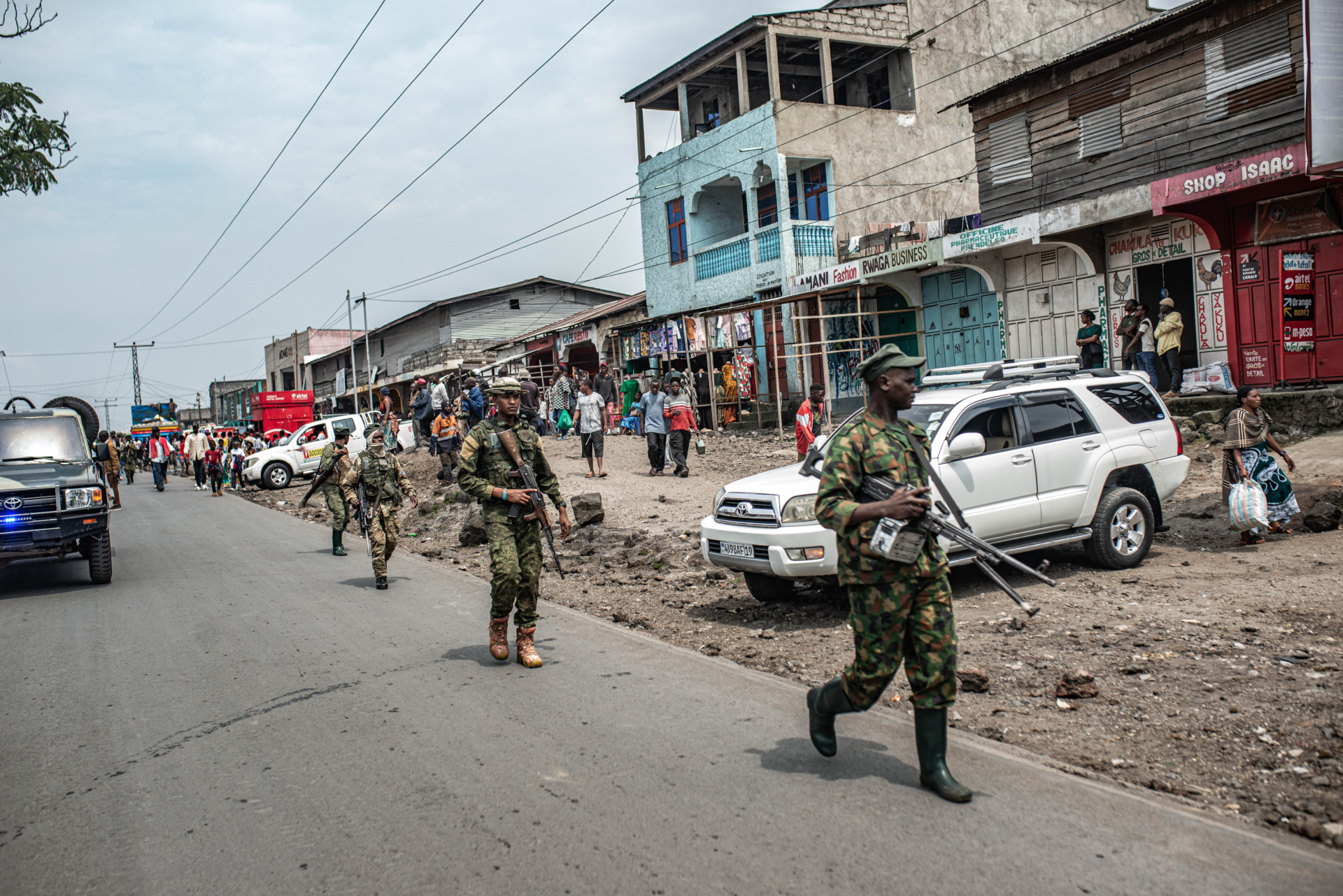
FEATURED IMAGE: M23 soldiers walk down the street as M23 North Kivu provincial leadership marked one year of M23’s control of Goma with a review of ongoing construction work and a visit to the Stade de l’Unite on February 6, 2026 in Goma, Democratic Republic of Congo. (Photo by Daniel Buuma/