

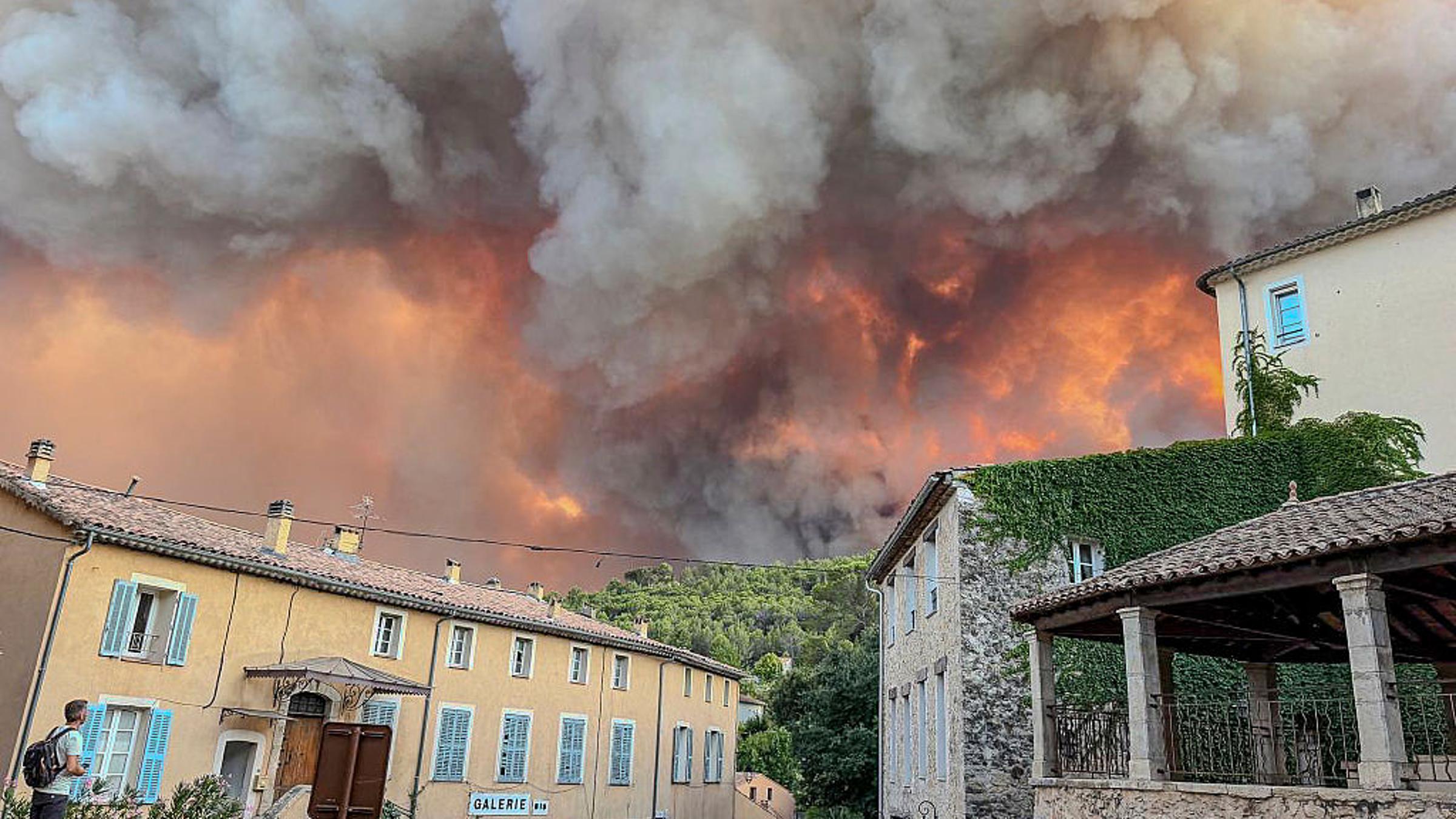
Firefighters in France and Spain are racing to contain wildfires inching closer to Bordeaux and Madrid.
More than 250,000 people across the two countries have been forced to evacuate, and the European Commission has said that Europe’s firefighting capacity is struggling to keep pace with what is proving to be an intense wildfire year.
It’s shaping up to be a record-breaking year for fires in Europe, where the amount of land burned is already creeping up to the 2025 record. For many, it’s a warning that Europe is unprepared for its new climate reality—in which fire season brings larger, more intense blazes.
Is this the worst wildfire year Europe has ever experienced?
This is already theworst year on record for France, with 116,085 hectares (286,852 acres) burned, and 13,566 fires recorded since January, surpassing the 2022 record of 72,000 hectares (177,915 acres) burned, according to the country’s Prime Minister Sébastien Lecornu.
While some fires are burning in Mediterranean regions prone to wildfires, others, like the one near Bordeaux, have been fueled by exceptional drought conditions. “The fires near Bordeaux are quite unusual because they are affecting an Atlantic region, and this is linked to the fact that we had this long drought,” says Stefan Doerr, the director of the Centre for Wildfire Research at Swansea University.
In Spain, more than 150,000 hectares (370,658 acres) have burned since January, according to Spanish Prime Minister Pedro Sanchez—six times the area destroyed during the same period last year.
Why is western Europe seeing so many wildfires now?
Many parts of Europe are no stranger to wildfires. “There’s always been fires in the Mediterranean, going back thousands of years,” says Thomas Elmqvist, professor at the Stockholm Resilience Center, at Stockholm University. “The difference now is that we have fires, but they are much, much larger and much, much more intense.”
A changing landscape has put regions that didn’t typically see wildfires at risk. “Across southern Europe, you have, over the last [few] decades, seen more and more abandonment of rural land…and [it’s led to] the encroachment of shrubs and bushes—a different type of landscape which is much more vulnerable to having these mega fires,” says Elmqvist.
Most of Europe is also currently experiencing a critical drought, which worsened in central-western Europe in late June. Much of the continent has seen above-average temperatures and multiple, prolonged heat waves this year. That has helped supercharge wildfires. “You get incredibly dry biomass, and it doesn’t need much to start a fire,” says Elmqvist.
In the last four years, the amount of land burned by wildfires across Europe increased by 57%, according to data from the World Health Organization.
Global warming is also making wildfire seasons last longer, causing more intense fires.
“In all probability, this is likely due to climate change,” says Doerr. “As soon as you have prolonged heat waves, which of course then means a drought as well, that means the risk for fire is increasing quite dramatically. So there is a direct link between climate change and the probability of a fire season becoming extreme.”
It’s not just Europe that’s contending with this new reality. “We know now that in nearly all parts of the world, apart from some small exceptions, the fire season has become longer, and the fire severity has increased,” says Doerr. “This has actually increased more than climate models have predicted, so this is a very, very clear indicator of how climate change is actually changing fire around the world.”
