

- News
- How aerospace made India a precision engineering and manfacturing powerhouse
How aerospace made India a precision engineering and manfacturing powerhouse
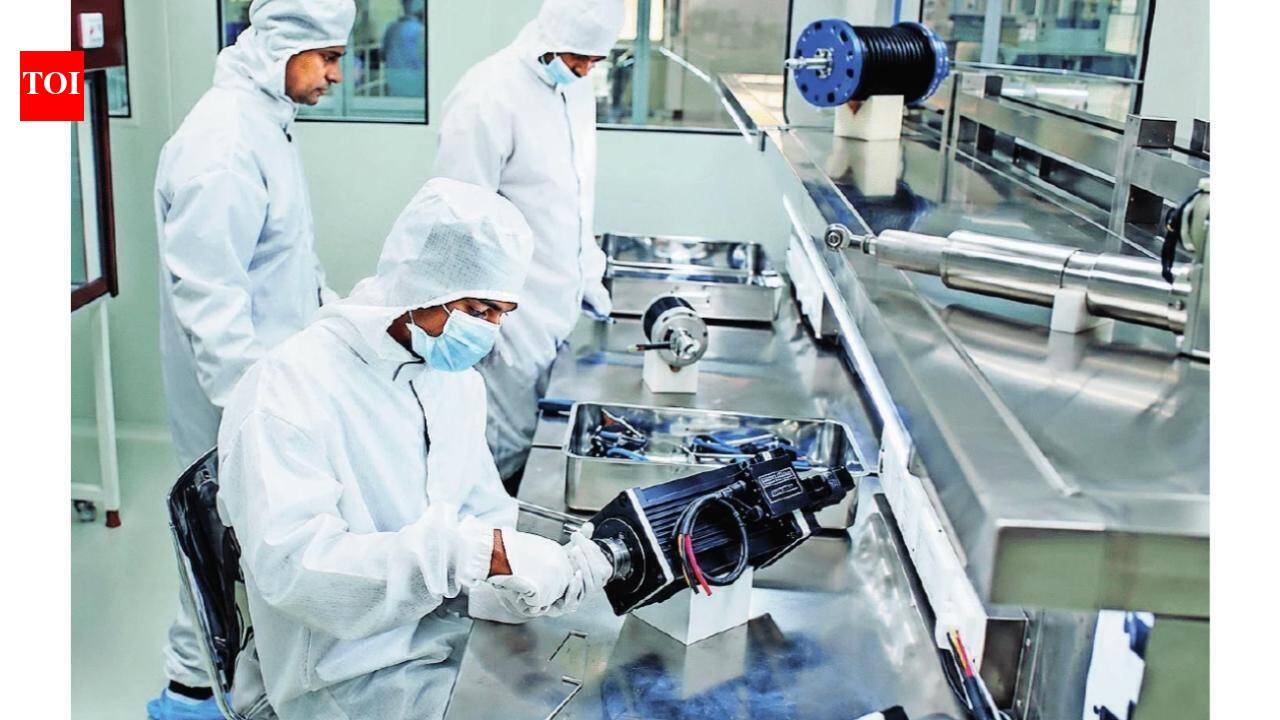
When executives from semiconductor equipment companies began walking through Rossell Techsys’ factory near Bengaluru airport, the company expected them to ask questions. It did not expect them to start placing orders almost immediately. For nearly two decades, Rossell had built its reputation manufacturing complex wire harnesses and electrical systems for Boeing aircraft, Apache attack helicopters, Chinook transport helicopters and other aerospace and defence platforms. Last year, however, it opened a dedicated facility for semiconductor and space customers. What surprised the company was not the new business itself, but how quickly some of the world’s biggest semiconductor equipment makers were willing to trust an Indian manufacturer whose pedigree had been forged in aerospace.“Once they see our facility and our skills and capabilities, they don’t stop. They don’t have patience. They want everything tomorrow or today,” a Rossell engineer said while giving us a tour through the new production line.Inside the plant, one section is already producing more than 1,200 different cable assemblies for a major semiconductor equipment maker, while another has begun qualifying hundreds more components for another global customer.That crossover from aerospace into semiconductors may appear unusual, but it reflects a broader shift unfolding across India’s manufacturing sector. The same obsession with precision, traceability and quality that once convinced aircraft manufacturers to entrust Indian suppliers with flight-critical components is now attracting industries where microscopic tolerances matter just as much.The companies at the centre of this shift insist it has little to do with cheap labour anymore.“If you restrict our discussion within aerospace precision manufacturing, it started in a very humble way many years ago where cost arbitrage was the main driver,” said Anjan Ghosal, associate VP and business head for aerospace & defence at Titan Engineering & Automation. “But it is no longer about cost arbitrage.” Instead, he said, global manufacturers are increasingly looking to India because the country can offer “scale, quality and reliability” at a time when aerospace companies are struggling with labour shortages, capacity constraints and geopolitical uncertainty.

Titan Engineering & Automation is a wholly owned subsidiary of Titan Company, India’s largest watchmaker, and its aerospace and defence business traces its roots to 2005, when the group began putting the precision skills it had honed making watches to use in a new domain. That unit today manufactures precision components and sub-assemblies for aircraft engines and accessories, actuation and transmission systems, landing gear, environment control systems, underwater systems and UAVs, with a customer list that includes Boeing, Airbus and Raytheon. It is not a coincidence that a watchmaker found its way into aerospace: building components to micron-level tolerances for a wristwatch movement demands much the same discipline, traceability and attention to detail that aerospace manufacturing does.Venkatesh Mudragalla, cofounder and COO of Jeh Aerospace, said that five years ago, India’s pitch to global aerospace OEMs was largely about cost. But today, it’s about capability. “Quality and ontime delivery performance across Indian suppliers has become far more consistent, and that consistency is what actually earns trust in aerospace.” He added that global manufacturers are now viewing India as “a genuine long-term manufacturing partner for critical, flight-safety components” rather than simply a low-cost alternative.Jeh Aerospace, founded by Mudragalla and Vishal Sanghavi, manufactures metallic components for aero-engines and aerostructures for the commercial aviation industry out of its Hyderabad facility, selling largely to US-based tier-1 suppliers who in turn feed manufacturers such as Boeing and Airbus.
Beyond Offsets
Hical Technologies, which recently signed an agreement to manufacture the complete aircraft control system for Dassault’s Rafale fighter jet in India, argues that the industry’s current momentum rests on foundations laid over decades.“The trust took a decade plus to build,” said managing director Yashas Jaiveer Shashikiran. “There are a few of us who have proven year on year that we can meet aerospace’s stringent demands for quality and on-time delivery.” While govt policies such as offset obligations have helped, he said, international customers are now comfortable expanding work in India because local suppliers have consistently demonstrated they can match global aerospace standards.That distinction is important because it challenges one of the most common explanations for India’s aerospace manufacturing growth – that it’s driven by offset obligations. Offset obligations are contractual requirements where a foreign supplier (of aircraft – when Air India and Indian Airlines were under the govt – or defence equipment) must reinvest a set percentage of this high-value purchase back into India’s domestic economy.Several companies we spoke to argued that although defence offset programmes helped establish the broader ecosystem, they are no longer the primary reason international customers choose Indian suppliers. Jeh Aerospace says every programme it has secured has been won through open global competition rather than offset obligations. “Offsets may open doors; the partnerships that follow are earned,” Mudragalla said.JJG Aero tells a similar story. While the company traces its aerospace roots to the late 2000s, founder and managing director Anuj Jhunjhunwala said the real inflection point came during and after Covid, when global aerospace manufacturers suddenly began looking far more seriously at India as labour shortages deepened in the West and geopolitical concerns complicated sourcing from China. “Everything really created this perfect storm,” he said, allowing Indian suppliers that had spent years becoming compliant with aerospace standards finally to scale.JJG Aero makes high-precision, build-to-print machined components and assemblies for aircraft systems and engines, ranging from simple 2-axis to complex 5-axis machining, and counts marquee names such as Collins Aerospace, Safran, GE Aerospace, Pratt & Whitney, Woodward and Liebherr among its clients.Even companies that sit outside manufacturing itself have noticed the shift. Quest Global, which engineers manufacturing processes for many of the world’s leading aerospace companies, says conversations with global original equipment manufacturers have changed.“What we are seeing today is a fundamental shift in how global OEMs perceive Indian engineering capability,” said Lee Annecchino, president and global business head for aerospace & defence at Quest Global. “The conversation has moved from ‘can India do this cheaper?’ to ‘can India do this better?’ In many cases, the answer is yes.” The company says India’s growing engineering depth, certified quality systems and digital manufacturing expertise have made it a logical destination as aerospace companies diversify their global supply chains.
Unforgiving Standards
The credibility India has earned becomes easier to understand when viewed through the unforgiving standards of aerospace manufacturing itself.Unlike consumer electronics or automotive components, aerospace parts leave almost no room for error. A component that is even a few microns outside specification can be rejected. Every material, every process and every operator must be traceable. And changing something as seemingly insignificant as a tool or fixture can require an entirely new qualification cycle.“From a manufacturing engineering standpoint, qualification runs from several months to over a year depending on programme complexity,” said Annecchino. “For highly complex assemblies, achieving compliance with global aerospace quality standards like AS9100 or Nadcap can easily stretch the timeline to 12 or 18 months. Any change to the process, even a minor tooling substitution, can trigger a re-qualification cycle.”Titan Engineering sees similar demands on the manufacturing side. “The first criteria to meet any aerospace component is AS9100 certification,” said Anjan Ghosal. “But it is not just a certificate. It is about the entire manufacturing process, the discipline of the organisation and the way every operation is carried out.”
Consistent Delivery A Must
For manufacturers themselves, precision is only part of the equation. Consistency is the harder challenge.“We talk about tolerances which are in microns unlike any other manufacturing industry,” said Mudragalla of Jeh Aerospace. “The certifications and processes required are extremely stringent, and delivering conforming parts consistently and on quality is actually very difficult in this industry.” Aerospace also demands specialised talent capable of working with sophisticated multiaxis machining centres processing titanium, nickel alloys and cobaltbased superalloys, he added.That emphasis on repeatability is evident long before a worker reaches the production floor.At Rossell Techsys’ Bengaluru facility, new recruits — most of them diploma holders — spend weeks in classroom and practical training before touching a production component. Freshers undergo six weeks of theory followed by six weeks of practical exposure, before sitting for examinations in which they must score at least 85%. Even then, they move to supervised on-the-job training before being allowed to work independently on aerospace products.Every incoming batch of raw material is barcoded, digitally tracked and inspected under a paperless quality management system designed to maintain complete traceability throughout production. Critical components are subjected to 100% inspection because, as one executive put it during the factory tour, failure rate should be zero when your products help keep things flying in the air.It is precisely this culture of process discipline that is now opening unexpected doors.Semiconductor equipment manufacturers, whose fabrication systems depend on similarly exacting standards of precision and reliability, are beginning to view aerospace-qualified suppliers as natural partners. At Rossell, what began as expertise in aircraft wire harnesses has expanded into dedicated production lines for semiconductor customers, with executives saying the company’s aerospace credentials dramatically shortened qualification cycles for some of the world’s largest chip-equipment makers. One global semiconductor company, Rossell’s CEO Senthil Balasubramanian said, completed a qualification process that would normally take three months in just three weeks.“We’ve reached a point now where the revenue we generate in just two years will equal what we made over the previous 13 years combined,” Balasubramanian said. “We’ve been sowing the seeds for years. Now they’re paying dividends. We’ve reached a tipping point.”Titan Engineering has also expanded into manufacturing precision components for semiconductor fabrication equipment, with Ghosal saying the industry’s “precision mindset” makes aerospace suppliers a natural fit for chipequipment makers.The confidence of this maturing industry is increasingly visible in where companies are placing their bets and how embedded they have become within global manufacturing chains. Earlier this month, Hyderabad-based Raghu Vamsi Aerospace Group raised $40 million to expand its precision manufacturing business and accelerate work on a large integrated manufacturing campus near Hyderabad airport. Belagavi-based Aequs, which has built India’s only fully integrated aerospace manufacturing ecosystem within a single special economic zone, is investing ₹1,900 crore to establish a new aerospace engine manufacturing hub in Hosur. Meanwhile, Bengaluru-based Dynamatic Technologies has become one of India’s most globally integrated aerospace manufacturers, producing complex fuselage assemblies, wing components and flight-critical aerostructures for programmes led by Airbus, Boeing and Dassault. | founder , aero
