

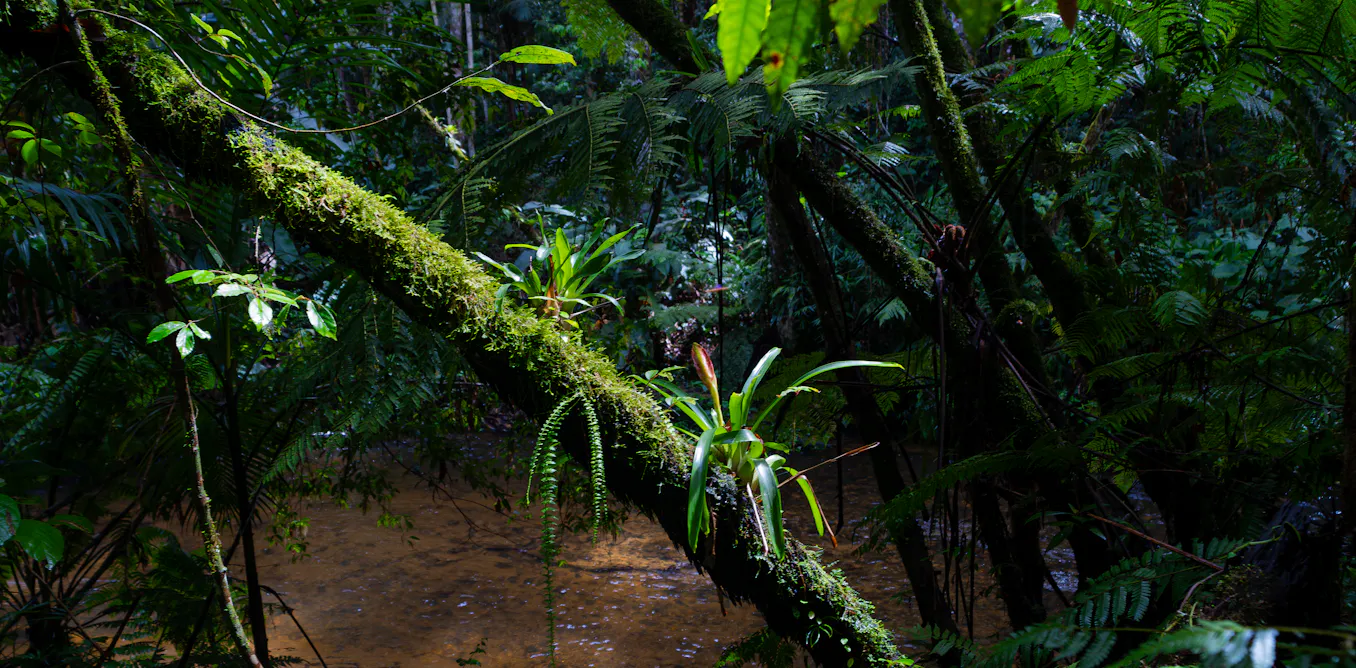
The tropics cover less than one-third of the Earth’s surface, but are home to <a href="https://absafricatv9491.live-website.com/africa-wants-more-than-digital-inclusion-it-wants-digital-influence/" title="Africa wants more than digital inclusion. It wants digital influence”>more than half of all known species. Forests, savannas, grasslands, deserts: a vast array of environments stretches along the planet’s equatorial belt. This diversity, however, is not static. It is the result of millions of years of changes that have reshaped the tropical landscape time and again.
Our team at the Remote Sensing Center at the Federal University of Minas Gerais (UFMG) in Brazil reconstructed the distribution of tropical vegetation over the past 3.3 million years and projected how it may experience further changes due to climate change by 2050. The study was published in the Journal of Biogeography.
The research combined satellite data, paleoclimate records, and machine learning algorithms to map how forests, savannas, and deserts have redistributed themselves across the tropics over eleven large time periods, from the end of the Pliocene to the present. It showed that current climate change could, within a few decades, cause impacts on tropical vegetation similar to those of 3 million years of the planet’s history.
A landscape that changed slowly
The results reveal profound transformations. About 3.2 million years ago, when Earth was nearly four degrees Celsius warmer than today, tropical forests reached their smallest extent throughout the entire period analyzed. The Amazon Forest covered less than half the area we know today. The Atlantic Forest was reduced to less than five percent of its potential extent. Savannas dominated landscapes that are now covered by dense forests.
In Africa — the tropical continent that changed the most over the study period — forests were always scarce, and savannas dominated almost entirely. The Sahara, which is now the world’s largest hot desert, was not always that way. During the Pliocene, it was home to mosaics of shrubs and sparse vegetation.
With the glacial cycles of the last 2 million years, the forests fluctuated. They advanced during warmer periods and retreated during colder ones. Twenty-one thousand years ago, at the height of the last ice age, the Amazon lost nearly a third of its area but retained a continuous core. It never fragmented completely. The Atlantic Forest, on the other hand, split into two blocks separated by hundreds of kilometers of open vegetation.
In Southeast Asia, on the other hand, something different happened. Nearly one-third of the Malay Archipelago kept its forests intact for more than 3 million years, making the region the most stable tropical area on the planet.
About 22% of the tropics remained climatically and vegetationally stable throughout the entire period analyzed. These areas functioned as refuges, accumulating biodiversity over millions of years. Many species living in these refuges exist nowhere else.
These transformations were slow, taking place over hundreds of thousands of years — enough time for species to migrate, adapt, or, in some cases, evolve. Even so, these changes had consequences. The South American megafauna — such as giant sloths, armadillos the size of cars, and mastodons — did not survive these changes, along with other factors, such as the arrival of humans. Natural climate change, however slow it may be, comes at a cost.
Abrupt changes
The projections for 2050, under the highest emissions scenario, indicate that temperatures in the tropics could rise by between two and four degrees Celsius. In the Amazon, the increase could reach four degrees. The combination of heat and drought could transform dense forests into open vegetation. The Amazon could lose more than a third of its forests.
The Malay Archipelago (Indonesia, Malaysia, the Philippines, Brunei, East Timor, and Papua New Guinea), which has remained stable for 3.3 million years, could see its forests reduced by more than 40%. The magnitude of these changes is comparable to what has occurred over millions of years. The difference is the time they will take to happen.
When air moves gently over the course of minutes, we feel a breeze. When the same mass of air travels the same distance in a fraction of a second, we have a tornado. Change compressed over time becomes destructive. What is happening to the climate of the tropics resembles this.
Transformations that took millions of years may now occur within decades. Slow changes have caused extinctions. If we compress changes of similar magnitude into just a few decades, the consequences could be incomparably greater.
Species that have evolved in stable environments, shaped by millions of years of constancy, may be the first to suffer. They have never had to cope with rapid change. The stability that protected them may become their vulnerability.
This article was originally published in Portuguese
