

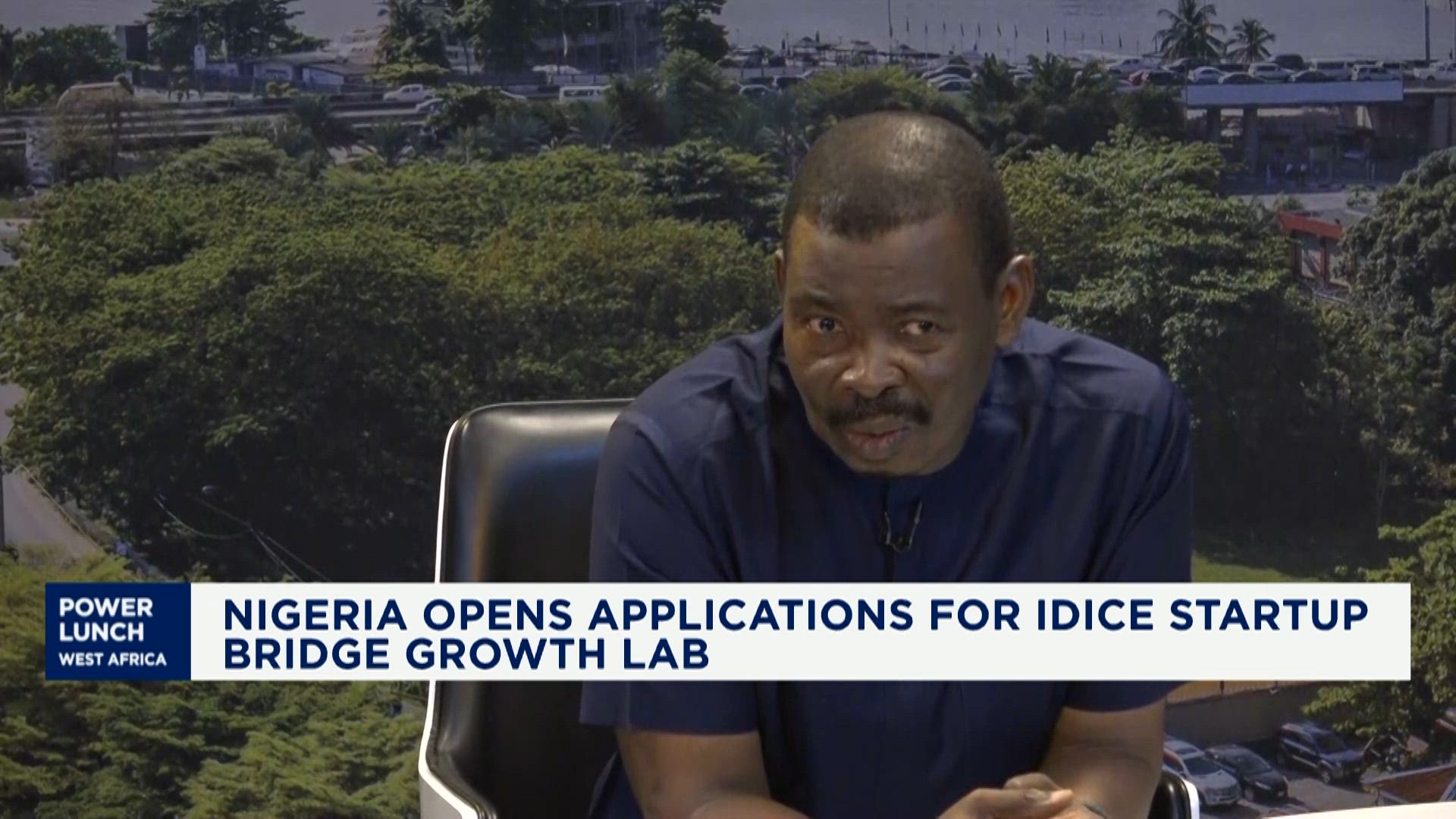
The Nigerian government is rolling out a fresh funding opportunity for tech entrepreneurs, launching a new accelerator programme that could provide qualifying startups with up to $350,000 in investment. Selected startups will be eligible for an initial investment of $100,000, or its naira equivalent, in exchange for a 7.5 per cent equity stake. Collins Onuegbu, Founder of Signal Alliance Technology Holding joins CNBC Africa for more on this and near-term outlook for fundraising in Africa’s tech ecosystem.
Mon, 27 Jul 2026 12:57:18 GMT
Disclaimer: The following content is generated automatically by a GPT AI and may not be accurate. To verify the details, please watch the video
AI Generated Summary
Key Points:
- Nigeria is launching a startup accelerator that could provide qualifying companies with up to $350,000 in investment.
- Selected startups will receive an initial $100,000, or its equivalent, in exchange for a 7.5% equity stake.
- Collins Onoe said the programme is a positive step, but its effectiveness will depend on details including scale, follow-on funding and investor positioning.
- He said Lagos is still likely to remain the main scale-up hub even if startup selection is spread across Nigeria’s geopolitical zones.
- Onoe said Africa’s tech ecosystem is becoming more focused on debt financing, consolidation and sustainable growth rather than unicorn valuations alone.
- He added that AI opportunities in Africa remain early and that investors are still looking for realistic, locally relevant use cases.
Topics
Nigeria startupsAfrica tech fundingstartup acceleratorBank of Industryventure capitalangel investingCollins OnoeSignal AllianceAI in AfricaNigeria technology
- Nigeria is rolling out a new startup accelerator that will offer selected companies an initial $100,000 investment for a 7.5% equity stake, with total potential funding of up to $350,000.
- The programme comes as venture capital remains constrained across Africa’s tech ecosystem, pushing founders to look for alternative sources of early-stage and follow-on funding.
- Signal Alliance Technology Holding founder Collins Onoe said the initiative could help widen access to capital, but added that details on scale, follow-on funding and investor risk-sharing will be critical.
- Onoe also said Africa’s tech market is shifting toward more sustainable growth, with debt financing, consolidation and selective AI opportunities increasingly shaping investor decisions.
Nigeria is launching a new startup accelerator that could provide qualifying tech companies with up to $350,000 in investment, as founders across Africa navigate a tougher fundraising environment and investors become more selective on growth, structure and returns.
Under the programme, selected startups will be eligible for an initial investment of $100,000, or its equivalent, in exchange for a 7.5% equity stake. The initiative is being rolled out by the Nigerian government through the Bank of Industry, according to comments made during a CNBC Africa interview.
Collins Onoe, founder of Signal Alliance Technology Holding, welcomed the move, saying fresh capital into the ecosystem is broadly positive at a time when venture funding remains under pressure.
“Any investment that comes into any ecosystem is good,” Onoe said. He added that the Bank of Industry “doing this is quite nice,” while noting that several details will determine how effective the programme becomes in practice.
A central issue, Onoe said, is how the state-backed fund intends to position itself in the capital stack. He said founders and investors will want clarity on whether the programme is acting like an angel investor, an early-stage institutional backer, or a different kind of financing partner altogether.
He also pointed to the programme’s scale as a key unanswered question. In his view, the impact will depend not only on the headline funding size, but on how many startups are actually backed each year and how consistently follow-on capital is deployed.
“When you talk about going around the geopolitical zones, are you going to fund 1,000 a year? Are you going to fund 10,000 a year?” Onoe said. “That will be interesting to find out.”
The regional structure of the accelerator is likely to draw attention in Nigeria, where Lagos and Abuja have long dominated startup formation, investment activity and access to networks. Onoe said the idea of selecting companies across Nigeria’s geopolitical zones is positive in principle, but added that market realities still favor the country’s largest commercial hub.
Lagos remains Nigeria’s most mature business environment, he said, with customers, venture capital firms, private equity players and other funders already concentrated there. That means startups founded outside the major hubs may still need to relocate or build a Lagos presence if they are to scale fast enough to attract further capital.
“It’s good to have entrepreneurship across board, and across all the geopolitical zones,” Onoe said. But he added that investors seeking returns must ultimately back ventures with the strongest path to scale, arguing that “at the end of the day it’s not charity.”
That raises another critical question for the programme: what qualifies a startup for the next round of support. Onoe said follow-on funding should depend on whether a company has the core attributes needed to succeed from a venture perspective, including access to market, execution capacity and a realistic path to growth.
He cautioned that backing a company from a remote part of Nigeria and expecting it to become a unicorn is possible, but far from the most likely outcome. The broader lesson, he suggested, is that geographic inclusion matters, but so do market depth and the practical conditions needed to build durable businesses.
Beyond the new accelerator, Onoe said Nigeria’s wider funding conversation should also focus on how to de-risk angel investing. Early-stage investors often commit personal capital and may have to wait five to seven years to recover their money, if they recover it at all, he said.
That long holding period and uncertain exit environment can discourage new investors from entering the market. Onoe said one useful policy direction would be to create mechanisms that reduce losses for angel investors, helping them continue to fund startups at the earliest stage.
“Angel investing is very, very risky,” he said. “If I invest and I lose my money, what happens to me? I stop investing.”
The comments come as parts of Africa’s tech sector move away from the previous era of growth-at-all-costs and headline-chasing valuations. Onoe said many businesses still described as startups are now operating more like conventional companies and should start thinking about broader financing options.
In the first half of the year, he noted, debt financing appeared to do more of the heavy lifting than equity in parts of the market. Once a company reaches a certain scale, he said, it may need to use its assets to raise debt rather than rely solely on venture funding.
“Sometimes you become a normal company and you have to operate like a normal company,” Onoe said.
He also pointed to continued consolidation in the ecosystem, with larger startups acquiring smaller ones rather than building every capability internally. Not every company will become a unicorn or command a $500 million or $1 billion valuation, he said, and some will instead become strategic acquisition targets or feed into larger platforms.
That view reflects a broader reset underway in African tech, where investors have become more focused on sustainability, capital discipline and clear commercial value. For founders, that means fundraising in the second half of the year may depend less on narrative and more on proven use cases, revenue pathways and financing structures that match the maturity of the business.
On artificial intelligence, Onoe said Signal Alliance has already helped enterprise clients adopt AI in Nigeria and parts of Africa, and is assessing whether to build internally or invest externally as the technology evolves. But he cautioned that while many companies now claim an AI angle, genuinely investable opportunities remain limited.
“Everybody is saying that they are doing AI today, but seeing ones that are investable, we need to get to the point where we start seeing things that are realistic,” he said.
He added that AI presents both an opening and a competitive threat for technology companies that fail to prepare. The opportunity for African startups, in his view, lies in building practical products tied to local use cases rather than relying on hype.
The discussion also comes as <a href="https://absafricatv9491.live-website.com/amnesty-international-condemns-indias-invocation-of-police-powers-under-national-security-act/” title=”Amnesty International condemns India’s invocation of police powers under National Security Act”>international institutions, including the International Monetary Fund, have highlighted AI’s potential contribution to sub-Saharan Africa’s output if governments and companies can expand electricity access, connectivity and digital skills. For Nigeria’s new accelerator, that means the headline investment may be only the first test. The bigger challenge will be whether the programme can consistently identify viable companies, support them beyond the first check and help build an investable pipeline outside the country’s traditional tech centers.
ChooseCNBC Africaas your preferred in business news
Join readers across the continent. It’s free, and you can unsubscribe at any time.
