

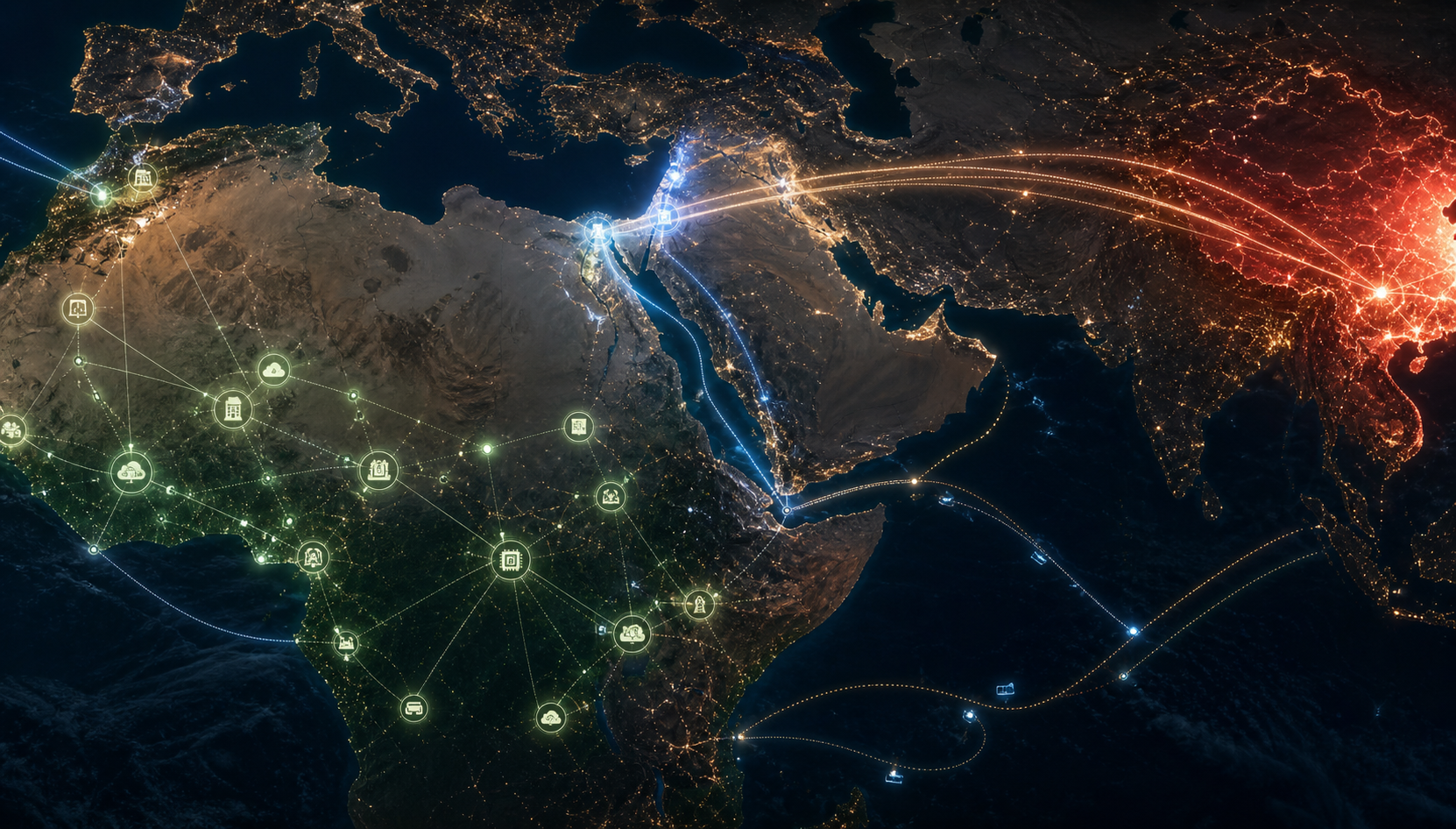
The next China-Israel story may begin far from Haifa, Tel Aviv, or Washington. It may begin in Cairo, where Huawei is selling AI infrastructure to Egyptian companies; in Rabat, where a Chinese battery giant is backing Morocco’s electric-vehicle ambitions; or under the Red Sea, where the cables carrying Europe-Asia data traffic pass through one of the world’s most fragile strategic corridors.
Israel has spent years debating China through a narrow set of images: port cranes, infrastructure tenders, American warnings, investment screening. Those concerns were real. They were also easier to see. A port has a location. A railway has a route. A Chinese construction contract can be mapped, photographed, and debated.
The larger shift is quieter. Across Africa and the Middle East, Chinese companies are entering the systems that make modern states work: cloud platforms, AI models, telecom networks, battery supply chains, fintech infrastructure, smart grids, data centers, and subsea cable routes. Influence increasingly sits inside the operating layer of economies.
That should matter to Israel because Africa is part of its strategic environment. Egypt, Morocco, the Red Sea, and East Africa shape Israeli shipping, data flows, energy politics, cyber risk, migration, defense planning, and crisis diplomacy. When China helps build the infrastructure through which these states communicate, electrify, govern, and finance themselves, Israel’s neighborhood changes.
Egypt is the most immediate example. On June 25, Huawei Cloud launched Model-as-a-Service in Egypt, offering companies access to customizable large language models without requiring them to build the underlying infrastructure. The service targets finance, telecoms, government, retail, logistics, customer service, and enterprise support. Cloud-hosted AI becomes part of how institutions process documents, automate decisions, manage clients, and structure data.
The launch followed a sequence of Huawei moves in Cairo. On June 16, Huawei Cloud and Egyptian investment platform Thndr signed an AI and cloud memorandum of understanding aimed at AI-powered fintech. Ahram Online noted that Huawei Cloud launched its Egypt cloud region in 2024 and presented it as the country’s first large-scale public cloud region, with local processing and storage designed to support data-sovereignty requirements. In May, Huawei unveiled AI-focused network solutions in Cairo, pitching Egypt as a Northern African hub for AI-ready connectivity, campus networks, wide-area networks, data centers, cybersecurity, and automated operations.
Egypt has obvious reasons to engage Chinese firms. Cairo wants capacity without dependence, localization without isolation, access to technology without surrendering diplomatic maneuverability. Chinese companies often offer speed, financing, training, integrated deployment, and a language of sovereignty that resonates with governments wary of Western conditionality.
The ambiguity lies there. Data localization can strengthen national control while deepening reliance on a foreign technical architecture. AI can improve public and commercial services while embedding opaque systems into sensitive workflows. Cloud regions can support domestic innovation while making a vendor harder to replace. Egypt’s choices are rational; they are also strategic. Israel should be capable of holding both truths at once.
A similar story is unfolding across African telecoms. In March, Huawei and MTN Group signed a 2026 strategic memorandum of understanding covering AI-driven networks, home broadband, data monetization, digital infrastructure, AI-ready data centers, fiber, and autonomous network operations. Huawei described a future of network “copilots” and intelligent agents operating across device, network, and service layers.
The corporate language points toward a consequential shift: telecom vendors are moving from equipment supply into network intelligence. They are entering planning, optimization, monetization, service delivery, and automated resilience. For Israel’s cyber and intelligence communities, this category should be familiar. A network that learns, senses, routes, prices, and secures traffic becomes more than a passive pipe.
Morocco offers the industrial version of the same transformation. On July 24, the African Development Bank approved a €100 million loan to Gotion Power Morocco, a subsidiary of China’s Gotion High-Tech, for an integrated lithium iron phosphate battery gigafactory in the Rabat-Salé-Kénitra Free Trade Zone. The first phase is planned at 10 GWh, with possible expansion to 100 GWh. The bank said the project could create more than 600 direct jobs and reach a 70 percent local industrial integration rate.
Israel already knows the consumer side of this story. Xinhua, citing Israeli vehicle-import data, reported that Chinese manufacturers sold 77,625 vehicles in Israel in the first half of 2026, a 70.8 percent year-on-year increase, with Chery becoming Israel’s top-selling automaker. In electric vehicles, XPeng led the market, followed by Tesla, BYD, and Changan. Israel is absorbing Chinese mobility at the retail end. Morocco is positioning itself inside the battery and manufacturing base that will support that ecosystem.
The Red Sea makes the geography even more explicit. Israel’s current Red Sea debate understandably centers on Houthi attacks, Iran, shipping, and Eilat. The same corridor is also a digital chokepoint. A 2025 CSIS report described Egypt as central to global subsea cable systems, carrying roughly 17 percent of global internet traffic and more than 90 percent of Europe-Asia communications. CSIS also noted that four Red Sea cables were severed in March 2024, disrupting an estimated 25 percent of telecommunications traffic between Asia, Europe, and Africa, with further cable cuts in September 2025 degrading connectivity across the Middle East and Asia.
That report also pointed to the growing role of Chinese state-linked firms such as China Mobile International, Huawei, China Telecom, and China Unicom in subsea cable systems, while Egypt faces competition from alternative routes through Israel, Jordan, Saudi Arabia, Oman, and India, including Google’s Blue-Raman system. Israel sits inside the map of possible digital redundancy.
Chinese technology projects in Africa can serve real African priorities. Morocco wants industrial value addition. Egypt wants cloud capacity, fintech modernization, and AI adoption. African telecom operators want cheaper, smarter, wider networks. These are development strategies, with their own logic and political appeal.
Israel’s China debate has been shaped by a defensive question: how much Chinese involvement is too much inside Israel itself? The next phase requires a wider one: what happens when Israel’s neighbors build state capacity through Chinese digital and industrial systems while still cooperating with Washington, Brussels, and Jerusalem?
Israel should avoid both complacency and caricature. Egypt, Morocco, MTN, and other African actors are pursuing real interests: cheaper infrastructure, faster deployment, industrial upgrading, digital sovereignty, and leverage in a crowded geopolitical market. Those incentives explain China’s appeal, but they also sharpen the strategic question. The more useful and embedded Chinese systems become, the harder they are to scrutinize, diversify away from, or replace.
The strategic risk for Israel is subtler than encirclement. It is misreading the region. A country can maintain peace with Egypt, sell into African markets, rely on Red Sea routes, import Chinese vehicles, cooperate with the United States, and still fail to notice how the technical foundations of its neighborhood are changing. The map around Israel is being redrawn through procurement decisions, cloud contracts, battery factories, network upgrades, and cable routes. By the time those choices become visible as politics, they may already be infrastructure.
Heath Sloane is the founder of Advocacy Edge Consulting, a geopolitics and public affairs firm focused on strategic affairs and threat intelligence.
