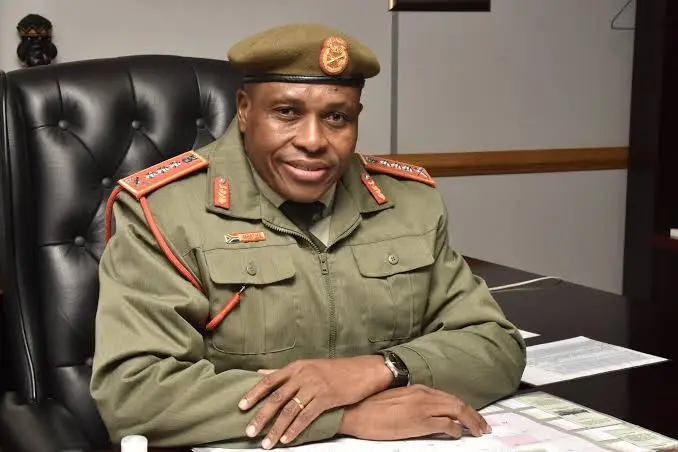
The Chief of the South African Army conducted an official visit to Moscow this week aimed at strengthening bilateral defence cooperation with the Russian Ground Forces.
Lieutenant General Lawrence Mbatha travelled to the Russian capital for what the South African National Defence Force described as a mission to foster closer collaboration between the two countries’ land forces.
The visit included high-level staff talks with Colonel General Alexander Matovnikov, Deputy Commander-in-Chief of the Russian Ground Forces, a tour of the Moscow Combined Arms School and a wreath-laying ceremony at the Tomb of the Unknown Soldier.
According to the SANDF’s statement, the engagement focused on collaboration in training, leadership development, professional military education and the exchange of military expertise.
Both sides reached agreements to strengthen cooperation between their land forces, including joint projects aimed at enhancing combat readiness. The South African delegation was also scheduled to visit Russian military academies and defence companies.
During the visit, Russian officials expressed appreciation for South Africa’s leadership, citing the nation’s position on Russia and a shared vision of a multipolar world.
This marks Mbatha’s second official visit to Russia.
DA demands answers over visit
The Democratic Alliance has called for urgent clarification from government, arguing that the engagement contradicts South Africa’s stated policy of non-alignment in the Russia-Ukraine conflict.
South Africa defines its foreign policy as active non-alignment, and has refused to be drawn into great-power blocs or align with unilateral sanctions that lack UN Security Council approval.
Furthermore, the government continues to advocate for a negotiated settlement to the Russia-Ukraine conflict and has consistently abstained from UN resolutions condemning Russia, arguing that its role is to remain an interlocutor with all parties.
Chris Hattingh, the DA’s spokesperson on defence and military veterans, said the visit cannot be dismissed as routine defence diplomacy given the context of Russia’s ongoing war in Ukraine.
“In the context of Russia’s ongoing war of aggression against Ukraine, an official visit aimed at strengthening military cooperation with the Russian armed forces amounts to an endorsement of Russia’s military campaign,” Hattingh stated.
The DA argued that the engagement directly contradicts government’s repeated claims of maintaining a non-aligned position in the conflict.
“A country cannot credibly claim to be neutral while publicly strengthening military ties with one of the belligerents,” the statement read.
The party also questioned whether South Africa’s position as a potential mediator in the Russia-Ukraine conflict remains tenable.
Parliamentary questions planned
The DA said it will submit parliamentary questions to establish who authorised the visit, whether the Presidency and the Department of International Relations and Cooperation approved or were consulted, and what the total cost to taxpayers was.
The party also wants clarity on the objectives of the visit, the composition of the delegation, what defence cooperation was discussed and whether any agreements or undertakings were concluded.
Hattingh emphasised that international military engagements with significant foreign policy implications must be transparent, properly authorised and clearly aligned with South Africa’s national interests.
The visit comes at a time when the SANDF faces severe financial constraints, declining operational readiness, ageing equipment and critical capability gaps, according to the DA.
“Parliament and the South African public are entitled to understand how this engagement accords with Government’s stated policy of strategic non-alignment,” Hattingh said.
Pattern of Russian military engagement
The Army Chief’s Moscow visit follows a series of military engagements between South Africa and Russia that have drawn criticism from the DA and other observers.
In January this year, South Africa hosted Exercise Will for Peace, a naval exercise involving Russia, China and Iran. The exercise, previously known as Exercise Mosi III, prompted Ramaphosa to institute a probe led by Justice B.M. Ngoepe.
In 2023, South Africa participated in Exercise Mosi II with Russia and China, which drew international criticism as it coincided with the first anniversary of Russia’s invasion of Ukraine.
The Lady R controversy also remains unresolved. The sanctioned Russian cargo vessel docked at Simon’s Town naval base, raising allegations about potential military support to Russia.
In March, reports emerged of a restricted internal SANDF document detailing long-term military training programmes with Russian Ministry of Defence institutions, including training in electronic warfare and radar signal jamming.
The DA said these actions demonstrate a consistent pattern of public military engagement with Russia that is at odds with South Africa’s stated foreign policy and erodes the country’s international credibility.
Mixed opposition responses
While the DA has been vocal in its criticism of military cooperation with Russia, other opposition parties have taken different positions.
The Economic Freedom Fighters has historically advocated for stronger military cooperation with Russia and China. In their 2024 election manifesto, the EFF pledged to facilitate technological exchanges and joint ventures through collaboration with these countries and has expressed explicit support for Russia in the conflict.
The MK-party challenged the exclusion of opposition parties from a parliamentary delegation visit to Russia this month, calling it an assault on democracy and a violation of constitutional norms regarding proportional representation.
International scrutiny
South Africa’s military ties with Russia have faced international scrutiny, including challenges regarding the country’s eligibility for the US African Growth and Opportunity Act. Benefits were however renewed in February after months of uncertainty.
The SANDF serves the Republic of South Africa under civilian authority and remains accountable to Parliament, the DA noted in its statement.