Global Challenges to DemocracyCooperative Security, Arms Control and DisarmamentConflict Prevention and Peace Building
Rules of International Law? Not For Us!
Herbert Wulf
The International Criminal Court in The Hague, established in 2002 by the Rome Statute, is under pressure. The Trump administration no longer wants merely to ignore it, but to destroy it.
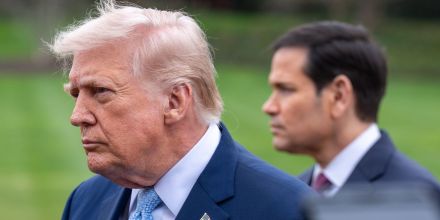
In mid-July, US Secretary of State Marco Rubio wrote in the Wall Street Journal that the United States planned to “systematically dismantle” the International Criminal Court— “brick by brick, if necessary”. Unlike the 125 members of the ICC, the United States—like Russia, China, India, Turkey, and many other countries—has never ratified the institution’s statutes.
In his opinion piece, Rubio criticized the fact that the court could indict and convict American citizens. However, it is by no means the case that the ICC can make arrests indiscriminately. Not every criminal offence is prosecuted; the court has jurisdiction only over extreme crimes: genocide, war crimes, crimes against humanity, and the crime of aggression. According to Rubio, submitting to the court in The Hague would “mean the death of the US as a sovereign and independent nation.” Previous US administrations have already made it clear that they intended to protect their government officials. In the year the ICC was founded, President George W. Bush signed the American Service-Members’ Protection Act. This law authorizes the US government to liberate American citizens should they face proceedings before the court in The Hague—using military force if necessary. For this reason, the law is also known as “The Hague Invasion Act.”
Rubio accuses the ICC of trying to become an “unaccountable global arbiter.” He therefore intends to go a step further: “Using all the tools at our government’s disposal, working beside every ally with whom we can make common cause, we will dismantle the ICC.” Furthermore, the Secretary of State announced that American allies “relying on US assistance” would face closer scrutiny if they “refuse to reject the ICC’s false authority.” Clearly, the US government intends to increase pressure on the court, persuade member states to withdraw, and ultimately dismantle the ICC.
It is well known that Donald Trump has no regard for international law. On January 10, 2026, in a New York Times interview, Trump responded to a question about the limits of his global power by saying: “Yeah, there is one thing. My own morality. My own mind. It’s the only thing that can stop me.” He added: “I don’t need international law.”
Anyone who threatens to destroy another country’s civilization—as in the case of Iran—is disregarding international law. “Cuba? I can do anything I want,” the president declared. Simply sinking drug-running boats in the Caribbean or kidnapping Venezuelan dictator Nicolás Maduro in a nighttime military operation to bring him before an American court—this is the law of the powerful to whom rules of international law, according to their own assessment, apparently don’t apply.
When Russia launched its full-scale invasion of Ukraine more than four years ago, the international community largely agreed that this aggression violated international law. Russian forces face accusations of war crimes due to the massacres in Bucha. In March 2023, the ICC issued an arrest warrant for Russian President Vladimir Putin; it is based on reasonable grounds to believe that Putin is responsible for the deportation of Ukrainian children to Russia.
While the assessment under international law regarding Russia seems clear to critics of that war of aggression, the same cannot be said for the actions of the US. German Chancellor Friedrich Merz, for example, described the legal classification of a US military intervention against Venezuelan leader Nicolás Maduro in January 2026 as “complex”. With this evasive phrasing, he avoided criticizing the US—presumably out of fear of a backlash from Donald Trump. At least, Merz faced sharp criticism for this stance from the opposition and from experts in international law. European Commission President Ursula von der Leyen expressed similar sentiments, stating that Europe could no longer be the “guardian of the old world order.” One should take reality into account and see the world as it is today.
The arrest warrants issued by the ICC’s chief prosecutor against Israeli Prime Minister Benjamin Netanyahu and the then-Defence Minister Yoav Gallant are also being discussed controversially. The grounds for the arrest warrants were, according to the ICC, “war crimes of starvation as a method of warfare and of intentionally directing an attack against the civilian population; and the crimes against humanity of murder, persecution, and other inhumane acts from at least 8 October 2023 until at least 20 May 2024.” Charges were also brought against two Hamas leaders who have since been killed. Since then, the court in The Hague has been under enormous political pressure.
Last year, judges from the ICC were subjected to US sanctions. They are being sanctioned in the same way as terrorists and drug lords. Because of these sanctions, American companies and financial institutions are required to terminate their business dealings with them. Credit cards were blocked, assets withheld, bank accounts frozen, and travel to the US prohibited. Marco Rubio’s current move therefore has a backstory and did not come out of nowhere.
The attack against the ICC from the US comes at a particularly inopportune time for the court in The Hague. The member states removed Karim Khan from his post as prosecutor on 24 July. The decision follows months of investigations into allegations of sexual misconduct by Khan against staff members.
If pressure from the US prompts only a few member states—or none at all—to withdraw from the Rome Statute, the ICC could weather the blow. However, a wave of withdrawals could be the end for the Hague-based court. Yet, for now, proponents of effective international law in Asia, Africa, Europe, and Latin America remain committed to their membership. They are not yet willing to submit defencelessly to the law of the strong.
Recent articles from this author:
The Arrogance of Power: Trump and Putin Could Learn a Lesson, If They Could Learn (3-mimute read)
Regime Change – Sometimes It Works, Often It Doesn’t (3-minute read)
NATO is Falling Apart; the EU is Faltering – Good! (3-minute read)
Trump’s ‘Board of Peace’: Reign of the Rich (3-minute read)
The Author
Herbert Wulf is a Professor of International Relations and former Director of the Bonn International Center for Conflict Studies (BICC). He is presently a Senior Fellow at BICC, an Adjunct Senior Researcher at the Institute for Development and Peace, University of Duisburg/Essen, Germany, and a Research Affiliate at the National Centre for Peace and Conflict Studies, University of Otago, New Zealand. He serves on the Scientific Council of SIPRI.







 "Boost for Ugandan Businesses as Deadline is Extended for Prospective Service Providers")