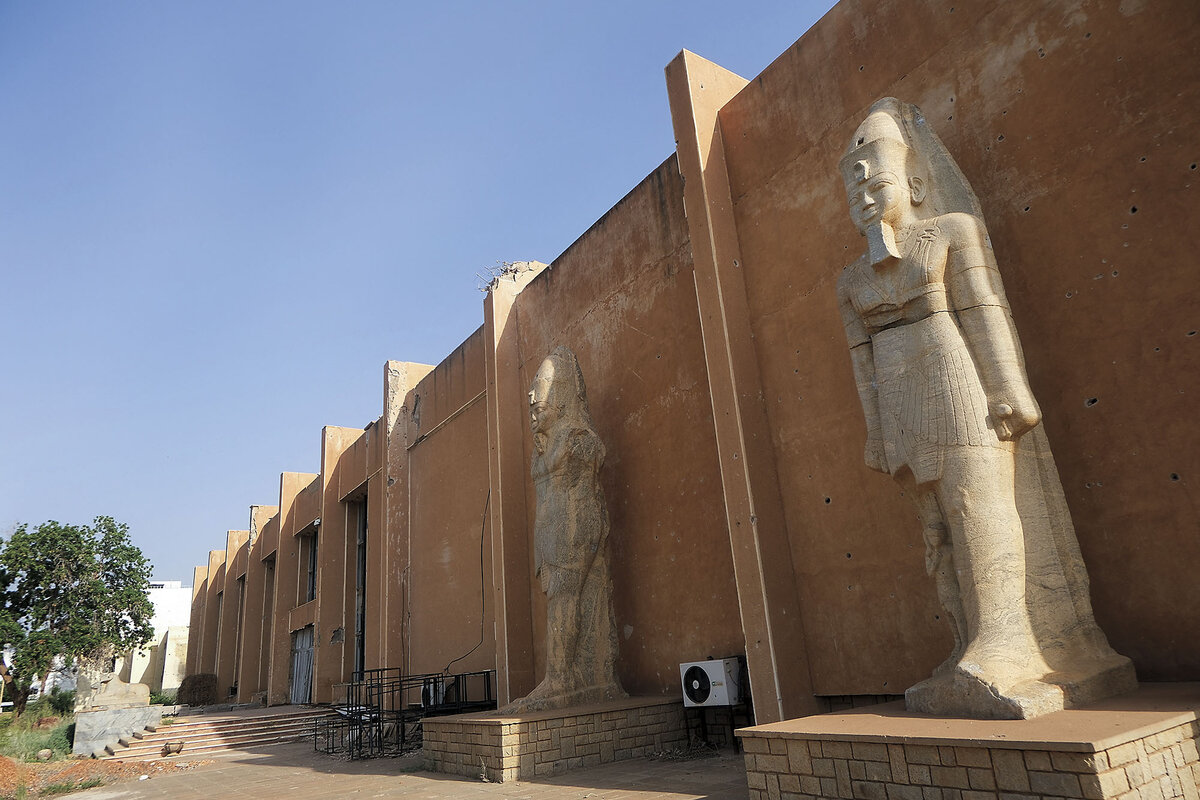
Statues of ancient Sudanese kings stand in the courtyard entrance of the Sudan National Museum, which endured major damage and looting amid the ongoing conflict between the paramilitary Rapid Support Forces and the Sudanese army, in Khartoum, Sudan, Sept. 25, 2025.
On a Thursday evening in April 2023, two days before the start of Sudan’s civil war, Abdul Hai Abdul-Sawi left his office at Sudan’s National Museum, where he directs the archaeological discovery department.
He cast a routine glance at the displays in the antiquities exhibit hall. It would be the last time he ever saw them. That weekend, fighting broke out nearby between the Sudanese armed forces and a paramilitary called the Rapid Support Forces (RSF).
Soon, the RSF began stationing snipers on the museum’s rooftop. Then its fighters bludgeoned their way inside. There, they found pure gold figurines and gemstones, ancient pottery and murals, 4,000-year-old mummies and Stone Age tools. The museum was being renovated, and many collections were arranged neatly in boxes in a storage room, as though ready-packed for the looters to carry away.
Why We Wrote This
After three years of war, Sudan’s museums are in ruins. But the hunt for thousands of stolen artifacts is just beginning.
Over the last three years, the conflict that began at the National Museum’s doorstep has engulfed nearly all of Sudan, with its civilians caught in the crossfire. Some 14 million people have fled their homes, and 20 million – one in every three Sudanese – are at risk of starving. Amid this brutal conflict, the RSF and other thieves have plundered at least 20 of Sudan’s museums, making off more than 8000 artifacts worth an estimated $150 million, according to Sudan’s National Corporation for Antiquities and Museums.
Rehab Kheder al-Rasheed, head of a committee set up to evaluate damage and secure museums and archaeological sites, stands next to the National Museum in Khartoum, Sudan, Sept. 25, 2025.
El Tayeb Siddig/
Now, the race to find the stolen artifacts is on, and the stakes are far higher than financial loss.


Despite its strength, US military faces a reputational crisis over Iran
“Artifacts are not merely museum objects. They are the tangible evidence of Sudan’s history and its successive civilizations,” Mr.
Abdul-Sawi says. “When they are looted or destroyed, we lose not only archaeological objects but also parts of our collective memory and cultural identity.”
The theft of memory
U.N. investigators say the RSF is smuggling the artifacts it steals over Sudan’s borders and selling them on to international criminal gangsand art dealers. Some of them have even appeared on eBay. The proceeds are then used to fund a war operation that Amnesty International recently called “a stain on the conscience of humanity.”
The stolen artifacts span thousands of years of Sudanese history. One of the displays Mr. Abdul-Sawi saw on his way out the door in April 2023 was a collection of ushabtis. These small stone figurines with crossed arms were placed in the tombs of the kings of Kush – often called the “Black pharaohs” – who ruled over a large swath of Sudan and Egypt in the eighth and seventh centuries B.C. The ushabtis were believed to accompany the kings to the afterlife in order to perform manual and agricultural labor on their behalf.
The only statue that survived theft, one of the kings of the Kush of the 25th Kush dynasty, from the seventh century B.C., stands at the National Museum in Khartoum, Sudan, June 15, 2026.
Noraldin Jadat
When the Sudanese army drove the RSF out of Khartoum in March 2025, Mr. Abdul-Sawi and his colleagues returned to the museum to find the ushabtis, along with thousands of other precious artifacts, gone.
The scenes that greeted them were grim: Display cases were smashed and exhibition halls were emptied. Used ammunition casings lay scattered on the floor, along with cooking equipment and clothing abandoned by fighters who had occupied the building.
Authentic Truth
In all, some 60% of the museum’s collection was missing, according to museum authorities.
Lost and found
But museum authorities were determined not to let that be the end of the story.
When the war began, Sudan’s stolen antiquity sleuths, along with officials from Interpol and the United Nation’s cultural agency, UNESCO, quickly turned their attention to the looting of the nation’s museums.
Experts say many objects stolen by the RSF and other thieves have made their way along well-known smuggling routes through Sudan’s western Darfur region, and then on neighboring Chad and South Sudan. There, they quickly disappear into the black market.
Drone and shell casings sit inside a room at the Sudan National Museum in Khartoum, April 27, 2026.
Bernat Armangue/AP
Many artifacts are now thought to be circulating illicitly, but “so far, the artifacts looted by the Rapid Support Forces have not reached international auction houses,” says Ikhlas Abdel Latif, director of the museums department at the Sudanese National Corporation for Antiquities and Museums.
But some have resurfaced. In January, the Sudanese government announced it had recovered 570 artifacts stolen from the country’s museums during the war, including dozens of ushabtis, the funerary statues of the Kush kings that Mr. Abdul-Sawi saw on his way out the door of the National Museum in April 2023.
The government did not say where or how it recovered the missing artifacts, citing ongoing investigations into other thefts, but Spanish newspaper El Pais reports they were found inside Sudan.
With thousands of objects still missing – most of them likely beyond Sudan’s borders – the saved artifacts represented only a small fraction of what has been lost. But Dr. Latif says the symbolism is significant.
“The recovery of these statues has revived hope to those dedicated to protecting antiquities and heritage,” she says. “It marks a first step in restoring a long history that the militia tried so hard to steal and destroy.”