

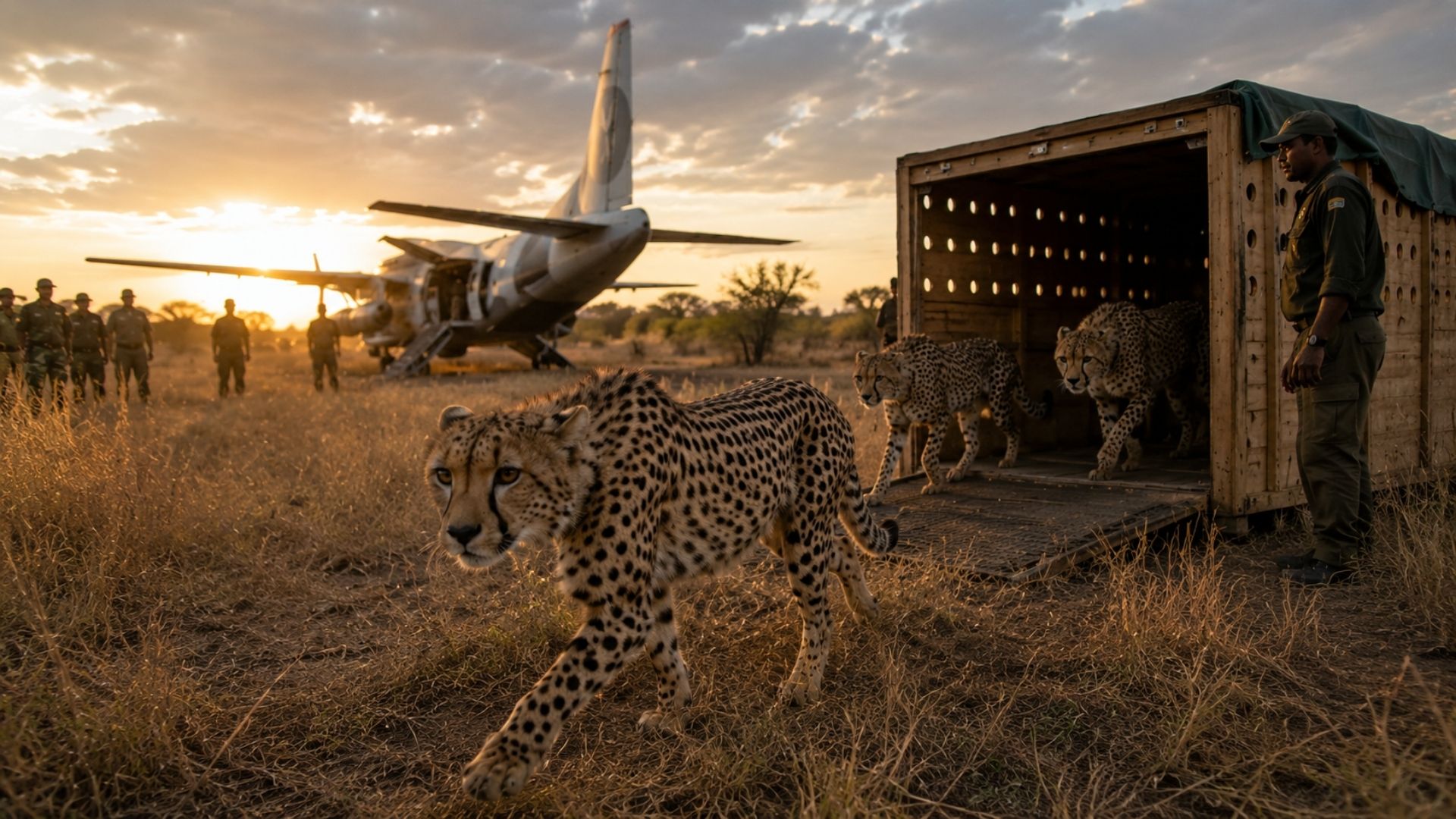
Declared extinct in India in 1952, the cheetah returned in 2022 inside transport boxes from Africa. Almost four years later, the felines are already reproducing on Indian soil, the official count has surpassed half a hundred animals and the project gathers praise from the government and criticism from specialists.
India’s Environment Minister, Bhupender Yadav, announced on February 18, 2026, the birth of a litter of cheetahs in Kuno National Park, Madhya Pradesh, raising the number of felines of the species in the country to 38 at that time. The mother is Gamini, a female brought from <a href="https://absafricatv9491.live-website.com/tyla-announces-apop-world-tour-with-2-south-africa-dates-in-january-2027/” title=”Tyla announces A*Pop World Tour with 2 South Africa dates in January 2027″>South Africa, who became a mother for the second time since arriving in India. The information was released by the minister in a statement and on social media, and was replicated by the AFP agency and the Indian press.
The announcement marked the ninth successful litter on Indian territory and raised to 27 the total number of cubs born in the country that survived, according to official figures on that date. The context behind the celebration is of an animal that had disappeared: the Asiatic cheetah was declared extinct in India in 1952, and the return of the species only happened in September 2022, with the arrival of African specimens transported by air.
The announcement that raised the count of felines in Kuno
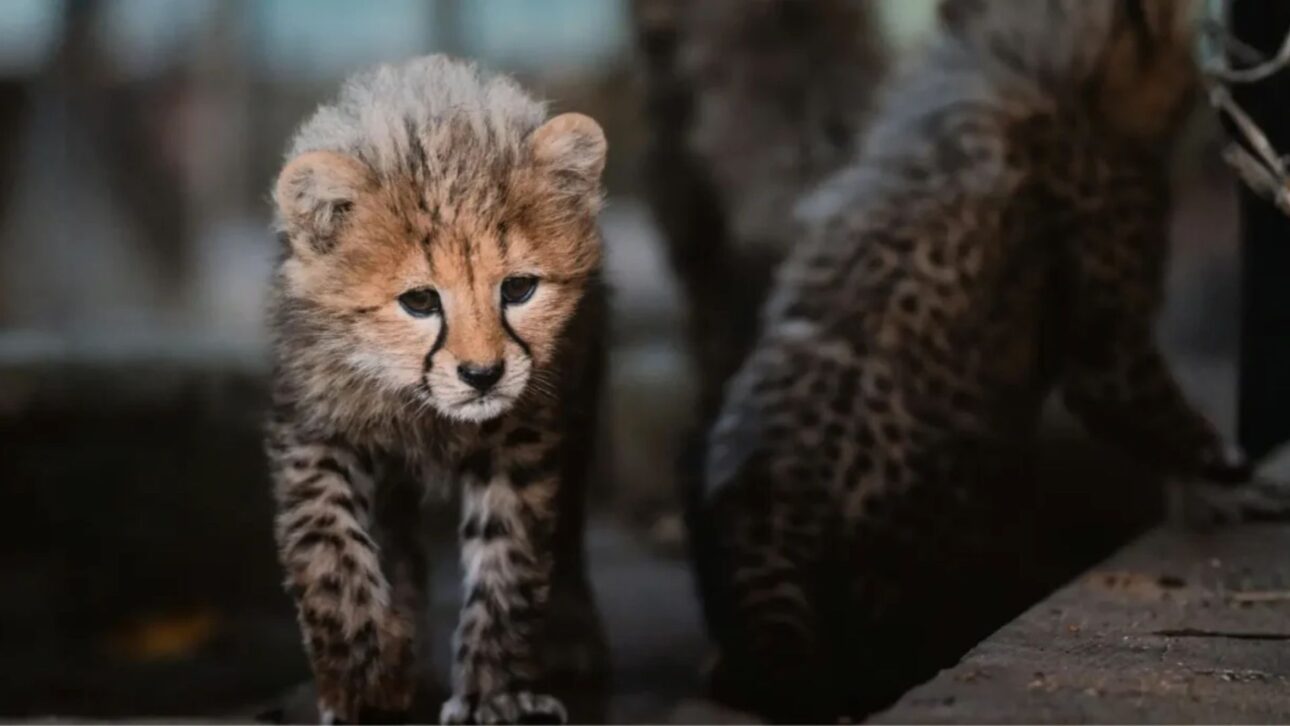
Yadav described the birth as a new chapter of the project and shared a photo of the female with the cubs. He made a point of linking the date to another milestone: the litter arrived at the moment when three years had passed since the arrival of the felines from South Africa, which occurred in February 2023. The official celebration was wrapped in numbers, and it is precisely the numbers that tell the complicated part of the story.
ARTICLE CONTINUES BELOWSee also
The official tone contrasts with the program’s reputation. AFP itself described the initiative as ambitious and notorious, an adjective that aptly summarizes an operation that has become both a government showcase and a target of technical contestation. The 38 animals announced in February represented an increase compared to the 28 cheetahs imported since 2022, despite the mortality recorded throughout the project. A precise note: subsequent Indian publications indicated that Gamini’s litter was counted with four cubs, not three, the same type of correction that had already occurred in 2024, when a litter announced with five cubs was later confirmed with six after the veterinary team located the last cub.
Seventy years of absence and an extinction declared in 1952
The Asiatic cheetah was found from the Middle East to Central Asia and India. The last recorded specimen in the country died in 1947, in the Korea district, an area that today belongs to the state of Chhattisgarh, and extinction was officially declared five years later. The subspecies survives today in very reduced numbers only in Iran and is classified as critically endangered.
It was this absence that the Indian government decided to tackle with African felines, a choice that generates debate among biologists for involving another subspecies. The idea is not new: the project was conceived in 2009, faced a denial from the Indian Supreme Court in 2013, and was only approved in January 2020, when the court authorized the introduction on an experimental basis to verify if the animal would adapt to local conditions.
The flight that brought the first African felines
On September 17, 2022, Prime Minister Narendra Modi personally released eight cheetahs from Namibia, five females and three males, into enclosed enclosures within Kuno. On February 18, 2023, another 12 felines arrived from South Africa. Together, they formed the 20 animals of the first phase and turned the operation into the first intercontinental relocation of a large carnivore ever conducted.
A detail often gets lost in the headlines. The animals were not released directly into the wild: they went through quarantine and acclimatization enclosures, the so-called soft bomas, fenced areas ranging from 50 to 150 hectares used for conditioning and reproductive management. The release into the free area happens in stages, animal by animal, and not all at once.
Kuno, 748 square kilometers chosen carefully
The chosen park is located in the Sheopur district, about 300 kilometers south of New Delhi, and has a central protected area of 748 square kilometers. The selection took into account the abundance of prey and the presence of grasslands, two factors that define the survival of felines that hunt in open runs.
Kuno was established as a sanctuary in 1981, with 350 square kilometers, and was elevated to the category of national park in 2018, when the goal was still to receive Asiatic lions. The territory that was meant for lions ended up becoming the address for cheetahs. Today the park is part of a much larger wildlife division, with just over 1,200 square kilometers.
The toll of deaths that the project carries
Not everything in the project is a celebration. Several of the animals died after being released, which led to harsh criticism of the initiative defended by Modi. Wildlife reintroduction experts remind that operations of this type usually record mortality rates above 50 percent, especially in the initial phases, when the animals are still adjusting territory, diet, and behavior.
There is no consensus on what to do with this data. For the Indian government, the mortality was within the expected range for a pioneering project, and each litter born in the country serves as a response to the criticism. For some researchers, the number of losses indicates that the chosen habitat may not support the intended density of felines.
The technical criticisms go beyond the deaths. Researchers have warned from the beginning about the competition for prey with the leopards that occupy the same area, and an inspection report from the Madhya Pradesh forest department, revealed by the newspaper The Print in May 2026, pointed out that the felines of Kuno were tranquilized 110 times until September 2024, in the first two years of the project. Studies cited in the report associate the repeated use of sedatives with negative effects on these animals.
The second generation and what it means
Here is the milestone that many people confuse. Gamini’s cubs, announced in February 2026, are the first generation born on Indian soil, as the mother came from South Africa. The second generation arrived earlier, in December 2025, when Mukhi, the first offspring born in India within the project, had five cubs, a fact announced by the Indian government’s official news agency as the arrival of a second generation in the wild environment.
The difference is not a language detail. While the felines born from imported females prove that the animal can reproduce in the location, the grandchildren of the African animals are the indicator that interests biologists: they show that the species can sustain itself without relying on new shipments from Africa. A population is only consideredternal reinforcement
Botswana joined the count and the population exceeded 50
The list of origins grew. In addition to the eight from Namibia in 2022 and the 12 from South Africa in 2023, eight cheetahs arrived from Botswana in December 2025, and another nine came from the same country on February 28, 2026, being six females and three males, received in quarantine enclosures. With this shipment, the government began to speak of 48 animals in the country.
The growth continued in the following weeks. On March 9, 2026, the Namibian female Jwala had five cubs, the tenth litter on Indian soil, and the official count reached 53. On May 10, 2026, the Chief Minister of Madhya Pradesh, Mohan Yadav, released two of the Botswana felines into the park’s free area, and the national total rose to 57, with 54 in Kuno and three in the Gandhi Sagar sanctuary. Of this contingent in Kuno, 17 roamed free and 37 remained in management enclosures.
Where the felines will live after Kuno
One park alone does not sustain the project. The Gandhi Sagar sanctuary, also in Madhya Pradesh, at the border of the Mandsaur and Neemuch districts, became the second address for the species and already houses three animals. The Nauradehi sanctuary appears in official plans as the third territory to receive the felines.
The declared goal is to form a self-sustaining metapopulation of 60 to 70 cheetahs in the landscape connecting Kuno to Gandhi Sagar by 2032. Along with the animals, the project created a social structure around it: more than 450 residents were trained as Cheetah Mitras, the friends of the cheetah, 380 direct jobs were generated, and 5 percent of ecotourism revenue began to be shared with the villages surrounding Kuno. The tourism money was included as part of the conservation strategy.
The animal that purrs instead of roars
It’s worth understanding what kind of animal this is. The cheetah is the fastest land mammal on the planet and, contrary to what its size suggests, does not roar like a lion: it emits a purr similar to that of a domestic cat, only much more powerful. It needs little water and survives in dry forests, grasslands, open plains, and desert regions.
Biology helps to understand the pace of the project. Gestation lasts about 90 to 95 days, litters usually vary from three to five cubs, the young are born blind and spend the first weeks hidden, and the mother stays with them for something between 16 and 18 months. That’s why the count of felines in Kuno jumps with entire litters at once and then remains stagnant for months.
The global situation of the species explains why each litter becomes news. Data from the Indian Ministry of Environment indicate a drop from an estimated 15,000 adults in 1975 to less than 7,000 in 2023. Each cub that survives in Kuno enters a global count that has been shrinking for decades. It’s this backdrop that turns a birth into a ministerial announcement.
Do you think the cheetah should have returned
The Indian project has two honest and opposing interpretations. On one hand, a species extinct for 70 years has started reproducing in the country again, the population has grown from 20 imported animals to over half a hundred, and the second generation has already been born. On the other hand, there are deaths, repeated sedation, competition with leopards, and the underlying question about bringing an African subspecies to occupy the place of another that disappeared.
Now it’s up to you. Does it make sense to spend public money to bring felines from another continent and recreate a species that disappeared from the country seven decades ago, or would it be better to invest this effort in protecting the animals that still survive there? And if such a project were proposed in Brazil, to bring back some regionally extinct species, would you support it? Comment below.
Tags
animaisfelinosPaisProjeto
