

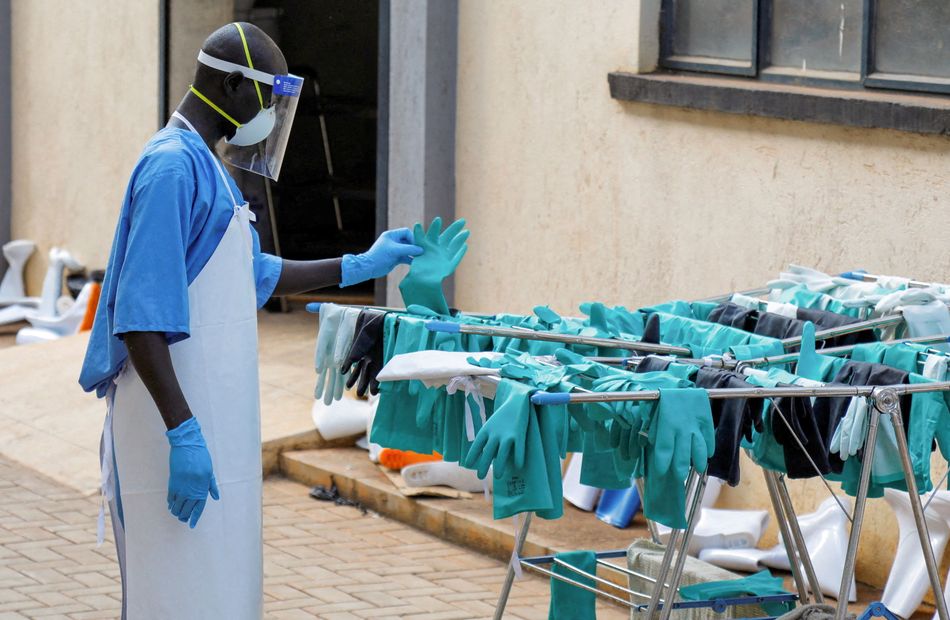
Uganda has officially declared the end of the 2026 Ebola disease outbreak after completing the mandatory 42-day monitoring period without recording a new case, marking another major public health victory for the country even as neighbouring Democratic Republic of Congo (DRC) continues to battle the deadly virus.
The announcement, made by the Ministry of Health on Tuesday, means Uganda is once again Ebola-free after months of intensive surveillance, contact tracing and cross-border cooperation that contained an outbreak linked to imported infections from eastern DR Congo.
According to Uganda’s minister of Health Dr Chris Baryomunsi, the declaration follows the discharge of the last Ebola patient on June 16 and the successful completion of 42 days of surveillance, during which no additional infections were detected.“This means Uganda is Ebola free,” Dr Baryomunsi said in a statement, noting that nationwide surveillance remained active throughout the monitoring period and found no evidence of community transmission.
Uganda’s declaration is expected to boost confidence among investors, tourists and international travellers after months of heightened public health precautions in which countries such as the United States, Canada and other declared Uganda unsafe for their citizens. This crippled business, tourism and travel to and from those countries into Uganda and neighbouring DR Congo as well as South Sudan.
In assuring the visitors and development partners that Uganda remains safe for tourism, <a href="https://absafricatv9491.live-website.com/egypt-tops-africa-in-foreign-direct-investment-inflows/” title=”Egypt tops Africa in foreign direct investment inflows”>investment and business, the Ministry of Health emphasised that surveillance systems remain operational across the country, particularly in border districts where the risk of imported infections remains highest.
The disease remains present in neighbouring DRC, with 3,262 confirmed cases and 1,437 deaths, making it one of the country’s worst Ebola outbreaks on record, and the fastest-growing in its history. The disease, mainly in Ituri Province, has spread to other provinces such as North Kivu, South Kivu, Haut-Uele, and Tshopo.
Ugandan communities living near the border with DR Congo have been urged to remain vigilant and report illegal crossings or anyone displaying symptoms consistent with Ebola.
The outbreak, declared on May 15, 2026, was unusual because investigators were able to conclusively trace its the origin remained uncertain, epidemiologists established the entire chain of transmission, identified all contacts and successfully interrupted further spread
According to the minister, Uganda registered 20 confirmed Ebola cases during the outbreak. Eighteen patients recovered, while two died. Of the confirmed infections, 15 were imported from DRC while five occurred among Ugandan health workers caring for infected patients.
Health officials say all identified contacts completed the mandatory 21-day follow-up period under institutional quarantine without developing further infections, while enhanced surveillance detected no unexplained community transmission.
The minister said during the latest outbreak, the government deployed rapid molecular diagnostic tools, whole genome sequencing, digital surveillance systems and real-time contact tracing technologies that accelerated case detection and outbreak investigations.
Health experts say genomic studies confirmed that the virus involved in the outbreak belonged to a distinct Bundibugyo Ebola while additional evolutionary research continues to improve scientific understanding of how the outbreak emerged.
The ministry said these scientific advances have changed how Ebola outbreaks are investigated compared to previous decades.
Although the Uganda outbreak has ended, officials warn that Ebola remains an active regional threat because transmission continues in neighbouring eastern DR Congo.
The porous border between Uganda and DRC, crossed daily by thousands of traders, refugees, transporters and families, makes continued vigilance essential, which has compelled Uganda to maintain heightened surveillance at border entry points, and strengthened rapid response teams. In addition, all health facilities across the country have been instructed to remain prepared to investigate any suspected cases.
Uganda says it will continue working closely with neighbouring states to prevent cross-border spread.
Uganda and DR Congo signed a memorandum of understanding on joint Ebola response, enabling coordinated surveillance and emergency interventions on both sides of the border.
Under the agreement, Uganda established two mobile laboratories as well as two 80-bed Ebola treatment units in Aru and Kasenyi inside DR Congo to support efforts to contain the outbreak closer to its source.
Officials say stopping Ebola where it originates offers the best protection not only for Uganda and DR Congo, but also for the wider East African region.
Thousands of trucks cross borders daily linking Uganda with Kenya, Tanzania, Rwanda, South Sudan and DRC. Any uncontrolled outbreak has the potential to disrupt regional commerce, increase transport costs and trigger health screening measures at border posts.
Earlier this year, Uganda introduced enhanced screening at border crossings with DR Congo, while neighbouring countries intensified surveillance of travellers arriving from affected areas.
The outbreak also tested regional emergency coordination mechanisms involving the East African Community, Africa Centres for Disease Control and Prevention (Africa CDC) and the World Health Organisation (WHO).
Both the WHO and Africa CDC have consistently encouraged stronger cross-border surveillance, rapid information sharing and joint outbreak investigations as infectious diseases increasingly ignore national boundaries.
Dr Baryomunsi attributed the country’s success to years of investment in resilient public health systems and the dedication of frontline workers, saying Uganda’s ability to rapidly detect infections, trace contacts, provide treatment and strengthen laboratory services enabled health workers to bring the outbreak under control before widespread community transmission occurred.

