

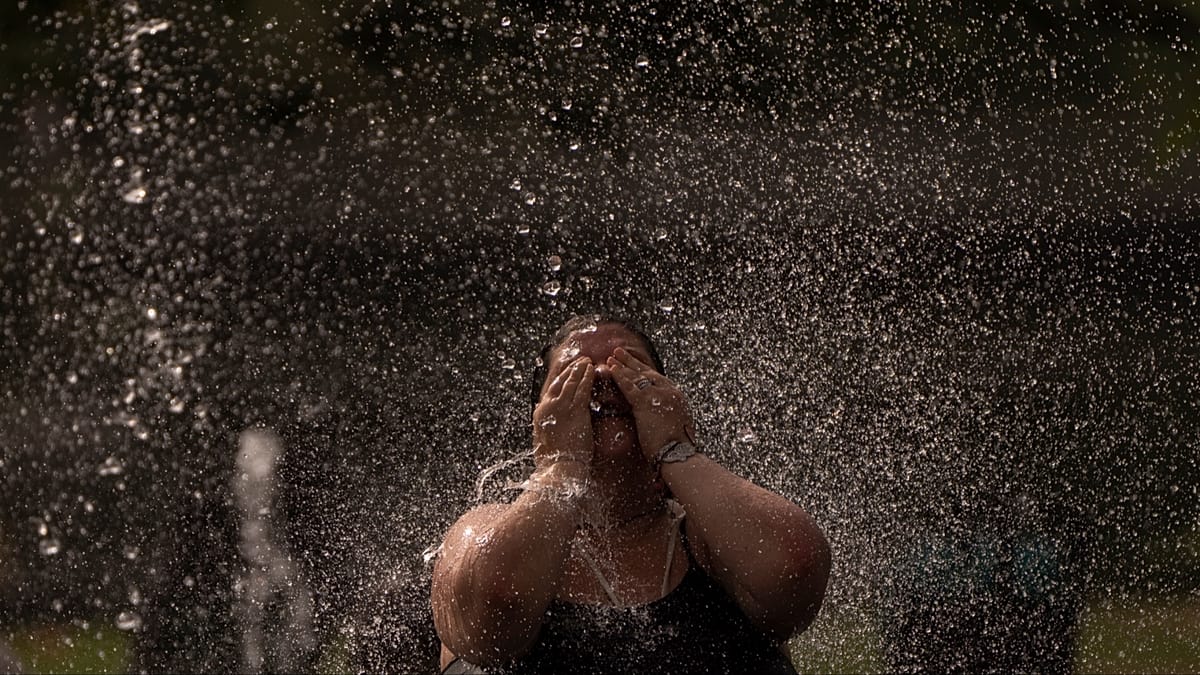
“The exceptionally warm Mediterranean Sea is leaving a fingerprint on land, and in several places it shows up in the nights rather than the afternoons.”
Europe is bracing for a “warmer-than-normal” August following a series of back-to-back heatwaves.
Much of the continent has been struggling to cope as temperatures climbed over 40°C in recent weeks, creating ideal conditions for wildfires that have ravaged huge parts of France and Spain and caused hundreds of thousands of citizens to be evacuated.
But chances of much-needed relief from blistering temperatures are looking unlikely, as early predictions warn that more heatwaves are possible.
Will Europe still be hot in August?
“As of their early-July issues, the seasonal updates all tilt the odds toward a warmer-than-normal August across Europe, and agree that the strongest, most confident heat signal sits over the Mediterranean and south-eastern Europe,” Ioanna Vergini, founder of weather forecast platform WFY24, tells Euronews Earth.
This includes recurring ‘heat clusters’ such as Iberia, Italy, Greece and parts of the Balkans.
“The exceptionally warm Mediterranean [Sea] is leaving a fingerprint on land, and in several places it shows up in the nights rather than the afternoons,” Vergini adds.
WFY24’s forecasts for the first days of August predict that Naples, Barcelona, Rome, Valencia, Nice, Thessaloniki, Split and Athens will hold above 20°C every single night. This is classed as a tropical night, which can increase the risk of severe heat stress – particularly amongst vulnerable populations.
Even further north, scorching temperatures are on the horizon. The UK Met Office warns that 35°C highs are expected in August as the mercury intensifies.
“Temperatures will probably be above normal and some spells of hot weather and heatwaves are possible, especially in the south,” its long-range weather forecast adds.
How do scientists know if climate change is behind extreme weather?
Advances in weather and climate data have made it easier for scientists to assess the influence of global warming on extreme events such as heatwaves and flooding. This is often referred to as extreme event attribution.
Because there are many interacting factors, including natural drivers like El Niño, extreme event attribution studies aren’t looking to find whether climate change directly caused a heatwave, but how warming temperatures have influenced the event.
This is often done by comparing how often an extreme event occurs today in comparison to how often it would have occurred in a world without human-caused climate change.
Researchers will also explore how climate change altered the characteristics of an extreme weather event – such as whether a heatwave became hotter because of heat-trapping gases.
For example, a rapid attribution analysis from World Weather Attribution (WWA) used both observed and forecast temperature data to analyse the hottest three-day period across a large area of Europe that was smothered by scorching temperatures in late-June.
Scientists concluded that both the daytime highs and overnight temperatures would have been “virtually impossible to occur at this time of year” as recently as 1976, just 50 years ago. The analysis also found that a similar heatwave occurring 50-years ago would be 3.5°C cooler than the one last month.
Scientists have what is called “high confidence” when it comes to extreme heat, due to the extent of data and understanding we now have on climate change.
“Continued fossil-fuel emissions are directly responsible for the disruption people are experiencing in their homes, schools and workplaces,” says Dr Keeping.
“The speed of change is startling. Every few years we are seeing heat records shattered in Europe. This year it has been in consecutive months.”
For weather hazards such as tornadoes and large hail, data is less complete. This makes it more difficult to confidently attribute their occurrence.
Attribution studies are also used to show the consequences of climate-fuelled extreme weather.
An analysis from Imperial College London, the UK Met Office and the London School of Hygiene and Tropical Medicine recently used weather data, climate models and studies on excess mortality during heatwaves to measure the impact of two recent heatwaves.
Researchers estimate that maximum daytime temperatures were 3°C to 4°C higher than they would have been without global warming – resulting in 10,000 excess deaths.
“Extreme heat is shattering records across Europe and the science is very clear about why: climate change is running rampant, caused by the world’s addiction to burning coal, oil and gas,” says Simon Stiell, UN Climate Change Executive Secretary.
What other factors influence extreme weather?
Many reports on extreme weather, particularly heatwaves, focus on the atmospheric pattern behind the event – rather than the cause.
For example, back in May France’s Météo-France weather agency blamed 40°C temperatures on a “heat dome”.
This is when a high-pressure system develops in the upper atmosphere, causing the air below it to sink and compress, raising temperatures in the lower atmosphere. Because hot air expands, this creates a bulging dome that traps heat within it.
Winds are normally able to move high pressure around, but due to how far heat domes stretch into the atmosphere, the weather system becomes almost stationary.
However, a 2025 study published in Proceedings of the National Academy of Sciences found that atmospheric patterns that lock in extreme weather, such as heat domes and flooding, have nearly tripled since the 1950s due to human-driven climate change.
An analysis by Climate Central in 2023 also found that a heat dome that caused temperatures to hit 48°C in parts of Mexico and the southern US was made at least five times more likely due to climate change.
What impact does El Niño have on heat?
El Niño (Spanish for ‘the boy’) is a naturally occurring phenomenon that can drive extreme weather. Earlier this year, the US National Oceanic and Atmospheric Administration (NOAA) declared that El Niño conditions are officially underway in the tropical Pacific.
El Niño happens when sea temperatures in the Eastern Pacific Ocean become unusually warm, and usually disrupts regions in the tropics. It is often linked to extreme weather events, even though experts warn it is being used as a “distraction” from global warming.
When El Niño conditions form, flooding is a common risk in South America, such as in northern Peru, and can reach parts of East Africa, Central Asia and the southern US. Droughts and wildfire risks also rise during El Niño, particularly across much of Australia, northern parts of South America and in Asian countries like Indonesia.
Most El Niño events have temporarily increased global average temperatures by around 0.2℃. This is not as significant as human-made climate change, which has pushed the global surface temperature up by approximately 1.3-1.5℃ compared to pre-industrial levels.
2025 was the third warmest year on record – hotter than the El Niño year of 2016 – despite the naturally forming cool drag of a La Niña (Spanish for ‘the girl’) event.
La Niña typically cools global temperatures by strengthening trade winds and pulling colder water from the ocean depths to the surface across the equatorial Pacific. It occurs irregularly too, but tends to last longer than El Niño.
Are falling pollution levels behind Europe’s sweltering summer?
Following Europe’s blistering start to summer, several prominent news organisations declared that the back-to-back heatwaves have been caused by a drop in pollution levels.
The claim was shared online by Richard Tice, deputy leader of the right-winged populist party Reform UK, and has been used to criticise the country’s net zero efforts.
It stems from a study published in the science journal Geophysical Research Letters, which does not include data on the very recent heatwaves.
Drops in pollution can reduce the cooling impact of aerosols, which absorb or reflect sunlight. However, Professor Erich Fischer, a climate scientist at ETH Zurich, tells Carbon Brief that framing this as the cause of Europe’s heatwaves is “wrong”.
“Heatwaves are caused by high-pressure systems and are now much more frequent and intense because they are happening in a climate that is much warmer than 100 years ago as a result of greenhouse-gas-induced warming,” he adds.
“The paper shows that the greenhouse-gas-induced summer warming had been temporarily masked by air-polluting aerosols. The full extent for European summers only becomes visible now as the air-polluting aerosols have declined.”
