15 MIN(s) agoMACRO MIRROR
Fahmida Khatun
Fahmida Khatun
VISUAL: ANWAR SOHEL
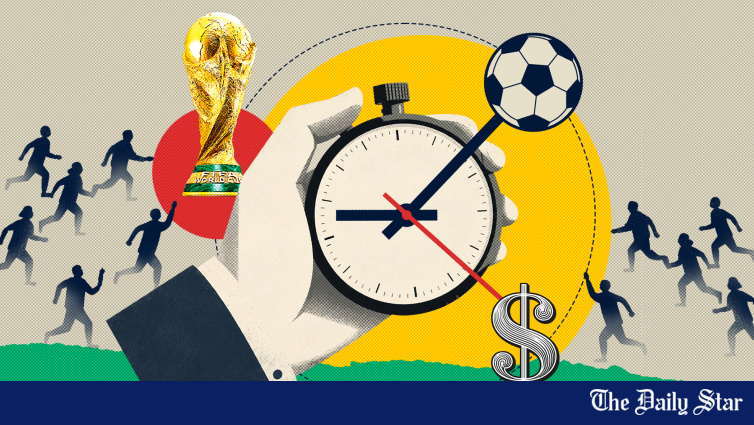
The recently concluded FIFA World Cup held a global audience for over a month, captivating millions. Despite ongoing geopolitical tensions, trade conflicts, and economic uncertainties, the tournament demonstrated football’s power to bring people together across borders, cultures, and languages. The World Cup has grown beyond being just the largest global sporting event, with economic factors playing a significant role behind the excitement. It has evolved into a major global enterprise, demonstrating how modern capitalism creates wealth through brands, media, technology, tourism, intellectual property, and human attention. The tournament offers insight into 21st century capitalism.
Sports economist Stefan Szymanski, in his 2009 book Playbooks and Checkbooks: An Introduction to the Economics of Modern Sports, argues that modern sports has evolved into a global industry in which on-field competition is inseparable from markets, media, finance, and public policy. The FIFA World Cup is perhaps the most compelling illustration of this transformation. FIFA’s revenues rose from $6.42 billion during the 2015-2018 cycle to $7.57 billion during the 2019-2022 cycle. The projected revenue for 2023-2026 was $11 billion, with the possibility of the earnings reaching $15 billion after the 2026 World Cup. Although financial statements are pending, it is clear that the tournament’s commercial scale has entered a new level.
The World Cup’s business model relies on several revenue streams—mainly broadcasting rights, sponsorship, ticket sales, hospitality, licensing, and merchandising. Unlike traditional industries, FIFA, the global authority of football, does not produce physical goods but monetises the valuable intangible asset: the quadrennial tournament.
This reflects a transformation in the global economy. In the 20th century, wealth largely stemmed from factories, machinery, and natural resources. Today, many leading organisations derive their value from intellectual property, brands, digital platforms, and networks. Global giants such as Apple, Disney, Netflix and Alphabet (Google) have fewer traditional industrial assets related to their market valuation. Their competitive edge lies in ideas, technology, reputation, and customer engagement. FIFA exemplifies this trend. Its primary assets are the World Cup brand, exclusive media rights, and the deep emotional loyalty of millions of supporters.
The World Cup also illustrates the attention economy. Human attention is a scarce and valuable reia competing for audience. During the World Cup, millions of people voluntarily watch the matches, creating significant value for broadcasters, advertisers, and sponsors
The experience economy is closely linked. Supporters now buy experiences, such as the thrill of being in a packed stadium, travelling with fellow supporters, wearing national colours, and joining a global celebration. These emotional experiences often outweigh their costs, allowing organisers to charge premium prices for tickets, hospitality, and services.
Technology has amplified economic forces. Digital broadcasting, streaming, mobile apps, and social media have turned the World Cup into a connected global event. More commercial opportunities have been created as fans engage online before and after matches through discussions, videos, fantasy football tournaments, personalised content, and even betting.
This remarkable commercial success raises an important question: as revenues rise and the premium experience becomes more expensive, does the World Cup still belong to the people? Or is football slowly becoming a luxury accessible mainly to the wealthiest?
Football has always been called “the people’s sport” because it’s accessible to all, regardless of income or social status. Ironically, the very commercial success that has turned football into a worldwide entertainment industry is now also making its biggest tournament less accessible to many everyday fans. Although FIFA provides tickets at various price ranges, the tickets are just one part of the overall expense. International attendees also need to cover airfare, accommodation, local transportation and other costs, which tend to increase significantly during the tournament. For many supporters from developing nations, the financial burden of attending the World Cup has become prohibitively high.
Corporate hospitality has strengthened this trend by providing premium packages with luxury seating and exclusive services, targeting businesses and high-income consumers. From a commercial standpoint, this approach is logically sound. Economists describe this as price discrimination, which implies that different prices are charged to different consumers according to their willingness to pay. It maximises revenue but also raises concerns about inclusion.
At the same time, technology presents a clear paradox. Although attending the World Cup has grown more costly, watching it has become more accessible than ever. Television, streaming services, and social media allow fans to follow every match from nearly anywhere in the world. As a result, football has become more inclusive in viewership but remains unequal in physical participation.
This is why markets need to find a balance between efficiency and inclusion. The most valuable aspect of football is not its broadcasting rights or sponsorships but the emotional connection it maintains with everyday people. Maintaining this bond is crucial in the World Cup.
Bangladesh can learn important lessons from the evolution of this global phenomenon. Staying competitive in the future will require shifting away from a development model that mainly relies on cheap labour. Success will rely more on innovation, digital skills, the creative economy, tourism, sports management, media, and building internationally recognised brands. Essentially, the country needs to look beyond its dependency on its RMG industry and enhance its manufacturing base with a more knowledge- and services-oriented economy.
The tournament also illustrates how technology is reshaping industries worldwide. Artificial intelligence, big data, digital broadcasting and online platforms have transformed not only the way football is played and managed, but also how fans engage with the game. Similar shifts are occurring across manufacturing, finance, healthcare, education and public administration. Countries that invest in research, digital infrastructure, innovation and human capital will be better placed to improve productivity and compete in an increasingly knowledge-based global economy.
An important lesson is recognising the significance of investing in people. Behind every successful national team are years of effort in grassroots programmes, coaching, sports science, and talent spotting. Similarly, economic growth relies on building a skilled workforce, enhancing institutions, encouraging innovation, and providing opportunities for the youth to reach their potential. While physical infrastructure is vital, it must be complemented by investments in education, skills, and technology.
The World Cup also reminds us that economic success is not only about financial gains. Football became a global sport because it crossed borders, income levels, and cultures, uniting people through a common passion. Similarly, development is not just about increasing growth rates. It is about making sure growth creates more opportunities, reduces inequality, and enhances people’s quality of life.
Ultimately, the economics of the World Cup go beyond football. It shows that future economies will compete through creativity, technology, talent and trust, not just factories and infrastructure. For Bangladesh, the key is to adopt this shift so that future growth is not only faster but also more productive, innovative, inclusive and resilient.
Dr Fahmida Khatunis an economist and executive director at the Centre for Policy Dialogue (CPD).
Views expressed in this article are the author’s own.
Views expressed in this article are the author’s own.
FollowThe Daily Star Opinion on Facebookfor the latest opinions, commentaries, and analyses by experts and professionals. To contribute your article or letter to The Daily Star Opinion, see ourguidelines for submission.


![Xbox Mobile Store Stalls as 30% App Fees Persist [2026]](https://tech-insider.org/wp-content/uploads/2026/07/xbox-mobile-store-2026.webp "Xbox Mobile Store Stalls as 30% App Fees Persist [2026]")