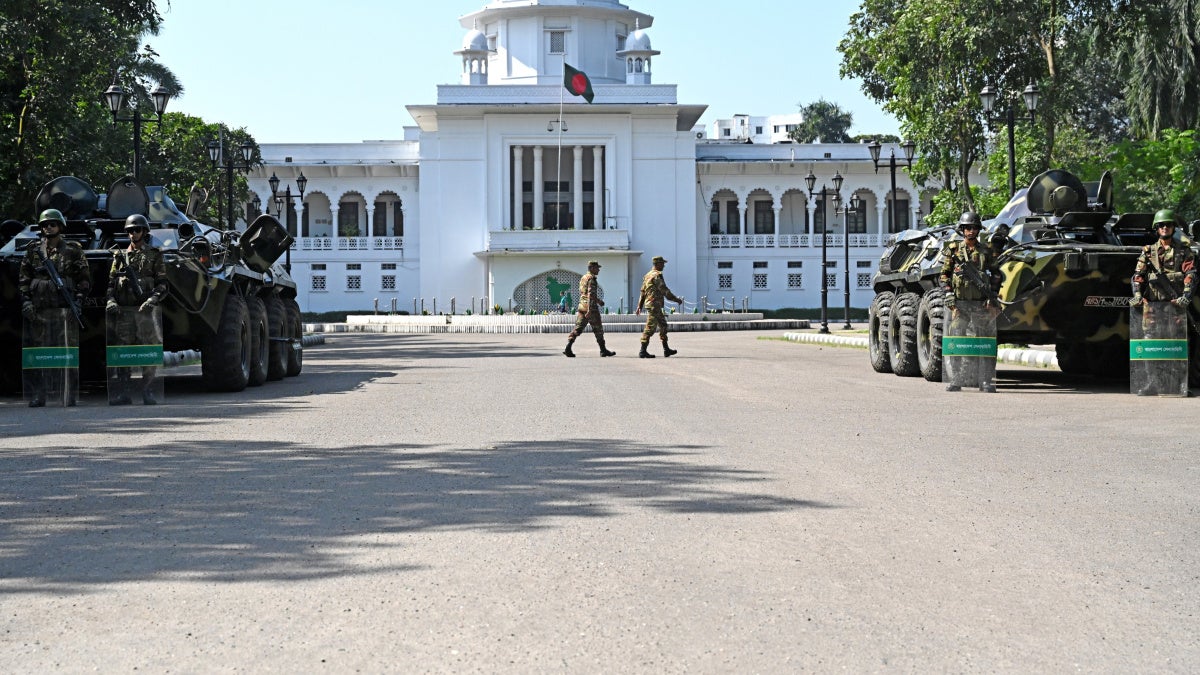
(London) – Bangladesh authorities are failing to uphold international legal standards at the country’s International Crimes Tribunal, Human Rights Watch said today. The failures risk denying justice to victims, undermining the rule of law, falsely imprisoning political opponents, and repeating the rights violations of the past.
On July 27, prosecutors submitted charges against 41 people for crimes against humanity and genocide. The tribunal is prosecuting individuals, including politicians, members of security forces, and even journalists, accused of serious human rights violations under former Prime Minister Sheikh Hasina’s Awami League government, which was toppled by protests in 2024 after over 15 years of increasingly authoritarian rule.
“Those responsible for the many abuses committed under the Sheikh Hasina government should be appropriately held to account, but many prosecutions are falling short of international fair trial standards,” said Meenakshi Ganguly, deputy Asia director at Human Rights Watch. “Bangladesh needs to urgently reform its criminal justice system, and the new government should ensure that there is no room for political vendettas through shoddy investigations and arbitrary allegations.”
The tribunal is hearing cases related to the security forces crackdown on student-led protests in July and August 2024, resulting in over 800 deaths and thousands of serious injuries, which ultimately toppled the Awami League government. The tribunal is also prosecuting other abuses, including alleged extrajudicial killings and disappearances, committed during Hasina’s rule.
Human Rights Watch monitoring of over a dozen cases being prosecuted by the International Crimes Tribunal—a domestic tribunal mandated to try serious crimes under international law—raises significant concerns regarding due process. Prosecutors have detained and charged individuals for alleged crimes and in multiple cases relied on witness statements in which incriminating passages appear to have been cut and pasted into multiple statements.
Since the fall of Hasina’s government, the tribunal has completed 6 trials, resulting in the conviction of 62 people for crimes against humanity; 42 were tried in absentia, including Hasina herself; and 16 were sentenced to death.
The tribunal was first established by Hasina’s government in March 2010, to prosecute individuals who had allegedly committed crimes under international law, such as crimes against humanity, in support of the Pakistan military during Bangladesh’s 1971 war of independence. Those trials, which resulted in six executions, were widely criticized for lack of evidence, political bias, collusion between prosecutors and judges, and absence of basic due process protections.
After Hasina’s government was toppled by protesters in 2024, an interim government amended the law governing the tribunal, altering the definition of offenses under its jurisdiction to comply with international standards. However, these amendments fell short of ensuring due process and procedural standards equivalent to international courts dealing with similar offenses, Human Rights Watch found. The current administration led by Prime Minister Tarique Rahman’s Bangladesh Nationalist Party was elected in February 2026 and made no further amendments.
The law governing the tribunal still allows prosecutors to order the arrest of individuals without meeting any evidential threshold, to hold detainees for months without written reasons for their detention, and to provide no right of interlocutory appeal to a separate court. Trials can begin three weeks after the prosecution discloses its evidence, leaving little time for adequate defense preparation. Trials in absentia are held without appropriate safeguards including defendants’ right to choose lawyers to represent them. And the tribunal restricts defense lawyers’ ability to cross-examine witnesses.
On May 14, the tribunal ordered the arrest of two journalists for their reporting on a May 2013 protest by a fundamentalist group called Hefazat-e-Islam. While human rights groups had reported excessive use of force that killed several protesters, the prosecutors accused Mozammel Babu, managing director of Ekattor TV, a network that supported the then-Awami League government, and Farzana Rupa, a prominent presenter, of helping the government cover up the killings by presenting “false information.”
The journalists’ lawyers told Human Rights Watch that the prosecutors did not provide either journalist with a written explanation of the grounds for their arrest, in breach of Article 14 of the International Covenant on Civil and Political Rights, and as required by Bangladesh’s International Crimes (Tribunal) Act.
On July 27, the prosecutors included the 2 journalists among 41 people listed in charges submitted to the Tribunal, accusing them of crimes against humanity, and also genocide. Under international law, genocide is defined as certain acts committed with the intent of destroying, in whole or in part, a national, ethnic, racial, or religious group as such.
Human Rights Watch has found that tribunal prosecutors and judges are relying on statements recorded by investigating officers that contain passages duplicated across multiple statements, casting doubt on their authenticity.
One example is the case of Dr. Muhammad Hasan Mahmud Chowdhury and others, in which the tribunal set out three charges against 22 Awami League politicians and activists over killings in Chittagong city center on July 16 and 18, and August 4, 2024. A key part of the prosecution’s evidence are 55 witness statements that have been made public.
One six-line passage, which appears almost word-for-word in fourteen separate statements, claims that seven named politicians had through their “planning, financing, provocation and instructions” used “Awami League terrorists” to kill six people. A second, longer passage, which appears virtually identically in nine further statements, claims that six of the accused had repeatedly made “provocative statements,” branded the protesters “militants, terrorists, and communal agitators,” and instructed the sixteen other accused to “use maximum force to suppress the movement and explicitly ordered the killing and torture of innocent, unarmed, peaceful students and the public.”
In this same case, the defense team for one of the 22 accused, ABM Fazle Karim Chowdhury, a senior Awami League politician who is in custody, provided journalists with recordings purportedly of a tribunal prosecutor offering to secure Karim’s bail earlier in the year in exchange for 10 million takas (US$82,000). The prosecutor resigned following the disclosure, but the chief prosecutor’s office has yet to complete its investigation, while the judges have proceeded with framing charges and the trial is due to start on August 6.
“Bangladesh authorities need to recognize that they cannot repeat the abuses of the past, when the Awami League conducted political witch-hunts,” Ganguly said. “Allegations based on duplicated witness statements, however, show the lack of a credible justice process, which will once again fail victims, their families, and all Bangladeshis.”
Your tax deductible gift can help stop human rights violations and save lives around the world.
- Asia
- Bangladesh
- International Justice
- November 12, 2018News Release
Pakistan: Girls Deprived of Education
- November 25, 2019Report
A Dirty Investment
- December 14, 2017Report
“They Were Men in Uniform”
- January 16, 2003Report
“We’ll Kill You If You Cry”
- November 12, 2018Report
“Shall I Feed My Daughter, or Educate Her?”