

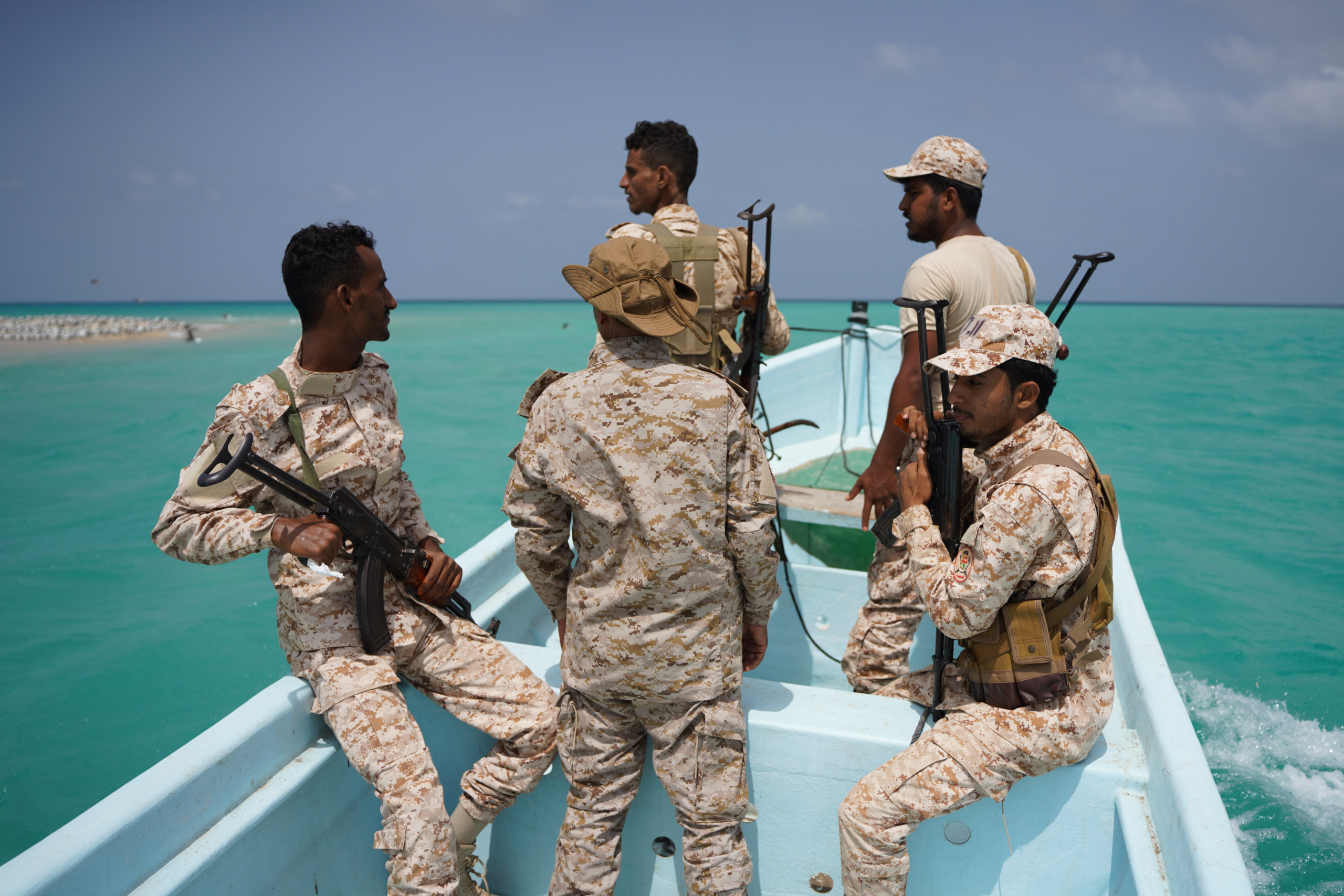
Houthi attacks on Saudi oil tankers and facilities have reignited tensions around Bab el-Mandeb. But the Iran-backed group is no longer the only threat to security in the Red Sea. Across the water, conflicts in the Horn of Africa are merging, fuelled by competing middle powers and increasingly threatening one of the world’s most important maritime corridors.
The timing could hardly be worse. The war between the US and Iran exposed the vulnerability of the Strait of Hormuz, renewing interest in alternative export routes. In April and May, Saudi Arabia exported between three and four million barrels of oil per day through the Red Sea, nearly double the volume shipped via the Bab el-Mandeb strait in 2024. Energy projects designed to bypass Hormuz, such as the expansion of the East-West pipeline across Saudi Arabia or Iraq’s proposed connection with Jordan’s Red Sea port of Aqaba, could increase the corridor’s importance even further.
The Houthis have shown how easily Bab el-Mandeb can be disrupted, but the danger no longer comes from Yemen alone. Sudan’s civil war is increasingly converging with the Ethiopia-Eritrea crisis. In northern Somalia, local disputes are becoming entangled with the Saudi-Emirati and Israeli-Turkish rivalries, potentially creating a new flashpoint in the Gulf of Aden. At the same time, piracy is resurging, increasingly aided by al-Shabab. Between April and May, Somali pirates hijacked three ships in the Gulf of Aden, including two oil tankers—more hijackings than in the previous five years combined.
The spread of low-cost drones means that both state and non-state actors can target this narrow maritime corridor cheaply. Although no group has yet fully replicated the Houthis’ tactics, the Islamic State in Somalia has carried out its first recorded drone strike in January, in Puntland, while reports suggest that al-Shabab has used drones for reconnaissance and propaganda.
Any major disruption to commercial and energy flows through Bab el-Mandeb would reverberate far beyond the region, with European energy importers and export-oriented economies particularly exposed. As the Red Sea becomes more important, the Horn of Africa matters more too.
When the Horn’s conflicts merge
The war between the Sudanese Armed Forces (SAF) and the Rapid Support Forces (RSF) in Sudan is not an isolated conflict. As it drives mass displacement and destabilises neighbours, it is also merging with the Ethiopia-Eritrea rivalry, raising the risk of a broader confrontation along the Red Sea.
Addis Ababa continues to seek sea access through Eritrea’s Red Sea port of Assab. Asmara, for its part, has strengthened ties with Tigrayan leaders and other anti-government groups inside Ethiopia. And their rivalry is increasingly spilling into Sudan. Reports indicate growing coordination between Tigrayan forces, the SAF and Eritrea in the east, while the RSF has allegedly received Ethiopian assistance in Sudan’s Blue Nile state. This new RSF front borders the areas of South Sudan where the government is trying to suppress a mounting insurgency among the Nuer, the country’s second largest ethnic group, potentially turning the vast tri-border area into a major conflict zone.
Any escalation between Ethiopia and Eritrea would likely draw in Sudanese factions and external powers, notably Egypt, which aligns closely with the SAF and Eritrea, and regards the Grand Ethiopian Renaissance Dam (located just across the border with Sudan) as a major security threat.
These tensions are amplified by competing Middle Eastern alignments: Egypt, Turkey and Saudi Arabia support the SAF and Eritrea, while the UAE, and to a lesser extent Israel, have ties with Ethiopia and the RSF, though officially denied. Such backing risks encouraging local actors to overestimate their capabilities and could trigger a wider regional confrontation threatening Red Sea security and navigation.
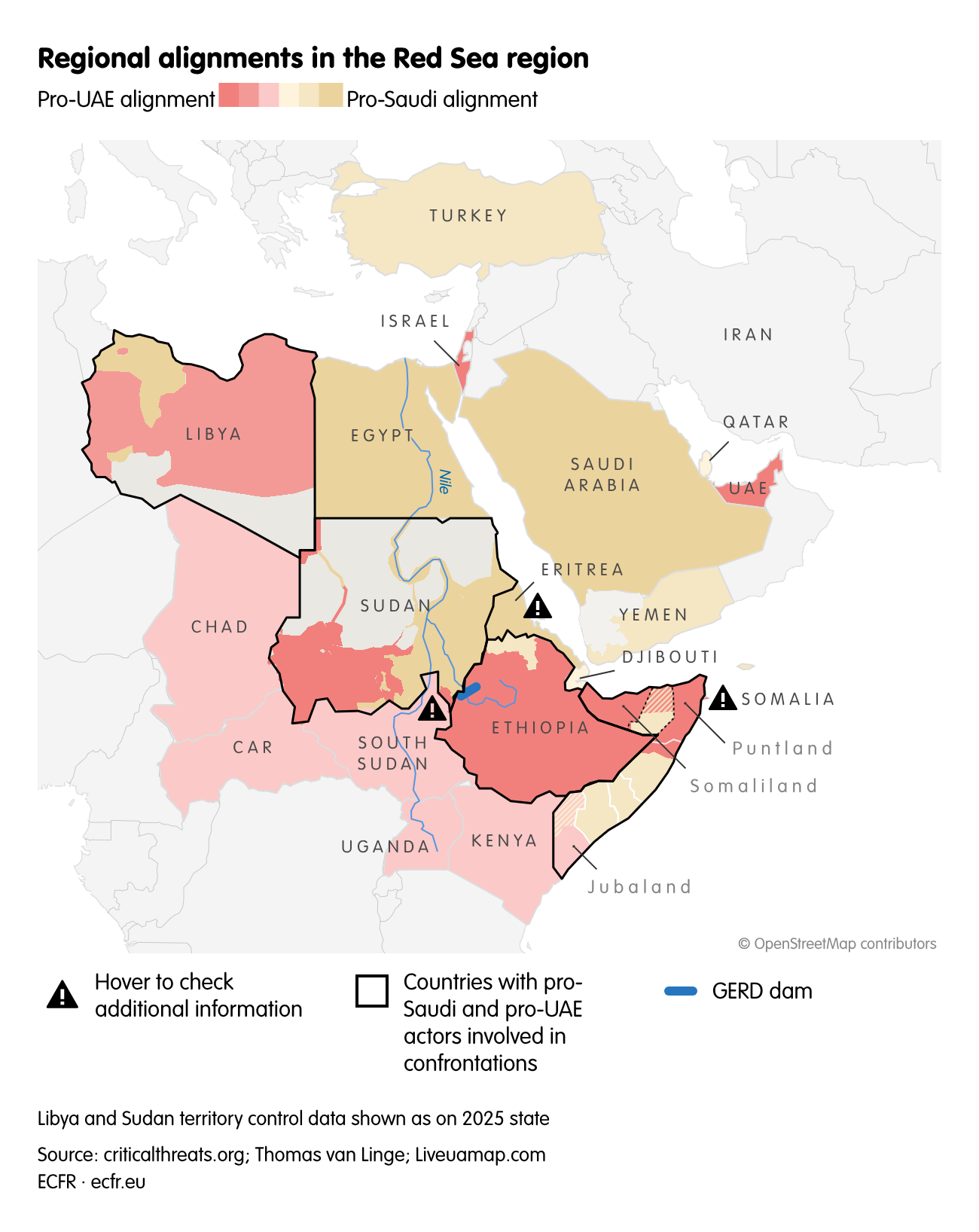
Somalia could become the second major front in the Red Sea crisis. As in the Ethiopia-Eritrea-Sudan triangle, domestic feuds are becoming entangled with broader Middle Eastern rivalries.
In December 2025, Israel recognised the breakaway, UAE-backed republic of Somaliland. The two sides signed security agreements covering training and intelligence cooperation, and Israel could soon deploy asu limited military presence in the Emirati base in Berbera, which is reportedly under expansion. A visit to Israel in late June by Somaliland’s president Abdirahman Irro showed how quickly the relationship is deepening.
Mogadishu responded to the recognition by severing diplomatic and security ties with the UAE. It has since moved closer to Saudi Arabia and Qatar through defence agreements, while strengthening its longstanding partnership with Turkey. In January, Turkey deployed F-16 fighter jets to the Somali capital.
Amid its dispute with Mogadishu, Abu Dhabi has continued to support for Puntland and Jubaland,[1] two federal states that broke relations with the Somali government in 2024 in pursuit of greater autonomy. That support has become more consequential as Somalia enters another struggle over federal leadership.
In March 2026, President Hassan Sheikh Mohamud extended the mandates of both the presidency and parliament by one year beyond their May 15 expiration date. Opposition figures, including the leaders of Puntland and Jubaland, rejected the changes and demanded elections. After mediation failed, government forces and opposition-aligned groups clashed in Mogadishu on June 3rd and 4th, echoing the violence surrounding the 2020–2021 electoral process.
Although the federal government’s substantial deployment in the capital makes the forcible removal of the president unlikely, violence may intensify elsewhere.[2] The most concerning area lies in northern Somalia, where a local territorial dispute is increasingly drawing in external actors.
Since declaring independence in 1991, Somaliland has controlled most of this area, but its authority has long been contested in the eastern regions of Sool, Sanaag and Cayn by local clans and by neighbouring Puntland. These tensions erupted into conflict in 2023, when the pro-government Dhulbahante sub-clan defeated Somaliland forces. In the aftermath, Mogadishu then backed the creation of a new state, the North East State, covering territory claimed by both Somaliland and Puntland.
The main prize is Sanaag, located along the strategically important Gulf of Aden coast. Its sub-clans are divided in their loyalties among Somaliland, Puntland and Mogadishu, and a worsening drought is fuelling clashes over re
Turkey reportedly plans to establish a presence in Lasqoray, Sanaag’s main coastal town, where both Turkish vessels and aircraft linked to the UAE have been spotted.[4] Meanwhile, Mogadishu is courting Puntland sub-clans and business elites dissatisfied with the state’s president, and has suggested that the army stands ready to deploy in Somaliland.[5]
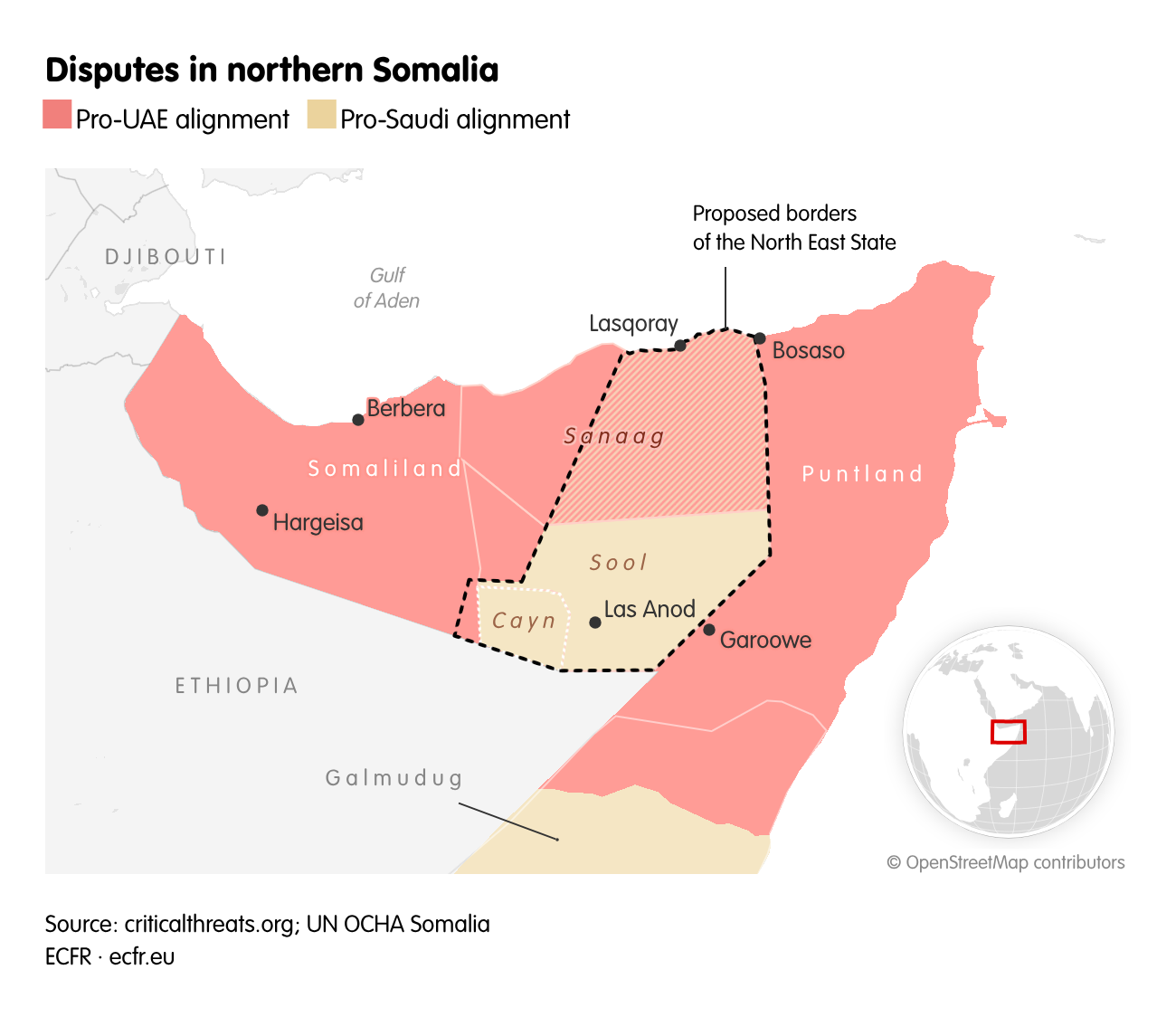
Northern Somalia is therefore becoming a battleground where local and national rifts collide with rivalries between Saudi Arabia and the UAE, and between Israel and Turkey. Any serious escalation would pose a direct threat to the Gulf of Aden. It would also create opportunities for other groups: piracy networks, the Islamic State in Somalia and al-Shabab also operate in the area, with the two jihadist groups receiving smuggled weapons from the Houthis across the sea last year.
Instability in the Horn of Africa creates new threats to Red Sea navigation, with direct consequences for European security and economic stability. Strained European economies cannot afford another disruption after Hormuz.
Europe must therefore abandon the widespread perception that it is primarily a provider of aid. Prevention must combine soft and hard power.
The EU already deploys two naval missions in the Horn of Africa’s seas: Aspides and Atalanta. But both were designed for a different threat environment. Atalanta was created to combat Somali piracy, while Aspides was established to protect shipping from Houthi attacks with a deliberately defensive mandate.
As maritime threats intensify, the EU should increase deployments and expand the mandates of both missions to include offensive operations, particularly against al-Shabab and the Islamic State in Somalia. This would strengthen anti-piracy efforts, increase pressure on destabilising actors and signal a more credible European security posture in the Red Sea. To ease fears of retaliation, Europeans should reassure regional states such as Saudi Arabia and Djibouti that the expanded mandate will not include offensive operations against the Houthis. Europeans should also seek a greater naval presence from Asian players with major stakes in Red Sea security, such as South Korea and Japan.
At the same time, the EU and its member states should engage more directly with northern Somali actors, including Somaliland and Puntland. A stronger European presence through security and development instruments would increase influence in this highly contested area, feeding into its de-escalation efforts. An expanded mandate for EU naval missions, for instance, could support Puntland’s and Somalia’s federal government operations against the Islamic State in Somalia and al-Shabab.
Greater engagement would also give Europe more leverage to encourage dialogue between the federal government, Somaliland and Puntland over disputed territories, and help push Somali political actors toward a resolution of the electoral standoff. In this regard, the EU must act transactionally to ensure that its 2026 funding packages, including €75m for the African Union peace mission and €63m for humanitarian aid, contribute to these stabilisation goals.
The EU should also coordinate closely with America and Britain, which in the past have led credible mediation efforts around the electoral standoff and security initiatives in the north, such as anti-IS operations. Similar coordination could support de-escalation efforts between Ethiopia and Eritrea, where Washington has recently engaged both sides.
Finally, engagement with Middle Eastern actors is unavoidable. The Horn of Africa’s instability is increasingly shaped by the competition between the two emerging blocs around Saudi Arabia, Egypt and Turkey on one side and the UAE and Israel on the other. The recent war with Iran has increased the value these states place on reliable international partners and regional stability. Europe should use this moment to press for restraint. The EU, Germany, France, Italy and Spain, in coordination with the UK and, where possible, the US, should make clear to Middle Eastern powers that any support to Ethiopia and Eritrea in the context of an all-out escalation would cross a red line and trigger immediate consequences on relations with them across the board. A similar approach should be adopted for northern Somalia.
Europeans can do far more to prevent the Horn of Africa’s conflicts from converging into a wider crisis. They cannot afford to wait until they become another maritime emergency.
[1] Author’s interview with Somalia security expert on May 21.
[2] Author’s interview with European diplomat on May 10.
[3] Author’s interview with Somalia security expert on May 21.
[4] Author’s interview with European diplomat on May 10.
[5] Author’s interview with Puntland-based civil society representative on May 12.
The European Council on Foreign Relations does not take collective positions. ECFR publications only represent the views of their individual authors.
Author
Corrado Čok@CorradoCok on X
Visiting Fellow
