Who shapes the global economy?
Publikováno: 20. 7. 2026
Autor:
Karel Černý
Foto:
Wikimedia and editorial staff
Sdílet článek
Geopolitics is reshaping the world’s investment landscape, technology is rewriting established business models, and capital is searching for new opportunities. These developments were at the heart of a closed roundtable discussion organised by the Davos Lodge platform in Zurich. The event brought together investors, business leaders and representatives of major institutions from four continents. Donald Trump Jr. attracted the greatest attention.
Who is truly shaping the global economy today? Not long ago, the answer would have pointed primarily to the world’s largest economies, central banks and multinational institutions. Today, however, private investors, technology companies, sovereign wealth funds and new economic centres beyond the traditional Western world are playing an increasingly significant role. This transformation was the focus of the roundtable entitled Who Shapes the Global Economy?, held in Zurich in June. The meeting focused on geopolitical developments, global capital flows, energy security and long-term investment strategies. In today’s global economy, the boundaries between politics, security and business are becoming increasingly blurred. Trade disputes affect supply chains, conflicts influence energy prices, and new technologies are reshaping investment flows. The interconnection of these topics formed the foundation of the Zurich discussion.
New centres of economic influence
One of the discussion’s main themes was the changing balance of global economic power. Alongside the United States and Europe, regions such as the Middle East and Asia are becoming increasingly influential. Sovereign wealth funds manage vast amounts of capital and are playing an ever more active role in technology, infrastructure and energy projects. At the same time, geopolitical risk has become a routine part of investment decision-making. Around 75 invited guests gathered in Zurich, with The event was conceived and organised by Davos Lodge Founder and Chief Executive Officer Irene Vantaraki. Her ability to bring together leading figures from different parts of the global economy was one of the defining characteristics of the meeting. The main programme took place behind closed doors and was followed by a reception and a private dinner. The organisers did not publish a final communiqué or a detailed record of the discussions. Publicly available information, however, indicates that participants discussed relations between the West and China, Europe’s position, geopolitical conflicts and technological developments. The objective was not to adopt political decisions or formulate recommendations for governments. The essence lay in a direct exchange of views among people who observe global developments from different perspectives and who, in many cases, are themselves responsible for major investment decisions.
From left Shafik Gabr, Luděk Sekyra, Thomas Borer (Former Swiss ambassador), Donald Trump Jr.
Trump Jr.: Technology and geopolitice
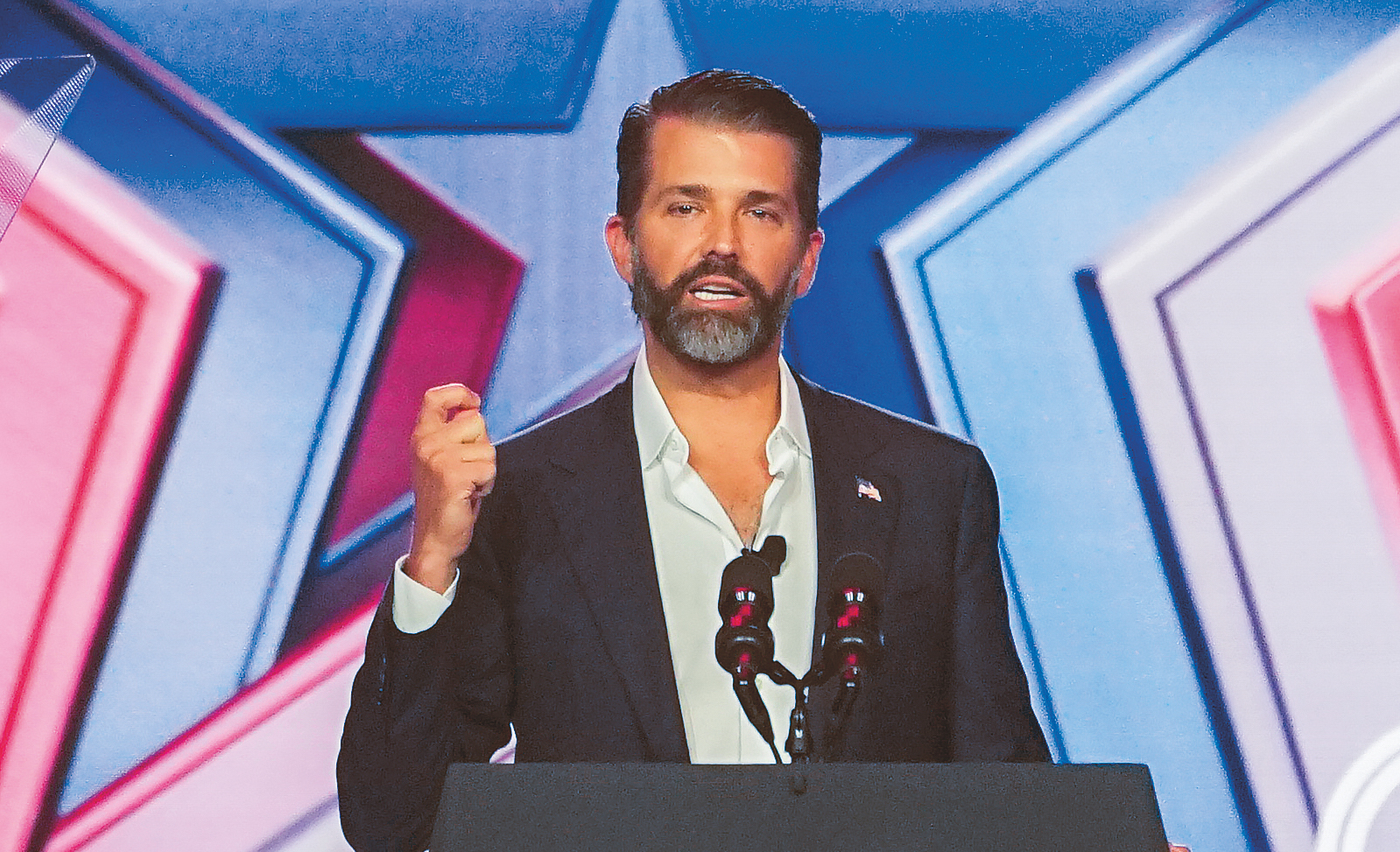
Donald Trump Jr. attracted the greatest attention. The eldest son of the President of the United States and one of the leading figures within the Trump family business empire operates at the intersection of business, investment and politics. In Zurich, he devoted considerable attention to cryptocurrencies, blockchain and artificial intelligence. In particular, he described the combination of blockchain technology and AI as having extraordinary potential. In his view, the integration of these technologies could fundamentally transform entire industries and represent a game changer. His remarks also reflected his own business interests. In recent years, the Trump family’s activities have expanded beyond traditional real estate into digital assets and technology investments. Trump Jr. also commented on US foreign policy. Speaking about Iran, he expressed confidence that his father would be able to reach an agreement with Tehran. He described his father’s approach to international affairs as that of someone whose thinking is rooted primarily in the world of business. He also addressed China, arguing that Western economies should gradually reduce their dependence on the Chinese market, while acknowledging that such a process cannot happen overnight. In his view, Europe should assume greater responsibility for its own strategic direction and rely less on the United States. The close connection between geopolitics and investment thinking characterised the entire meeting. Political stability, access to energy, technological leadership and the security of supply chains are no longer merely subjects of government strategy. They have become integral elements of global capital allocation.
Donald Trump Jr., Peter Závodský
At One Table
Although Donald Trump Jr. was the most prominent participant, the guest list reflected the event’s international character. Those attending included John Koudounis, President and Chief Executive Officer of Calamos Investments; Anil Mohta, Chief Financial Officer of the global logistics company DP World; and Egyptian businessman and Chairman of ARTOC Group Shafik Gabr. The Czech Republic was represented by developer and investor Luděk Sekyra, accompanied by Peter Závodský, majority co-owner of The Business Soirée. The roundtable did not offer a simple answer to the question of who shapes today’s global economy. Its composition, however, suggested where economic influence is increasingly emerging – at the intersection of politics, private capital and technology. It is there that decisions are now being made about the direction of investment and the future economic weight of individual regions.
John Koudounis speaks while Donald Trump Jr. listens.
AI and blockchain
One of the prominent technological themes of the Zurich discussion was the combination of artificial intelligence and blockchain. Donald Trump Jr. described this combination as a potential “major breakthrough”. While AI can analyse vast amounts of data and automate decision-making, blockchain provides a decentralised system for recording and verifying transactions. Together, they could find applications in financial services, global trade and the management of digital assets. Investors are paying particular attention to the emergence of new business models, as well as the speed with which capital is moving into this area. Digital assets have become a significant part of the Trump family’s business interests in recent years. As a result, Donald Trump Jr. was not speaking in Zurich merely as an observer of technological developments – the subject directly relates to the investment environment in which he himself operates.
USAInternational relationships


Mohlo by vás zajímat
Sweet Waters at the Turkish Embassy

Czech–Slovak diplomatic evening: Our shared story does not end

Adriana Krnáčová: I do not need the trappings of power
International reations21. 5. 2026
Qatari ambassador at the Chamber of Deputies

Meeting at the Chamber of Deputies
Více článkůLoading…