

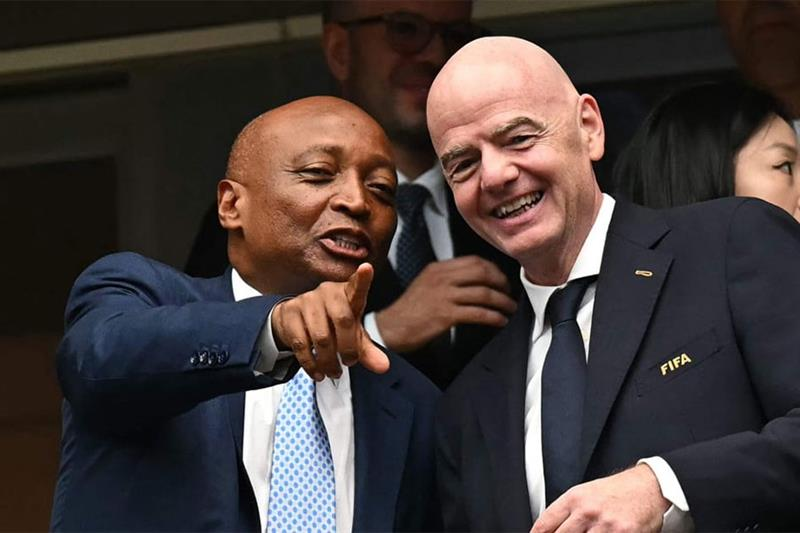
This move comes as the term of the South African president, Cyril Ramaphosa, at the head of the ANC (African National Congress) comes to an end in 2027. For several weeks now, a campaign has been pushing in favor of Motsepe. Although he long indicated he was not interested, the mining magnate is now reconsidering his position and ambitions—even though several people at CAF express doubts about his real political intentions.
Another pressing issue fueling talk of a departure: the tense relations and mistrust from part of his Executive Committee. Exasperated by his lack of familiarity with the institution he leads and his interminable meetings where he “repeats the same talking points,” several federation presidents have also taken issue with certain remarks, especially when Motsepe called several of them by their respective country because he (still) did not know their names…
Recently, yet another episode further decreased the little legitimacy he had left, with CAF’s official denial regarding the expansion of the AFCON to 28 teams, even though Motsepe himself had announced the tournament’s expansion at his press conference in Johannesburg. Another blunder, like his insistence on ensuring the AFCON would take place in 2027 even though the majority of the Executive Committee knows that two of the three host countries (Kenya and Uganda) are not ready.
A motion of no confidence against Motsepe?
This situation illustrates the isolation of a president who has also lost the support of two of his main allies, notably Gianni Infantino, who did not accept the signing of the agreement with UEFA allowing Sudanese referee Omar Artan to officiate at the UEFA Super Cup.
For the FIFA president, this signature is seen as a rejection and a stance against FIFA and in favor of UEFA after the World Cup episode. His other longtime ally, Fouzi Lekjaa, also no longer shields Motsepe from general discontent since the issue with the AFCON 2025 final—whose winner will finally be known after the hearings scheduled for October 8 before the Court of Arbitration for Sport (CAS).
According to our ago in order to remove Patrice Motsepe. However, Infantino’s support had held back these ambitions. Without this protection, several presidents have spoken again about a motion of no confidence to be presented at the next CAF Executive Committee meeting, before being submitted for approval at the organization’s General Assembly scheduled for October
Ahmed Yahya, Idriss Diallo and Souleiman Waberi have already begun their campaigns
For several months, would-be successors to Motsepe have started campaigning. Souleiman Waberi, president of the Djiboutian federation, notably invited many of his peers during the CECAFA elections held in his country in February.
Barely hiding his aspirations, his plan was quickly discovered by Infantino and Motsepe at the FIFA Annual Congress in Vancouver at the end of April. More discreet, Ahmed Yahya, the president of the Mauritanian federation, has never hidden his interest in the position as well as his closeness with the FIFA president.
More recently, Idriss Diallo, the president of the Ivorian federation, has started his lobbying, well supported by Samuel Eto’o, who is also close to Waberi. Diallo is even trying to convince the Ivorian executive to support him for the election within his own federation by imposing his single candidacy as a show of support, before running for CAF where he claims to be the “designated successor” by Motsepe with the backing of Morocco.
Although he maintains good relations with both sides, his claim is above all an extrapolation to pursue a second term. However, it’s a maneuver that sums up the end of an era for Motsepe—even if he has not said his last word and retains some support within COSAFA and in West Africa (Ghana, Nigeria). It’s a way for the South African to avoid the humiliation of being ousted from the institution he chairs, which would have dire consequences for his political ambitions.
Romain MOLINA and Mansour LOUM
